จำนวน Repository ( 580 )
Aggregate planning for optimal production quantity under uncertainty demand : Case study of food animals industry.
The objectives of this research were to find the distribution of food demand for laying hens and to find the optimum amount of that food production which had minimum cost. The data consisted of customer purchase orders for the food of laying hens price of food for laying hens cost per unit for the food inventory cost related to food of laying hens in which the food was out of stock such as fine overtime urgent purchase for material. They were collected in 2008-2009 form a factory in Nakhonratchasima province. The collected data were analized in order to explore the distribution of the monthly food demand for the laying hens and to see the rate of inventory per unit. The results were used in the stochastic linear programming model for aggregate planning in which the optimum production minimum cost could be obtained. Programming algorithm in MATLAB and tools in Linprog software were used to get the solution. The distribution of the food demand for laying hens and the random numbers were used in the model. The study found that the distribution of food demand for laying hens every month has normal distribution (January to December). The monthly average amount of production from January to December were 10936.94 12913.74 11898.12 13096 15443.26 14916.33 10322.64 10818.21 11393.11 11700.72 9706.05 and 11702.05 respectively. The minimum total cost average for 12months was Baht 62422386.98.
Analysis of steel industries in thailand : Case study of production planning and control by determination of time limited free back orders.
The objectives of this research were to find the distribution of food demand for laying hens and to find the optimum amount of that food production which had minimum cost. The data consisted of customer purchase orders for the food of laying hens price of food for laying hens cost per unit for the food inventory cost related to food of laying hens in which the food was out of stock such as fine overtime urgent purchase for material. They were collected in 2008-2009 form a factory in Nakhonratchasima province. The collected data were analized in order to explore the distribution of the monthly food demand for the laying hens and to see the rate of inventory per unit. The results were used in the stochastic linear programming model for aggregate planning in which the optimum production minimum cost could be obtained. Programming algorithm in MATLAB and tools in Linprog software were used to get the solution. The distribution of the food demand for laying hens and the random numbers were used in the model. The study found that the distribution of food demand for laying hens every month has normal distribution (January to December). The monthly average amount of production from January to December were 10936.94 12913.74 11898.12 13096 15443.26 14916.33 10322.64 10818.21 11393.11 11700.72 9706.05 and 11702.05 respectively. The minimum total cost average for 12months was Baht 62422386.98.

การพัฒนาผลิตภัณฑ์ป่านศรนารายณ์มัดย้อมสำหรับกลุ่มสหกรณ์การเกษตรหุบกะพง จำกัด
Research project of product development of hemp dying for Hub-Kra-Pong agricultural cooperatives limited. The purposes of this research were 1) Products development from hemp dying for Hub-Kra-Pong agricultural cooperatives limited. 2) To transfer technology of creativeproducts from hemp dying. 3) following the result of the project success. The research in the first year (Budget 2551) divided their operations into 3 phases. Phase 1) the experiment selected the appropriate characteristics of hemp fibers to the dying. Phase 2) the experiment was tie and dye method for appropriating characteristics of hemp fibers. Phase 3) design patterns in order to create product bags and hats design forms of 15 styles and chosen by the expert. The expert selected in each type 3 styles for making products to survey the product satisfaction. The research in the second year (Budget 2552) is a transfer technology products (bags and hats) prototype from hemp fiber that are made to Hub-Kra-Pong agricultural cooperatives limited. For the satisfaction of 30 participants trained to result as follows.
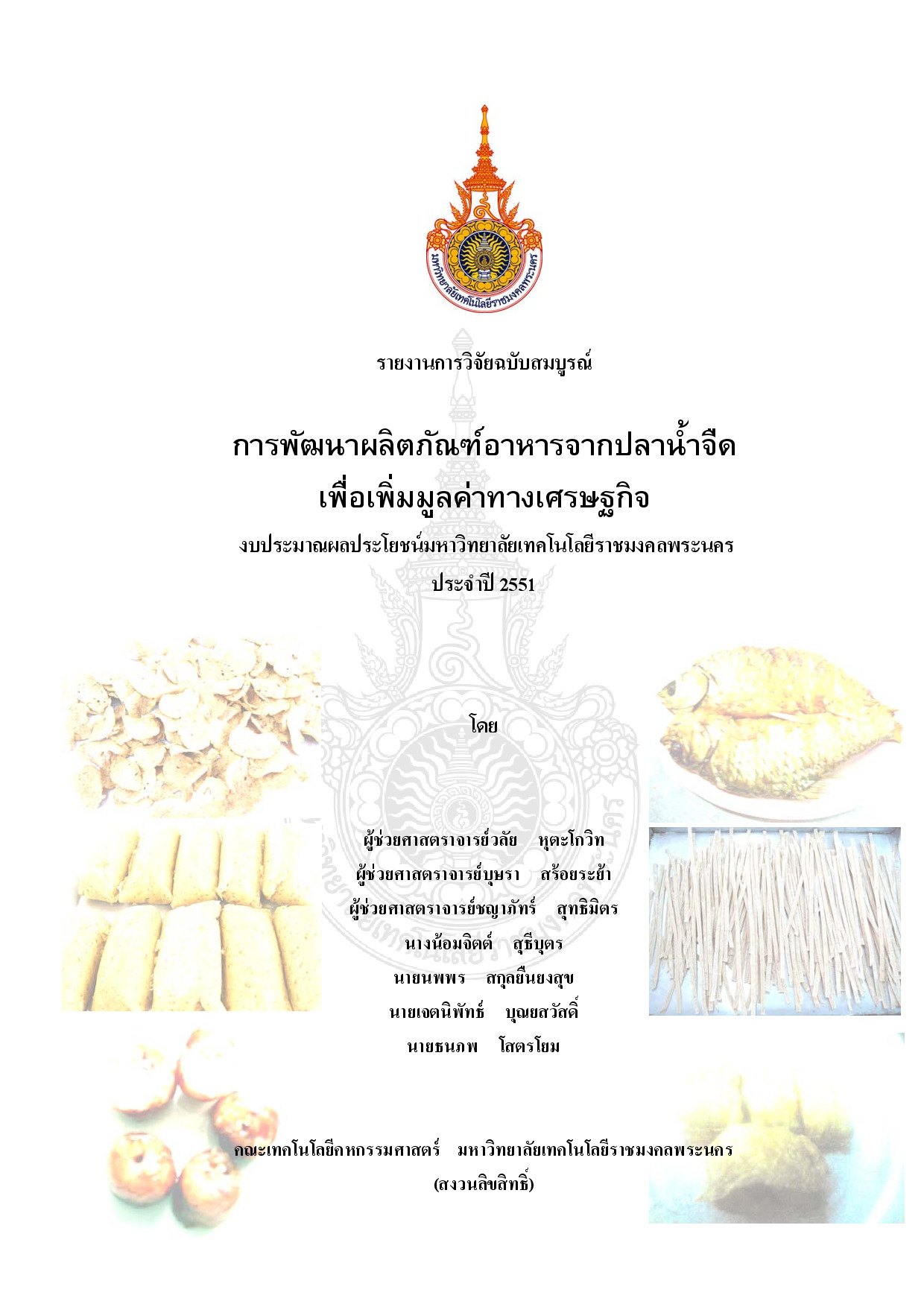
การพัฒนาผลิตภัณฑ์อาหารจากปลาน้ำจืดเพื่อเพิ่มมูลค่าทางเศรษฐกิจ
โครงการวิจัยเรื่อง การพัฒนาผลิตภัณฑ์อาหารจากปลาน้ำจืดเพื่อเพิ่มมูลค่าทางเศรษฐกิจ ได้ดำเนินการสำรวจและคัดเลือกแหล่งจัดซื้อวัตถุดิบที่เหมาะสม ความต้องการของตลาดผลิตภัณฑ์ปลาแปรรูป ผลิตภัณฑ์ที่เหมาะสมกับปลาแต่ละชนิดและน่าสนใจเพื่อนำมาพัฒนาเป็นผลิตภัณฑ์อาหารแปรรูปจากปลาน้ำจืด พบว่าการพัฒนาสูตรและกรรมวิธีการแปรรูปปลาน้ำจืด 6 ผลิตภัณฑ์ ได้แก่ ไส้กรอกปลารสต้มยำ ไส้กรอกอีสานปลานิล ปลายอสมุนไพร ปลาจ๊อ ปลาตะเพียนแผ่นปรุงรสสำเร็จ และน้ำพริกปลาตะเพียน ผลการพัฒนาผลิตภัณฑ์ พบว่า ไส้กรอกปลารสต้มยำ สูตรที่ยอมรับมากที่สุดเป็นสูตรที่ใช้ปลายี่สกทดแทนปลากราย 50 % และ เครื่องต้มยำกึ่งสำเร็จรูป (ชนิด C) 75 กรัม ไส้กรอกอีสานปลานิล ใช้สูตรพื้นฐานที่ได้จากกรมปศุสัตว์ ฝ่ายถ่ายทอดเทคโนโลยีผลิตภัณฑ์เนื้อสัตว์ และใช้ข้าวจ้าวหุงสุก ผลิตภัณฑ์ปลายอสมุนไพร ใช้เนื้อปลานิล แป้งมัน เกลือป่น พริกไทย ไข่ไก่ มันหมู ปริมาณน้ำพริกแกงเผ็ดสมุนไพรที่เหมาะสมในสูตรร้อยละ 3.5 การพัฒนาผลิตภัณฑ์ปลาจ๊อ สูตรที่ใช้เนื้อปลานิลบด มันหมู รากผักชี กระเทียม พริกไทย เกลือ แป้งสาลี น้ำตาลทราย ซีอิ้วขาว ไข่เป็ด ต้นหอม และผักชี ได้รับการยอมรับมากที่สุด การปรับปรุงลักษณะเนื้อสัมผัสโดยใช้ผสมมันหมูที่ใช้วิธีการบดผสม มีคะแนนความชอบมากกว่าการสับละเอียดและหั่นเป็นชิ้นเล็กๆ การศึกษาระยะเวลาการละลายน้ำแข็งจากการเก็บปลาจ๊อเข้าตู้แช่แข็งเป็นเวลา 2 สัปดาห์ เมื่อนำไปละลายน้ำแข็งที่กำลังความร้อน 70% เป็นเวลา1 นาที ผู้ทดสอบชิมให้การยอมรับมากที่สุด ผลิตภัณฑ์ปลาตะเพียนแผ่นปรุงรสสำเร็จรูป โดยการนำปลาตะเพียนขาวมาพัฒนาเป็นปลาแผ่นปรุงรสสำเร็จรูป พบว่าสูตรที่ให้การยอมรับมากที่สุด ประกอบด้วยเนื้อปลาบด ซีอิ๊วขาว น้ำตาลทราย เกลือไนไตรท์ ยี่หร่า พริกไทย ลูกผักชี และน้ำแข็ง กรรมวิธีการขึ้นรูปให้เป็นแผ่นโดยการอัดเป็นแท่งแล้วใช้เครื่องสไลด์ตัดมีคะแนนความชอบจากการทดสอบทางประสาทสัมผัสมากกว่าการคลึง การอัดเป็นแท่งแล้วใช้มีดตัด ผลิตภัณฑ์น้ำพริกปลาตะเพียนสูตรน้ำพริกปลาย่าง ใช้ปริมาณเนื้อปลาตะเพียน 70% วิธีการทำแห้งที่เหมาะสม คือ อบที่อุณหภูมิ 73 องศาเซลเซียส เป็นเวลา 1 ชั่วโมง This research aimed to survey and screen the appropriate resource study the need of fish processed product and investigate the suitable product that fit for each freshwater fish. The findings of this study demonstrated that the most suitable products were 6 ones such as Fish sausage with Tom Yam flavour added Fermented Thai Fish Sausage from Nile Tilapia fish Pla – Yor with Herbs Pla – Jor Fish Flake from Silver Barb Fish and Sauce of grilled silver barb fish paste and chili . The results of product development were : Fish Sausage with Tom Yam Flavour Added was developed by using Seven-Stripped Carp fish partial substituted with Spotted Featherback fish at level 50 % and 75 grams instant Tom Yum flavour (type C). Fermented Thai Fish Sausage from Nile Tilapia fish was developed by using dry-cooked rice. Pla – Yor with Herbs was developed by using Nile Tilapia and 3.5 % curry paste. Pla – Jor was developed by using minced lard and thawing 2-week frozen Pla – Jor by microwave at heat level 70 % for 1 minute. Fish Flake from Silver Barb Fish was developed by crushing to roll and sliding to sheet. Sauce of grilled Silver Barb fish paste and chili was developed by using Silver Barb fish partial substituted with shrimp at level 70 % and the appropriate drying method was using tray dryer at 73OC for 1 hour.
Species diversity and reproductive phenology of Podostemaceae in Na Hahaeo District, Loei Province, Northeastern Thailand.
The species composition of Podostemaceae was studied in Loei northeastern Thailand from November 2009 to July 2010 by extensive surveying in the rapids and waterfalls inside and outside of national parks wildlife sanctuaries and protected areas. The samples collected are classified into 2 subfamilies which are Tristichoideae and Podostemoideae. The former contains 2 genera and 3 species Dalzellia kailarsenii Terniopsis sp. 1 Terniopsis sp. 2. The latter has 4 genera and 9 species Hanseniella heterophylla Hydrobryum japonicum Hydrobryum loeicum Hydrobryum tardhuangense Hydrobryum vientianense Hydrobryum sp. 1 Hydrobryum sp. 2 Polypleurum sessile Thawatchaia trilobata. The highest number of species occurs in Hydrobryum with 6 species following by Terniopsis with 2 species. The other four genera have one species each. Based on morphological and molecular analyses revealed that 2 species of the genus Hydrobryum are new and 2 taxa of Terniopsis are also new species. Polypleurum sessile and Thawatchaia trilobata are new recorded in Loei province. The result from this study indicates that the genus richness is relatively high in Loei province which encompasses 60% of the total number of genera (10) in Thailand. The plants in vegetative phase are completely submersed in swiftly running water during a warm wet season (May-October). The plants flower and set fruits and seeds when exposing to air during water level drop in a cool dry season (November- February).