จำนวน Repository ( 757 )

Evaluation of curriculum for the bachelor of science program in computer technology of Rajamangala University of Technology Phra Nakhon
The purpose of this study was to Evaluation of Curriculum for the Bachelor of Science Program in Computer Technology of Rajamangala University of Technology Phra Nakhon. The CIPP Model was used as evaluated model. The samples in this research were 125 undergraduates 14 Instructors 17 graduates and 11 employers of graduates. The 4 questionnaires of rating scales was used as the research instrument. Percentage mean standard deviation were statistical method to analyze data. The results were as follows: 1. The samples agreed with the Context Evaluation in the aspect of curriculum objectives curriculum structure curriculum content were in moderate levels. 2. The samples agreed with the Input Evaluation in the aspect of Characteristics of undergraduates and Characteristics of instructors were in high levels supporting education was in moderate levels. 3.The samples agreed with the Process Evaluation in the aspect of curriculum Management. teaching Management experience training were in high levels . 4 . The sample’s satisfaction towards Input Evaluation in the aspect of professional knowledge and Professional Characteristics were in moderate levels Ethics was in high levels .
The factors leading to effective Co-operativeEducational Programs of Rajamangala Universityof Technology Phra Nakhon
The purposes of this research were to study and compare the factors leading to the effective of Co-operative Educational Programs to develop the Co-operative educational programs of Rajamangala University of Technology Phra Nakhon (RMUTP) more effectiveness and efficiency. The populations of this research were 2064 people included the Co-operative Education student Co-operative Education supervision and the company’s staffs that looked after the students who were attended to the Co-operative Education project. The research tool was questionnaire and the data was analyzed by using frequency percentage mean standard deviation T-test Independent One-way ANOVA and analysis of the difference with the method of Sheffe by determining the level of significance statistic of 0.05.
Canonical Correlation Analysis Between some Factors and Motivation on Producing Academic Papers of Instructors in The Office of Rajamangala University of Techlnology Phra Nakhon
The purposes of this research were to study the canonical relationship between some factors and motivation on producing that relative contribute to academic papers and to study the canonical weights of some factory motivation on producing academic papers. The Sample were the 222 instructors in the office Rajamangala University of technology Phra Nakhon who work during the first semester of Academic year 2005. The stratified random sampling technique was used for selecting the sample. The instruments were the questionnaire considering the salary work load working experience Attitudes toward producing academic papers Self development Internal control Academic ability Motivation on advancement Motivation on recognition and Motivation on environment of producing academic papers. The findings were as follow: 1. The canonical correlation between Salary Work load Working experience Attitudes toward producing academic papers Self development Internal control Academic ability Motivation on advancement Motivation on recognition and Motivation on environment of producing academic papers were .510 .231 and .134 respectively. The first canonical function was Statistically Significant at .05 level. The second and third canonical function were Statistically nonsignificant. 2. The canonical weights for Attitudes toward producing academic papersself development and Internal Control relative contributed to Motivation on advancement Motivation on recognition and Motivation on environment of producing academic papers in the first canonical function.
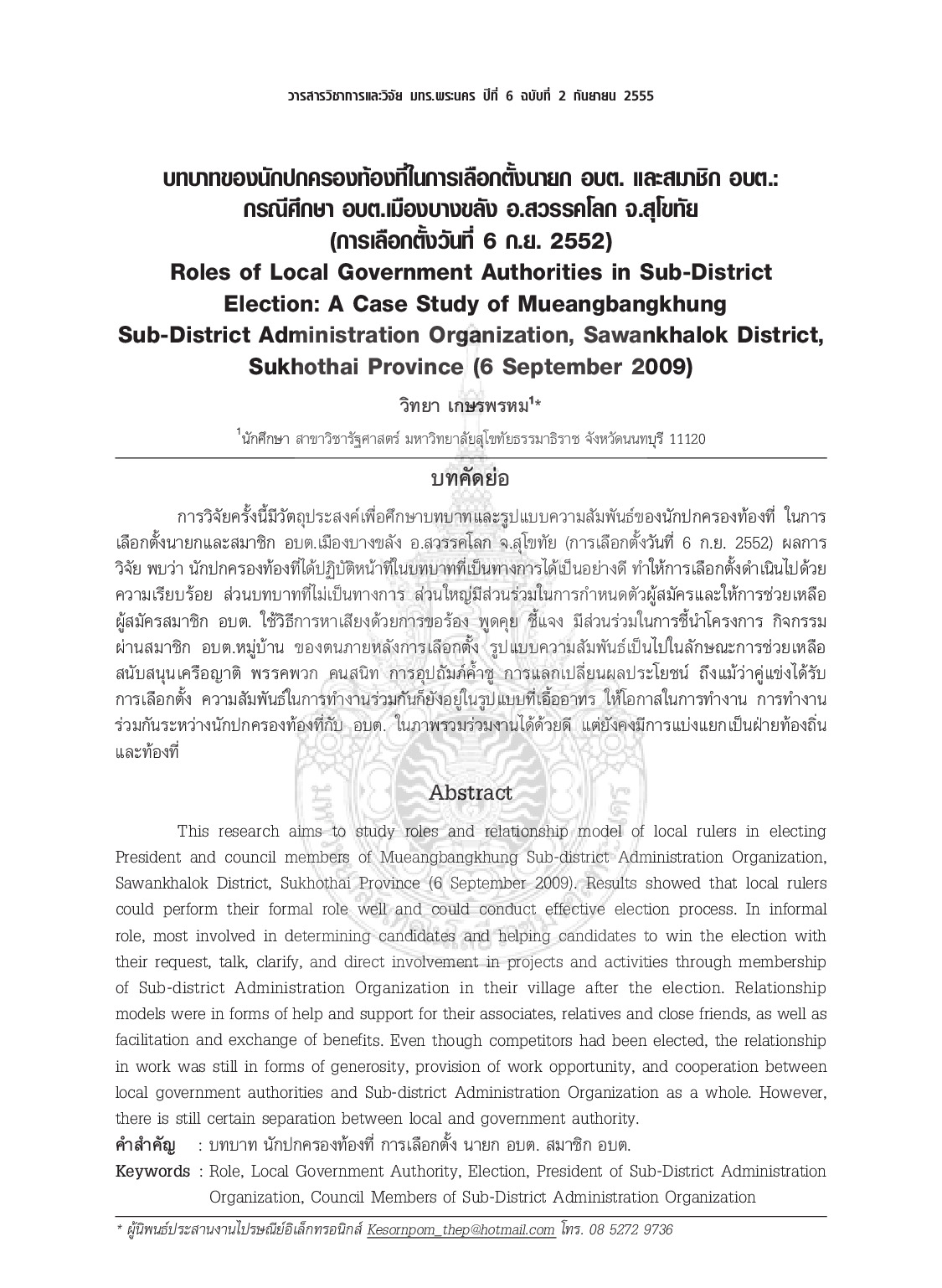
Roles of Local Government Authorities in Sub-District Election: A Case Study of Mueangbangkhung Sub-District Administration Organization, Sawankhalok District, Sukhothai Province (6 September 2009)
This research aims to study roles and relationship model of local rulers in electing President and council members of Mueangbangkhung Sub-district Administration Organization Sawankhalok District Sukhothai Province (6 September 2009). Results showed that local rulers could perform their formal role well and could conduct effective election process. In informal role most involved in determining candidates and helping candidates to win the election with their request talk clarify and direct involvement in projects and activities through membership of Sub-district Administration Organization in their village after the election. Relationship models were in forms of help and support for their associates relatives and close friends as well as facilitation and exchange of benef its. Even though competitors had been elected the relationship in work was still in forms of generosity provision of work opportunity and cooperation between local government authorities and Sub-district Administration Organization as a whole. However there is still certain separation between local and government author
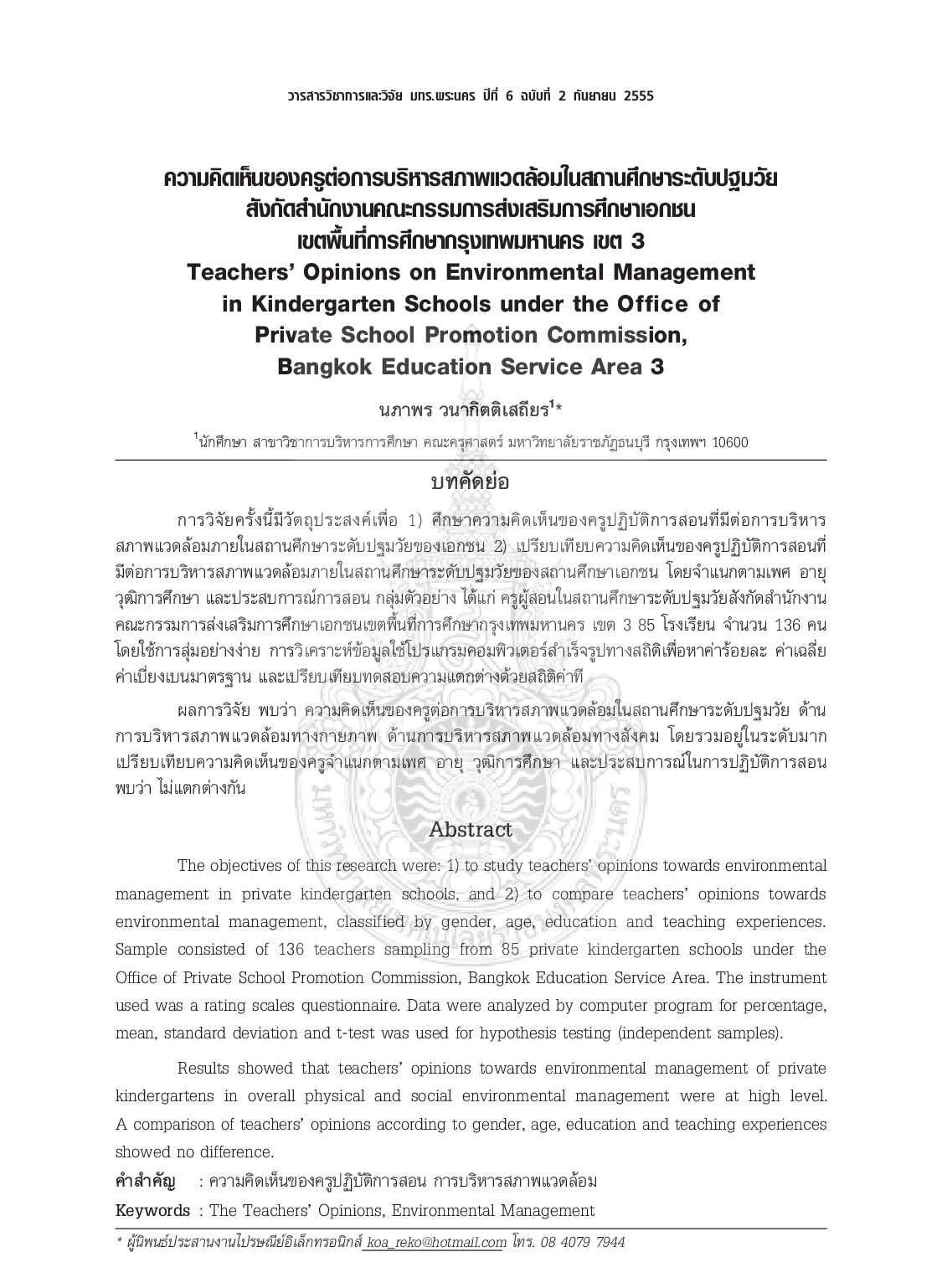
Teachers' Opinions on Environmental Management in Kindergarten Schools under the Office of Private School Promotion Commission, Bangkok Education Service Area 3
The objectives of this research were: 1) to study teachers opinions towards environmental management in private kindergarten schools and 2) to compare teachers opinions towards environmental management classif ied by gender age education and teaching experiences. Sample consisted of 136 teachers sampling from 85 private kindergarten schools under the Off ice of Private School Promotion Commission Bangkok Education Service Area. The instrument used was a rating scales questionnaire. Data were analyzed by computer program for percentage mean standard deviation and t-test was used for hypothesis testing (independent samples). Results showed that teachers opinions towards environmental management of private kindergartens in overall physical and social environmental management were at high level. A comparison of teachers opinions according to gender age education and teaching experiences showed no difference.