จำนวน Repository ( 952 )
การพัฒนาโครงสร้างผ้าของเครื่องแต่งกายเชฟที่เหมาะสมกับการปฏิบัติงานของเชฟในครัวอาหารไทย
The purpose of this research were 1) Development and production of the cotton fabric suitable for use in the kitchen apparel chef Thailand 2) test the suitability of the fabric from the fabric used to make kitchen apparel chef in Thailand. Tools used in the study are the fabrics used to make clothing chef woven pattern 2/1 for 3 structures 1) Cotton100 2) Polyester Microfiber and 3) TR. Being three fabrics to test of the fabric aspects of the durability of color to light color fastness to washing colorfastness to perspiration strength of the yarn yarn number weight yarn yarn twist yarn thickness weaving and resistance to abrasion properties of the fabric the effect of moisture. The quantitative data were analyzed by descriptive statistics from assessment and feedback of chef’s uniforms by the establishment of a laboratory in the kitchen by cooking in Thailand 15 Thailand kitchen. The chefs were wearing 3 sets each 5 days per a types of them for 15 days. Each of chef’s uniform made from the different types of fabrics. Data analysis and interpretation with the average 5 level content analysis and evaluation. Data analysis in descriptive and narrative. The results founded that Chef of food establishments restaurants Hotel and restaurant with 15 people most of the food is the leader in working kitchen (Executive chef) the timetable of working in the evening in the Thai-kitchen from 12:00 to 21:00 o’clock for 5 days a week. It’s about environments of Thai-Kitchen The temperature of the kitchen operations in restaurants and room temperature and after the experimental wear three types of 15 day Chef has been satisfied in sample number 2. It is Micro Fiber fabrics because there is good ventilation not get heat easy to clean fabric good reflect of oil or anti-oil water absorption and drying rate of the normal range. Micro Fiber fabric when Chef wear it not heavy able to wear at all times. The results of the test and analysis Micro Fiber Cloth material that is resistant to very light. The fabric is not easily broken. Strength and abrasion resistance as possible. It is oil on fabric and yarn on the oil splash in the Kitchen. Including the ability to absorb water and the distribution of water as much as possible.
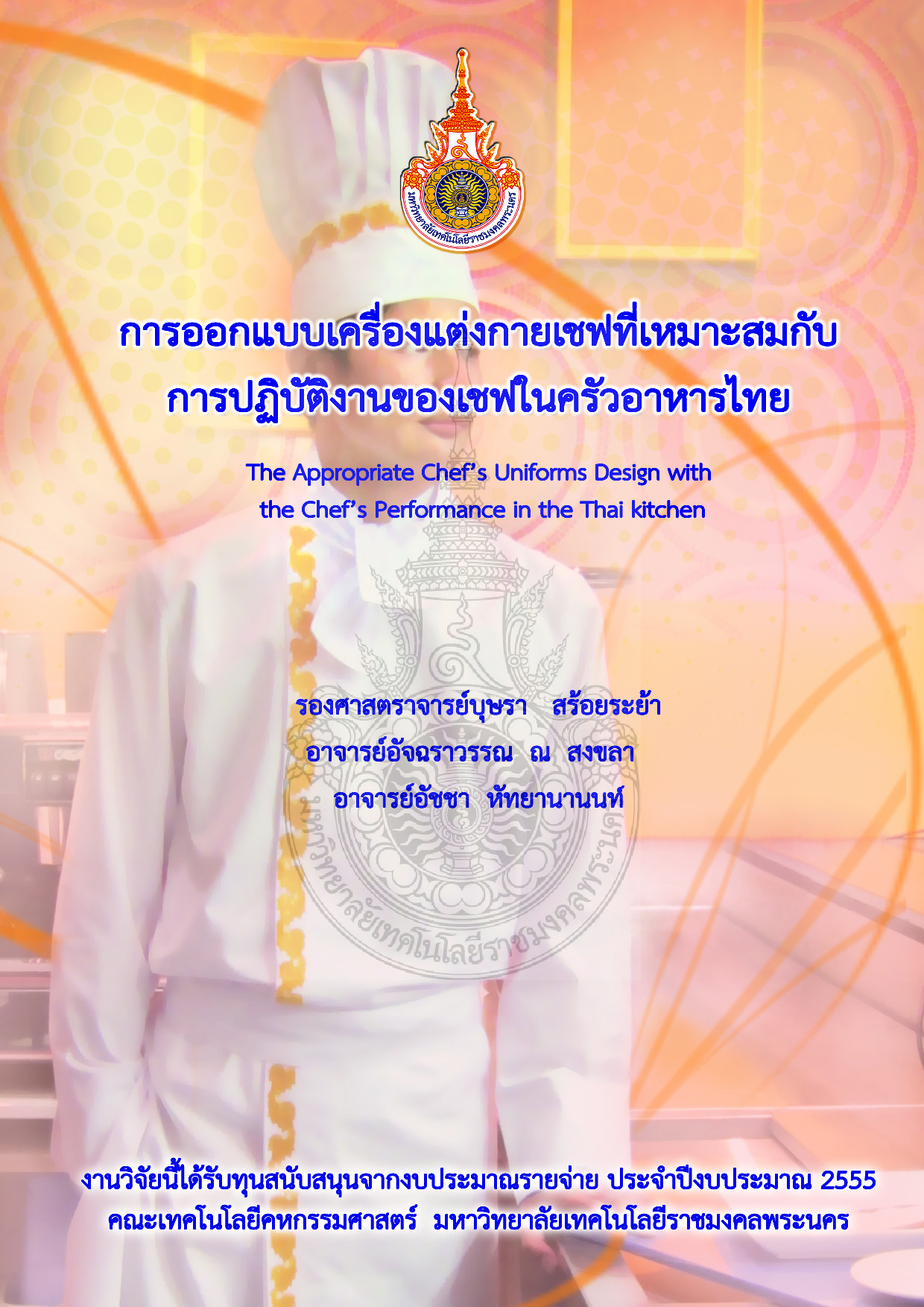
การออกแบบเครื่องแต่งกายเชพที่เหมาะสมกับการปฏิบัติงานของเชฟในครัวอาหารไทย
This research is the designing of chef apparel in order to appropriate with their tasks in Thai kitchen. The objective of this research are to design the appropriate chef apparel to work in the Thai kitchen and study the consumer satisfaction of apparel designing for the chef in Thai kitchen. Starting from sketching chef outfits. There are 60 styles from 15 styles of each category. For example hat chef jacket scarf and napkin. There are 5 sketches selection of each category by specialist. Therefore researchers set in to five outfits for sewing and survey the satisfaction amount 200 random sampling using 100 customers at Central Pinklao and 100 Thai kitchen chefs or Thai food business investor. The assessment and questionnaire was analyses through statistical and percentage to demonstrate in table. The study result in consumers’ satisfaction with regard the designing of chef apparel in order to appropriate with their tasks in Thai kitchen found that were mostly 59.5 percentages’ samples as male and 39 percent in an age range between 46 years. There are 50 percent of samples was professional chef sample with 47.5 percent of Bachelors degree and 33 percent of receiving monthly income from 30001 baht upwards. From the mostly research of consumer used to take the service in restaurant with a chef uniform was 90 percent. The 94 percent of opinions about Thai identity not show in chef uniform and also they agree with Thai identity in chef uniform 96 percent. The analysis of the satisfaction of consumers to the appropriate chef’s uniforms design with the chef’s performance in the Thai kitchen The analysis results showed that the overall images of all design as follow the first design is number 2 average in 31.04 in the highest level of satisfaction. Next the second design is number 3 average in 4.16 in the satisfaction level. Then the third design is number 4 average in 4.15 in the highest level of satisfaction. The fifth design is number 5 average in 3.92 in the high level of satisfaction and the last design is number 1 average in 3.29 satisfaction level was moderate.
ปัจจัยที่ส่งผลต่อเจตคติต่อการทำงานในโรงงานอุตสาหกรรมเสื้อผ้าของนักศึกษา คณะเทคโนโลยีคหกรรมศาสตร์ มหาวิทยาลัยเทคโนโลยีราชมงคลพระนคร
This research aims to study the factors affecting the attitude of students in faculty of home economics technology towards work in factory of garment industry. Contain factor of personal characteristics of students the family background of students and the learning environment of students. Population is divisions of fashion merchandising technology and fashion clothing & textile design class 1-4 of Year 2555 total 210 people. Tool used was the questionnaire. Statistics used were percentage mean standard deviation correlation coefficient of Pearson and multiple regression analysis. The results showed factors affecting attitude towards work in factory of garment industry of students in faculty of home economics technology statistically significant at the .01 level has 3 factors. Sort by factors affecting most to the least 1) learning environment of students 2) Number of subjects for textile cutting and sewing learned ever 3) Personal characteristics of students and could explain the variability of attitude towards work in factory of garment industry at 77.1 percent of this population.
ผลการจัดการเรียนรู้แบบร่วมมือเชิงบูรณาการ วิชาเทคนิคการจัดดอกไม้ ของนักศึกษา ระดับปริญญาตรี สาขาวิชาการบริหารธุรกิจคหกรรมศาสตร์ มทร.พระนคร
The research studied results of integrated learning management in flower arrangement techniques subject of students from the bachelor’s degree in Home Economics Business Administration program Rajamangala University of Technology Phra Nakhon. The researchers provided the cooperative learning and selected three units of flower arrangement techniques subject consisting of materials and tools for arranging flowers creative flower arrangement and international flower arrangement. The research samples were the second year students of Home Economics Business Administration program. The research methods used in this study were a learning achievement form a satisfaction form and a participant observation form. Results of the study found were: 1. The effects of cooperative learning on students flower arrangement techniques subject achievement was found that there was a statistically significant difference between students pretest and post-test scores at the level .05. 2. The satisfaction of students toward flower arrangement techniques subject was at the highest level ( x = 4.00). It showed that students’ attitudes toward cooperative learning were at good level.
พฤติกรรมการใช้น้ำ และไฟฟ้า ของนักศึกษาคณะเทคโนโลยีคหกรรมศาสตร์ มหาวิทยาลัยเทคโนโลยีราชมงคลพระนคร
The purposes of this research are to study water and electricity consumption behavior of the students to study understanding of water and electricity saving and to compare the difference of water and electricity consumption behavior classified as personal characteristic of the students Faculty of Home Economics Technology Rajamangala University of Technology Phra Nakhon. This research was descriptive research. The sample group used in the research was the students Faculty of Home Economics Technology Rajamangala University of Technology Phra Nakhon. Size of the sample group was specified to be 325 people by stratified sampling. The tool used in data analysis was questionnaire divided into 3 parts including part 1: questions regarding general details of a respondent part 2: questions regarding knowledge of water and electricity saving consumption the students of Faculty of Home Economics Technology Rajamangala University of Technology Phra Nakhon and part 3: questions regarding water and electricity consumption behavior of the students Faculty of Home Economics Technology Rajamangala University of Technology Phra Nakhon. The statistics used in data analysis consisted of frequency percentage mean standard deviation and hypothesis testing using t-test and ANOVA (Analysis of Variance) for testing parallel difference by LSD method. The research result found that: 1. The level of water and electricity consumption behavior of the students Faculty of Home Economics Technology Rajamangala University of Technology Phra Nakhon was overall in the moderate level. 2. The level of understanding and knowledge regarding water and electricity saving of the students Faculty of Home Economics Technology Rajamangala University of Technology Phra Nakhon was overall in the moderate level. 3. The comparison of different behavior of water and electricity consumption specified according to personal characteristics could be summarized that the students having different gender class and major had identical water consumption behavior and the students having different gender class and major had identical electricity consumption behavior. On the other hand the students having different major had statistical significance in electricity consumption behavior at 0.05