จำนวน Repository ( 1852 )

การพัฒนาศักยภาพสับปะรดในการผลิตผลิตภัณฑ์อาหารแปรรูป
This research has objectives to study about production process of four types of processed food product to study quality of processed food from pineapple Study the survey of consumer behavior of products made from pineapples that consumers like to eat if chopped chopped and processed into products that are already on the market. The top 3 are pineapple snacks (average 4.57) rice crackers (average 4.30). And flavored pineapple sheets (average 4.20) respectively. Study the processing process of pineapple from consumer product survey results. Pineapple pulp adds 40% in the ingredients of cracker products. The tasters give the most acceptance for their appearance color smell taste texture and overall liking. With an average of 8.10 8.83 7.95 8.03 7.95 and 8.00 respectively. Pineapple pulp replaced 100% banana juice. The tasters were the most accepted in terms of appearance color aroma taste texture and overall liking. The average values are 8.45 8.48 7.98 8.20 8.23 and 8.38 respectively. The optimum temperature and time for chopping and drying are temperatures at 90 degrees Celsius for 4 hours. Most respected in terms of appearance color smell taste texture and overall liking. With an average of 8.05 7.95 8.18 7.98 7.95 and 7.95 respectively. Study of chemical quality And physical quality of processed food products from pineapples Cracker products found that the quality of cracker chemistry Formula with the most moisture is as follows: Formula 3 (40%) Grams 3.30% Moisture Formula 2 (30%) Fat 21.37% Formula 3 (40%) crude fiber 8.38% Formula 1 (20%) Ash 2.00 percent Formula 2 (30%) Protein 2.03 percent as for physical quality brightness (L *) Formula 1 (20%) grams has the highest value 63.53 red (a *) and yellow (b *) Formula 3 (40%) grams has the highest values of 3.14 and 15.66. Pineapple pulp replaces some bananas by water. A pulp of banana pineapple replacement parts. The highest values are as follows: Formula 2 (30%) grams Moisture 54.01 percent Formula 1 (20%) grams Fat 0.35 percent Fat fiber 2.56 percent Ash 0.57 percent Formula 2 (30%) grams Protein 3.93 percent In physical quality the brightness (L *) formula 2 (30%) grams had the highest value 69.75 thered (a *) and the yellow (b *) formula 3 (40%) grams was very high. -1.61 and 12.67 dried seasoned pineapples The highest values are as follows: Formula 1 (20%) grams Moisture 8.02 percent Formula 3 (40%) Fat 0.68 percent Formula 2 (30%) grams Fiber 12.34 percent Formula 1 (20%) grams Ash 9.49 percent and 8.84 percent protein while the physical quality showed that the brightness (L *) formula 1 (20%) grams had the highest value 80.03 the red color (a *) had the highest value 9.24 and the yellow color ( b *) Formula 1 (20%) grams has the highest value. 24.76 Study consumer tests that affect In products processed pineapple Cracker products Consumers are satisfied with the product of cracker. At a medium liking level By giving a feeling to the product characteristics in appearance color smell smell and taste At a medium level Pineapple snack products At a medium liking level By giving a feeling to the product characteristics in appearance color smell smell and taste At a medium level Dehydrated Pineapple Products At a medium liking level By giving a feeling to the product characteristics in appearance color smell smell and taste At a medium level
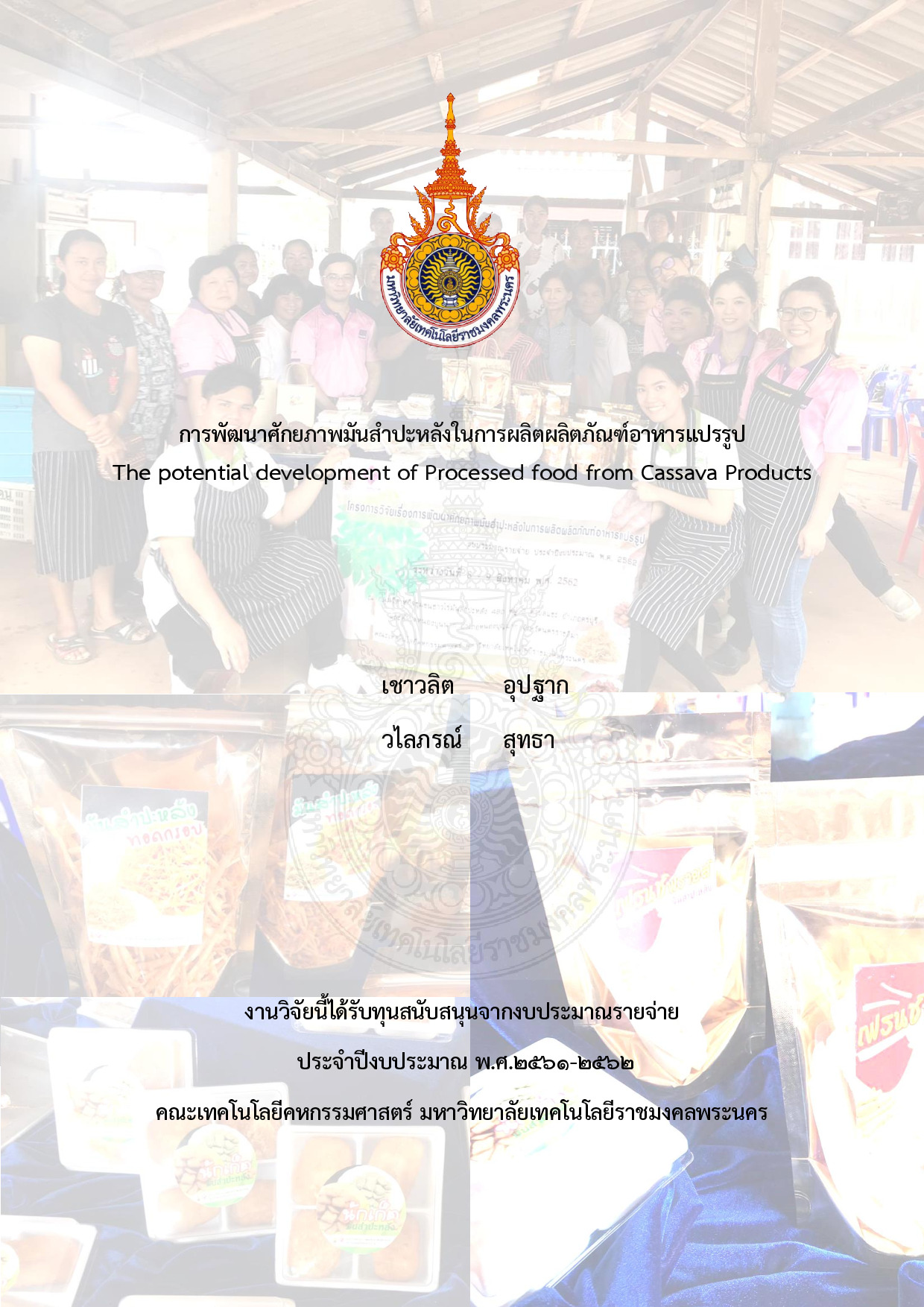
การพัฒนาศักยภาพมันสำปะหลังในการผลิตผลิตภัณฑ์อาหารแปรรูป
This research has objectives to study about production process of four types of processed food product to study quality of processed food product supplemented with cassava to study about consumer test towards processed food product to study quality of processed food product supplemented with cassava to study about consumer test towards processed food product made supplemented with cassava. From the test it was found about the appropriate quantity of cassava to supplement into four types of processed food product. The researcher had consumer test in order to test about acceptance of testers who are 40 instructors in field of Food and Nutrition field of Food and Nutrition Science and field of Food Service Industry using method of giving marks for favor in type of 9-point hedonic scale. The researcher supplemented cassava into barbecue powder French Fries at level of 0 2 4 and 8 percent of all ingredient. It was found that testers accepted the French Fries at level of 2 percent to be in level of moderate favor. The researcher made nuggets supplemented with cassava at level of 0 50 75 and 100 percent of all in gradient. It was found that testers accepted the nuggets at level of 75 percent. The researcher supplemented cassava into fish cake at level of 0 40 60 and 80 percent of all ingredient. It was found that testers accepted the fish cake supplemented with cassava at level of 60 percent to be in level of moderate favor. The researcher made crispy cassava mixed with Barbecue power at level of 2 4 6 and 8 percent of all ingredient. It was found that the testers accepted the crispy cassava at level of 4 percent to be in level of moderate favor. Regarding nutritional value of French Fries it was found that cassava for 2 percent in French Fries with Barbecue powder had moisture value for 28. 25 percent fat value for 27.21 percent fiber for 2.22 percent ash for 2.28 percent and protein for 2.22 percent. Nugget it was found that nugget supplemented with cassava for 75 percent had moisture value for 53.35 percent fat value for 6.47 percent fiber for 1.67 percent ash for 1.94 percent and protein for 17.98 percent. Fish cake it was found that fish cake supplemented with cassava for 60 percent the chemical quality had moisture value for 50.92 percent fat value for 13.78 percent fiber for 2.69 percent ash for 2.85 percent and protein for 21.97 percent. Crispy cassava mixed with Barbecue powder it was found that crispy cassava mixed with Barbecue powder for 4 percent chemical quality had moisture value for 1.39 percent fat value for 21.04 percent fiber for 3.64 percent ash for 3.05 percent and protein for 2.22 percent. However supplementing of cassava in four types of processed food products can be made but there shall be realizing about chemical elements of primary components such as moisture and fat quantity. These elements may affect the physical features for example smell and taste and texture. These features had effect on product acceptance. Study result of acceptance of consumers which had effect on products of semi-finished sauce supplemented with cassava; 100 consumers are at Faculty of Home Economics Technology Rajamangala University of Technology Phra Nakhon and Thewet Market. Regarding information of feeling on acceptance of French Fries product of cassava mixed with Barbecue powder it was found that consumers were satisfied with product of French Fries of cassava mixed with Barbecue powder for 2 percent in level of moderate favor giving feeling on product feature in appearance color smell smell and taste to be in level of moderate favor. Regarding information of feeling on acceptance of Cassava product it was found that consumers were satisfied with Fried Cassava product of 40 percent in level of moderate favor giving feeling on product feature in appearance color smell smell and taste to be in level of moderate favor. Regarding information of feeling on acceptance of French Fires product of cassava nugget it was found that consumers were satisfied with cassava nugget in level of moderate favor giving feeling on product feature in appearance color smell smell and taste to be in level of moderate favor. Regarding information of feeling on acceptance of crispy cassava mixed with Barbecue powder it was found that consumers were satisfied with crispy cassava mixed with Barbecue powder in level of moderate favor giving feeling on product feature in appearance color smell smell and taste to be in level of moderate favor. Result of technology transfer in project of tapioca potential development in producing of semi-finished sauce product which was held on 10-11 August 2019 at Tapioca Farmer community Enterprise Group Khon Buri District and Nong Bunmak District Nakhon Ratchasima Province there were 45 trainees. From evaluation it was found that 45 questionnaire respondents brought knowledge to utilize numbering 45 persons to be 100 percent. The satisfaction of academic and professional service receivers towards benefit from service of trainees was in much satisfaction and the most satisfaction to be 100 percent.
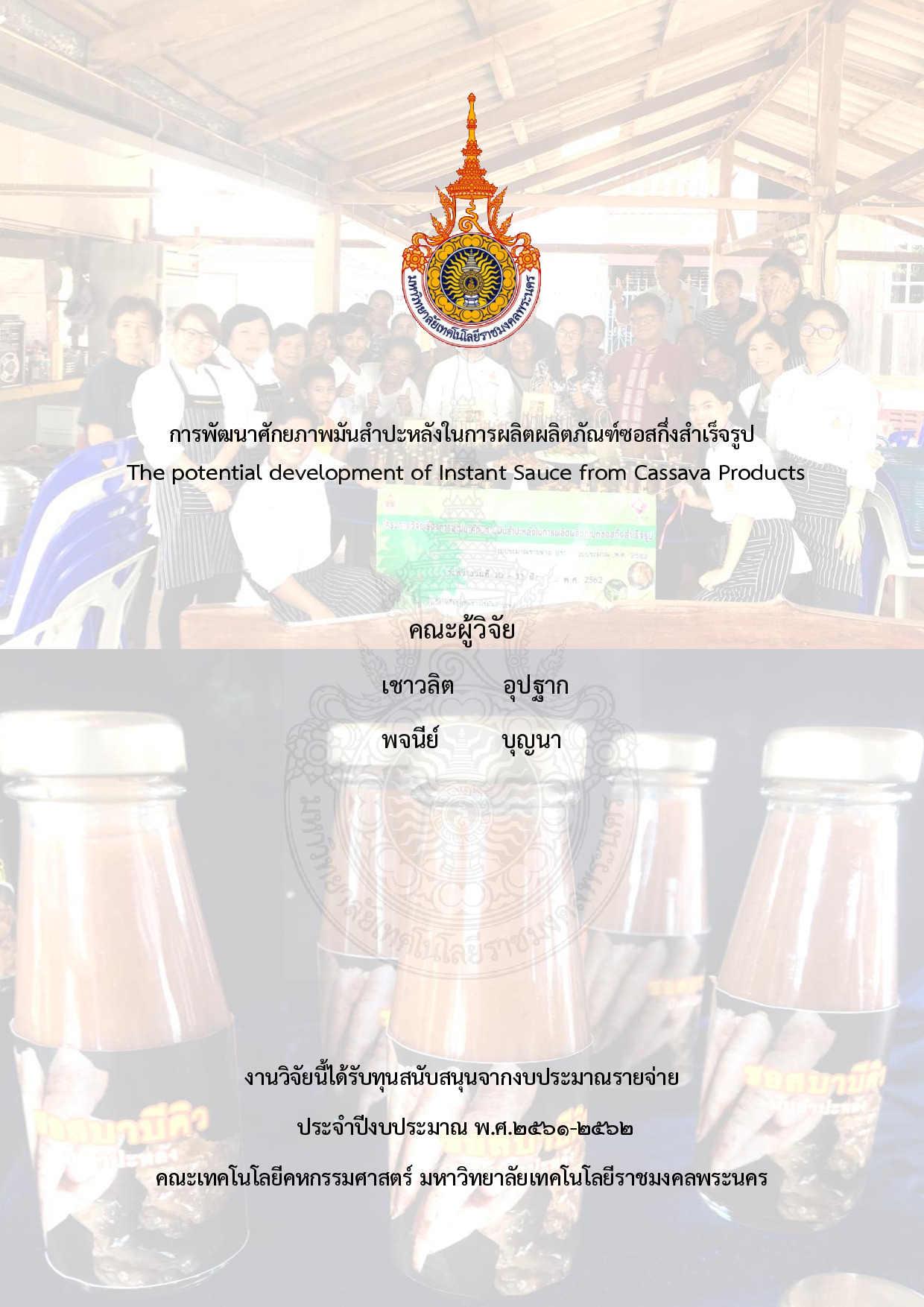
การพัฒนาศักยภาพมันสำปะหลังในการผลิตผลิตภัณฑ์ซอสกึ่งสำเร็จรูป
This research has objectives to study about production process of four types of finished sauce product made from cassava to study about quality of finished sauce product made from cassava to study about consumer test towards finished sauce product made from cassava. From the test it was found that study about quantity of suitable cassava supplement to the four types of finished cassava product by testing about acceptance of testers who were 40 instructors in field of Food and Nutrition field of Food and Nutrition Science and field of Food Service Industry. The method was to give marks for favor in type of 9-point hedonic scale by supplementing cassava into Teriyaki Sauce at levels of 0 20 40 and 60 percent of total ingredient. It was found that the testers accepted the sauce at level of 20 percent which was in the most favorite level. Semi-finished frying sauce supplemented with cassava at level of 0 40 60 and 80 percent of total ingredient; it was found that the testers accepted the level of 60 percent of Barbeque sauce supplemented with cassava at level of 0 40 60 and 80 percent of total ingredient; it was found that the testers accepted level of 40 percent in the level of much favor of semi-finished flavored fermented frying sauce supplemented with cassava at level of 0 20 40 and 60 percent of total ingredient it was found that the testers accepted the sauce at level of 40 percent which is in the level of much favor. Nutritional value of semi-finished sauce product it was found that Teriyaki sauce for 20 percent has moisture value of 78.66 percent fat value of 1.08 percent fiber for 1.36 percent ash for 2.29 percent and protein for 3.34 percent. Semi-finished frying sauce it was found that semi-finished frying sauce supplemented with cassava for 60 percent had moisture value of 80.85 percent fat value of 0.55 percent fiber for 1.35 percent ash for 3.35 and percent and protein for 3.29 percent. cassava for 60 percent it was found that chemical quality had moisture for 82.31 percent fat value for 0.75 percent fiber for 1.51 percent ash for 2.41 percent and protein for 3.37 percent. Semi-finished fermented flavored sauce it was found that semi-finished fermented flavor sauce supplemented with cassava for 40 percent it was found that chemical quality had moisture value for 83.67 percent fat value for 0.07 percent fiber 4.54 percent ash for 4.54 percent and protein for 2.42 percent. However supplementing of cassava into process of finished food products of 4 types; supplementing can be made but there shall be realizing about chemical elements of starting components for example moisture and fat quantity. These components may have effect on physical features for example smell smell and taste and texture. These features affected acceptance of products. The result of study about acceptance of consumers (Consumer test) towards product of semi-finished sauce supplemented with cassava and 100 consumers in Faculty of Home Economics Technology Rajamangala University of Technology Phra Nakhon and people in Tevet Market. Feeling towards acceptance of semi-finished sauce product supplemented with cassava it was found that consumers were satisfactory towards Teriyaki sauce product in moderate favor level having feeling on product in appearance color smell smell and taste in moderate favor level. Feeling towards acceptance of semi-finished sauce product it was found that consumers were satisfactory towards semi-finished frying sauce product 60 percent in moderate favor level having feeling on product in appearance color smell smell and taste in moderate favor level. Feeling towards acceptance of semi-finished fermented sauce product it was found that consumers were satisfactory towards semi-finished fermented sauce product 75 percent in moderate favor level having feeling on product in appearance color smell smell and taste in moderate favor level. Result of technology transfer in project of cassava potential development in production of semi-finished sauce product Tapioca Farmer Community Enterprise Group 480 Khon Buri District and Nong Bunmak District Nakhon Ratchasima Province 45 trainees; most were female having age of 36-45 years to be 96.00 percent. From evaluation it was found that 45 respondents used knowledge to be 100 percent and satisfactory of service receivers in academic aspect and professional aspect towards benefit from service of trainees in level from much to the most to be 100 percent.
การพัฒนาคุณภาพเส้นใยไหมด้วยนาโนเทคโนโลยี เพื่อกลุ่มธุรกิจเกษตรกรเลี้ยงหนอนไหมจังหวัดสุรินทร์
This research is to study the quality development of silk fibers by nanotechnology for the Silkworm farmer business groups of Surin Province. The research purposes are to study the efficiency and process of silkworm rearing using nanotechnology. To test the quality of silk fibers obtained from raising silkworms using nanotechnology. To compare of silkworm rearing results using nanotechnology and to transfer technology to improve silk quality with nanotechnology for silkworm farming business group in Surin Province. The results are as follows 1. The researchers designed the recording schedule which the party can record the changes easily of silk worm development during each day. This research allows the researchers to collect data from the farmer is more easily and finely into 4 groups of experiments with 3 nanotechnology formulas: 1. ZINC OXIDE 2. SILVER NANO and 3. ZINC OXIDE and SILVER NANO with 50:50 percentages each. The silk used in the experiment was “Nang Noi” which is popularly silkworm variety in every household in Surin province.When experimenting must clean the house and rinsing the container with DI WATER for aperiod of 7 months 2. This research is divided into 4 groups. Group 1: Silkworm feed normal methods without the use of nanotechnology. Group 2 silkworms feed with Nano substances such as ZINC OXIDE SILVER NANO ZINC OXIDE and SILVER NANO in 15 percentage concentration. Group 3 silkworms feed with Nano substances are ZINC OXIDE SILVER NANO ZINC OXIDE and SILVER NANO with 30 percentage concentration. Group 4 silkworms feed with Nano substances are ZINC OXIDE SILVER NANO ZINC OXIDE and SILVER NANO with 45 percentage concentration 3. The Results and comparison of silkworm rearing using nanotechnology the best formula feed is formula 1. When feeding Nano-sprayed on mulberry leaves using 3% 15% zinc silver and silver zinc it is found that the growth of worms in each age was good growth and not being a disease. Moreover Silkworms are slightly better and more alert than normal farming. The length in ages 3 - 4 - 5 is going in a better direction. Amount of eating mulberry leaves in each age. As usually eating more in ages 2 and 3 after passing the silk production process and testing the quality of silk fibers in the laboratory were found that the silk fibers are smooth not lacking toughness: Tenacity at 3.06 4.60 and 4.60 respectively and also result in fiber amount increase and also the color of the silk fibers is golden quite clear beautiful and consistent color. 4. When technology transfer to the Silkworm farmer business groups of Surin Province as workshop for 3 days. Most participants are satisfied with the highest levels in all questions.

การพัฒนาผลิตภัณฑ์กระเป๋าด้วยสิ่งทอเส้นใยและผืนผ้า จากต้นไหลตกแต่งเคลือบกันน้ำ เพื่อส่งเสริมเศรษฐกิจชุมชนจังหวัดบุรีรัมย์
The proposes of this research were to study the development of bag products with textiles fibers and fabrics from decorative flowing water-resistant coating to promote community economy in Buri Ram Province. With the objective To study the process of producing yarn from fibers from the flow source To design and develop textile and bag products from yarn from the Lai Ton To study the effect of coating with waterproofing on bag products using textiles fibers and fabric from the flow. And to transfer knowledge and technology for utilization to community groups and interested people in next fiscal year This research can be summarized as follows: 1. The study of Ton Lai found that most villagers grow Lai Ton and make products as a supplementary career. In using this flow source in this research the researcher used a large flow source with a diameter of about 1 hour and can be separated into 4 small strands for research and production. The dyes used are synthetic because they will get fresh colors save time and be consistent. 2. The researcher designed 2 designs of weaving designs with the idea of using the original pattern to add edit and then create the pattern that the community groups like and can actually produce it as a product. After getting the fabric pattern then design into 10 bags of women and men bags using leather as an ingredient Decorate the bag to look interesting increase the price and increase the target audience. Which will be different from the original. That uses colored fabric and striped fabric as decorative items. 3. Coating with waterproofing on the bag products with textiles fibers and fabrics from the flow found that the fabric that has been coated with water repellent. When pouring water on the water surface there is a clumping together. No water penetration through fibers. When wiping clean the fibers are still dry not wet. Which is different from fabric that has not been coated namely water is able to penetrate immediately and create moisture on the fabric surface. If stored for a long time it can cause mold. 4. Schedule of technology transfer with the plan to transfer the research in the budget year 2020. For 3 day knowledge transfer and workshop was 30 participants. The group consisted of weaving mats from Ban Bu community Chorakhe Mak Subdistrict Prakhon Chai District. Buriram province