จำนวน Repository ( 49 )

การพัฒนาผลิตภัณฑ์ลอดช่องไทยจากแป้งข้าวกล้องสังข์หยด
The research was aimed to: 1) create a standard formula of Sangyod brown-rice flour Thai Lodchong 2) study the change during storage and 3) study the consumers’ acceptance. The physical properties chemical composition sensory evaluation and microbiological quality were determined. The study showed that Lodchong in which the substitution of Sangyod brown rice flour at 50% by weight of rice flour and 30% of arowroot flour for the total flour weight were used was most accepted in all aspects. The product has a slight physical conversion at 7 °C for not longer than 48 hours. All the microorganisms yeast and mold found were still safe for consumers and none of Escherichia coli was detected in the product. Nutritional analysis results revealed that 100 grams of the product contained 78.64 kcal energy 0.98 g protein0.07 g fat 18.03 g carbohydrate dietary fiber 0.71 g and 11.63 mg anthocyanin. For consumers’ acceptance it was found that the product was much accepted and 99% of the consumers were interested to buy the product at 22 bath per 180 ml cup.
การพัฒนาผลิตภัณฑ์เครื่องดื่มน้ำถั่วผสมธัญพืชเสริมปลายข้าวสังข์หยดสำหรับผู้สูงอายุ
The objective of this research was to develop a beverage product from broken-milled sangyod rice for the elderly person. Raw materials of this product were broken-milled Dangyod rice soybean red kidney bean Job’s tears sesame and sucrose. The highest acceptance score (9-point hedonic scale) by the panelist who the elderly person ( 60 years old) showed that 7% broken-milled sangyod rice was proper for supplement in this beverage ( 0.05). The color in tem of L a and b values were 64.80+ 0.04 6.60+0.07 and 8.27+0.05 respectively. Viscosity of this beverage was increased by addition of broken-milled Sangyod rice. The B brand sweetener was gained the highest acceptance score. The developed product was 21.19 kcal/100g and fat protein fiber and carbohydrate content were 0.59% 1.25% 0.15% amd 2.75 % respectively. After storage at 4+ C for 15 days this product was shown to be safe for consumption. It passed quality criteria of Thai community product standard (TCPS 282/2015). The 100 elderly consumers focused on the nature of rice or cereal products in terms of health benefits. All of consumers were accepted on the product for beneficial for health.
การออกแบบอัตลักษณ์บนบรรจุภัณฑ์สาหรับผลิตภัณฑ์จากต้นตาล จังหวัดเพชรบุรี
Identity design design on packaging for products from sugar palm Phetchaburi Province The aim is to explore and analyze the creative capital of the province and to design Identity graphic on packaging for products from sugar palm. Participants were residents and visitors in the province of 100 people by accidental Sampling random and experts in the design of 5 people tools used in the research is to evaluate the design. How to conduct research Step 1) Secondary education and explore spatial data 2) screening analysis to identify the elements of identity 3) Synthesis and process design 4) test and evaluate the performance of samples 5) Selection and development 6) Prototype 7) Prepare and publish reports. The study concluded that design elements identity on packaging for products from sugar palm Phetchaburi Province. Ideas or inspiration from a long regatta. Conveys fun refreshing and cool nature Illustration graphic patterned palm combination stripes art Phra Nakhon Khiri (Khao Wang) and the Wat Yai mural Font BoonJot a text headline or highlight text orTypeface and font CS PraJad a body text Color of brown sugar and blue sea The composition an asymmetric split into two groups for the promotion of the area and an important indicator. The analysis evaluated the design. Overview of the evaluation group who have the qualification. The higher sample rate But with the same rating that is the highest score a run followed by the interpretation and design respectively
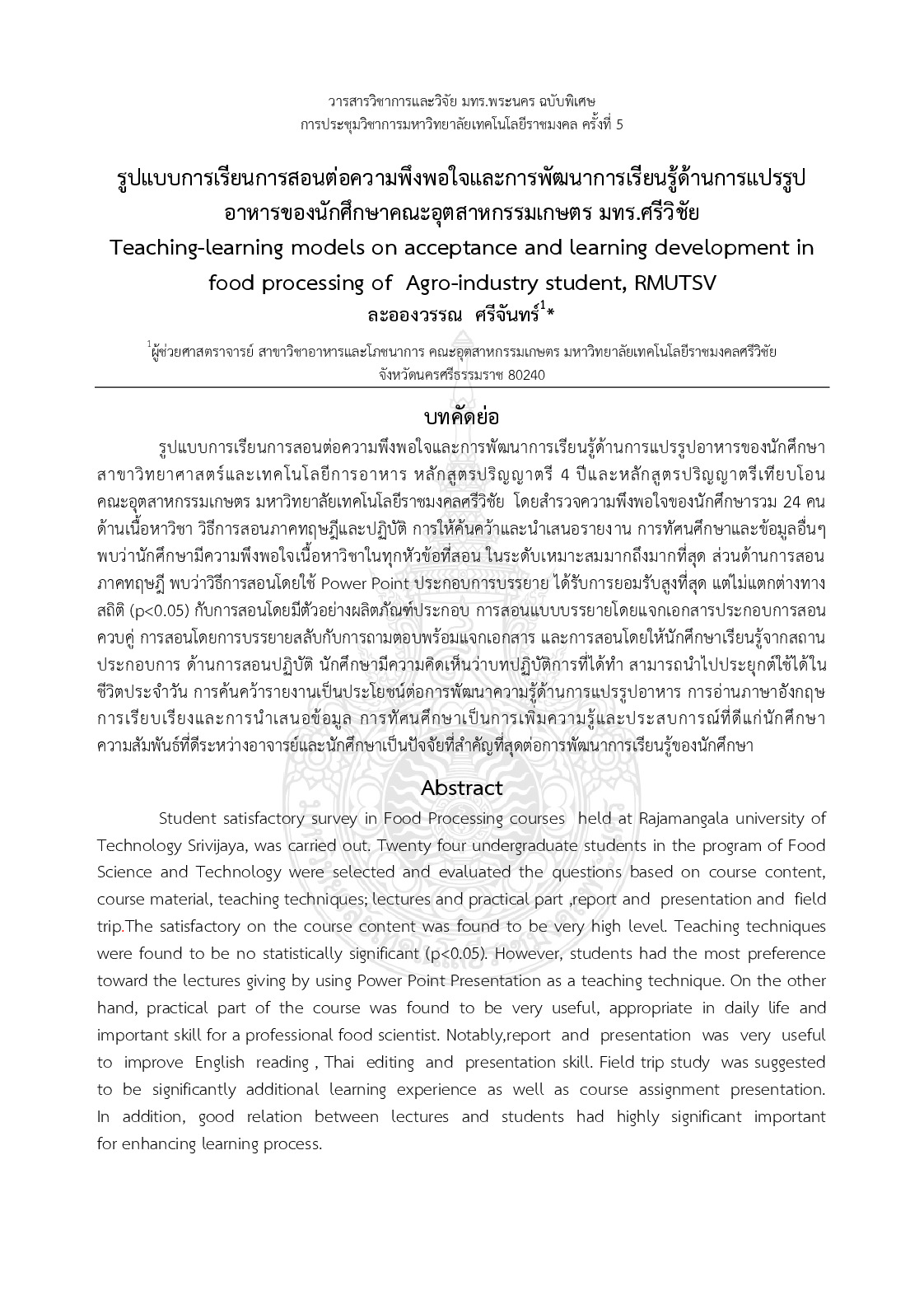
Teaching-learning models on acceptance and learning development in food processing of agro-industry student, RMUTSV
Student satisfactory survey in Food Processing courses held at Rajamangala university of Technology Srivijaya was carried out. Twenty four undergraduate students in the program of Food Science and Technology were selected and evaluated the questions based on course content course material teaching techniques; lectures and practical part report and presentation and field trip.The satisfactory on the course content was found to be very high level. Teaching techniques were found to be no statistically significant (p<0.05). However students had the most preference toward the lectures giving by using Power Point Presentation as a teaching technique. On the other hand practical part of the course was found to be very useful appropriate in daily life and important skill for a professional food scientist. Notablyreport and presentation was very useful to improve English reading Thai editing and presentation skill. Field trip study was suggested to be significantly additional learning experience as well as course assignment presentation. In addition good relation between lectures and students had highly significant important for enhancing learning process.
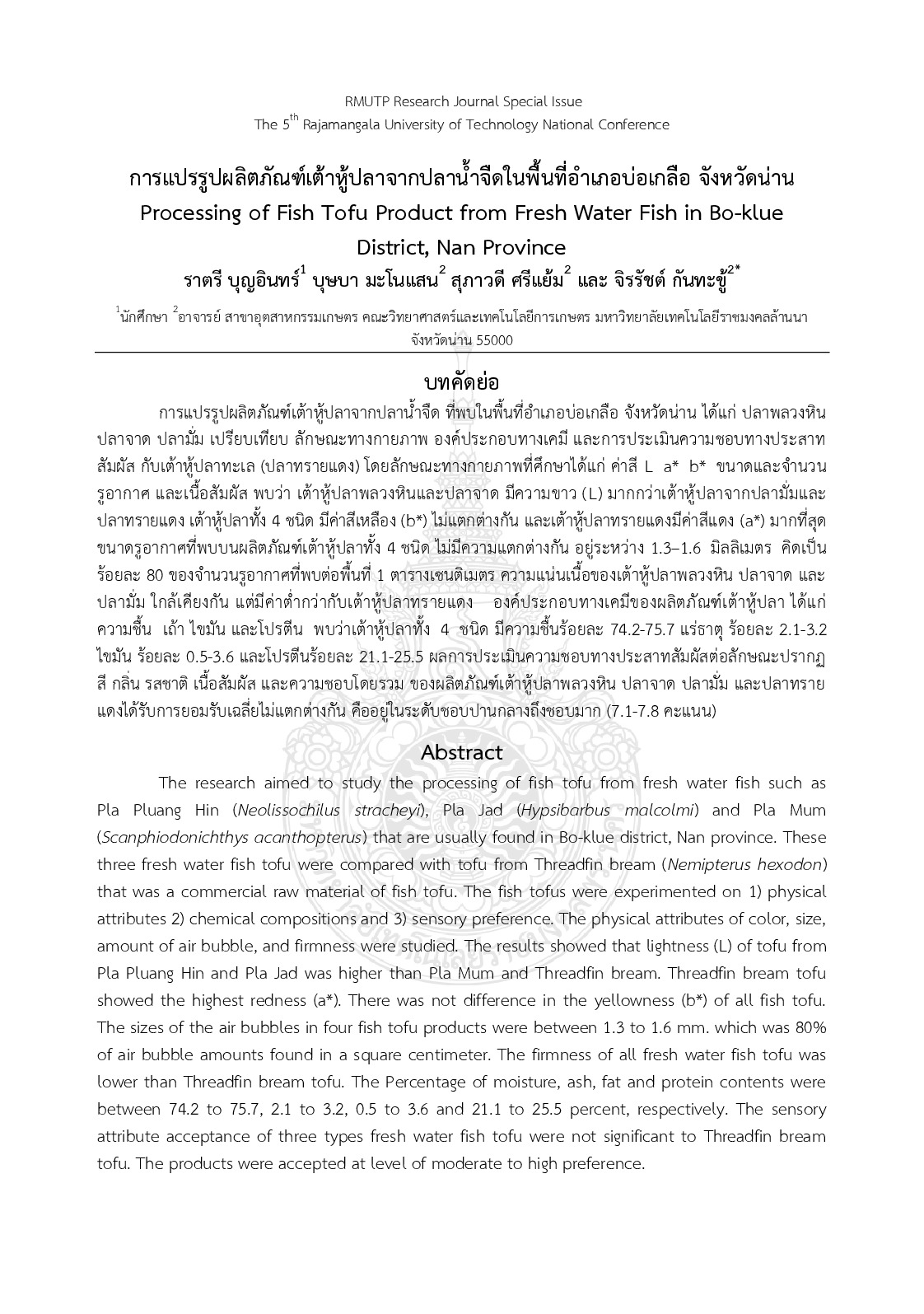
Processing of fish tofu product from fresh water fish in bo-klue district, nan Province
The research aimed to study the processing of fish tofu from fresh water fish such as Pla Pluang Hin (Neolissochilus stracheyi) Pla Jad (Hypsibarbus malcolmi) and Pla Mum (Scanphiodonichthys acanthopterus) that are usually found in Bo-klue district Nan province. These three fresh water fish tofu were compared with tofu from Threadfin bream (Nemipterus hexodon) that was a commercial raw material of fish tofu. The fish tofus were experimented on 1) physical attributes 2) chemical compositions and 3) sensory preference. The physical attributes of color size amount of air bubble and firmness were studied. The results showed that lightness (L) of tofu from Pla Pluang Hin and Pla Jad was higher than Pla Mum and Threadfin bream. Threadfin bream tofu showed the highest redness (a*). There was not difference in the yellowness (b*) of all fish tofu. The sizes of the air bubbles in four fish tofu products were between 1.3 to 1.6 mm. which was 80% of air bubble amounts found in a square centimeter. The firmness of all fresh water fish tofu was lower than Threadfin bream tofu. The Percentage of moisture ash fat and protein contents were between 74.2 to 75.7 2.1 to 3.2 0.5 to 3.6 and 21.1 to 25.5 percent respectively. The sensory attribute acceptance of three types fresh water fish tofu were not significant to Threadfin bream tofu. The products were accepted at level of moderate to high preference.