จำนวน Repository ( 53 )
การพัฒนาสมรรถนะวิศวกรนักปฏิบัติทักษะสูงเพื่อรองรับอุตสาหกรรม 4.0 อย่างยั่งยืน
The objective of this research was to develop the engineering students in accordance with the Bachelor of Engineering (B.Eng.) curriculum (industrial engineering) through the work-integrated learning program under which the students worked in the production line from Monday to Friday and studied the theories on Saturday. The learning program continued throughout the semester under the collaboration with Thai Cutting Tools Manufacturers (TCTM) of which 26 companies participated in the program. The program determined the development plan for the students of IE.102 course: Basic Production Process for Engineers through the project-based learning (PBL) program in accordance with the CDIO standard (Standards No.1-4). Twenty-seven (27) students of the work-integrated learning (WiL) program worked in 7 companies which were manufacturers and developers of cutting tools machine tools high precision parts and machines. All participating companies were designer and developers of new products and innovations and their products were distributed in and outside the country. Hence the students learnt from working in the production line to create new products according to the production plan. The products newly created through the integrated production method consisted of machine tools automated machines lathe milling drilling fitting grinding welding and metal sheets. The students learnt to use the tools to assemble and create the machines and developed the technology operation skill for production of high precision products. The learning and working were combined and applied to create those products. The students’ skills were developed in compliance with the CDIO standard (Standards No. 5) as the program required them to work in the workspaces to create the products in compliance with the CDIO standard (Standards No.6). The students created the cutting tools in compliance with the CDIO standard (Standard No.7) such as drills center drills end mills reamers insert tools and cutter tools. The students also created shafts gears bushes bolts and wedge assembled the parts in the power transmission of the machines the electric and electronic circuits of the machines and the electric motors and created the machines and molds for production. The teaching arrangement learning assessment and examination of the students’ competency were assessed from the integrated learning skills. Each student undertook the practices to develop the personal and interpersonal skills. The program development was based on self-learning under the supervision monitoring and recommendation of the lecturers specialized in the product design product creation and production management to develop the students in compliance with the CDIO standard (Standard No.7).The students practiced different skills such as conceiving designing implementing and operating respectively. In addition the students reported the progress under the project-based learning program and assessed the learning results before and after the learning session. Based on the study development under the “work college” project it was found that the students could develop the basic engineering skills throughout the semester. The basic engineering skills comprised the followings; 1) Integrated skill on the machine and tool operation in the basic engineering production process 2) Drawing and production drawing analysis skills 3) Material feature analysis skill for production 4) Machine-operating skill for production 5) Measuring tool-operation skill for product quality inspection 6) Machine tool and equipment operation skill for production of finish products 7) Part and component replacement skill for machine maintenance 8) Problem-solving skill in part and component production in case of incompliance with production drawing 9) Analysis skill of production process and conditions for operation at the workplace 10) Interpersonal skill obtained through the duty performance correction of defect parts in accordance with the advices of supervisors problem-solving with colleagues and project development. The 27 students gained the experiences through the work performance in the workplace according to the learning by doing approach. They performed duties developed the project solved problems and obtained the technology operation skill for production in accordance with the assigned tasks. They were trained to systematically solve the work problems. All of them produced cutting tools high precision tools and other tools from drawings and innovative development. They were equipped with basic engineering skills in compliance with the course curriculum standard and CDIO (Standards No. 8). The research findings affirmed that the students’ competency was increased with statistical significance of 0.5. Each of them developed a project under the project-based learning program. The developed projects were highly important. The students’ competency was developed through work performance covering product creation problem-solving. They learnt about the created products and their lifecycle in accordance with the science and engineering study approach. They were trained to identify the problems analyze the causes design the solutions implement the drawing designs and create the new products from the experimental results. The students were developed under the work-integrated learning program in accordance with the CDIO standard. The engineering skills were equipped through the creation of high precision tools and hard metal tools. Through the integrated learning the students obtained the basic engineering knowledge on the mathematic and physic calculations creation of the engineering drawings material analysis for engineering production project management and technology and innovation creation. The students communicated in English during working at the workplace. They understood the material features designed products for production and used these products to further create other products. They understood the connection of the supply chain in the industry with regard to production of 4 product categories which helped the students on creativity knowledge integration for engineering product creation product integration for further production and utilization of the industrial supply chain. The research contributed to the engineer development with regard to science research and innovation for the sustainable development.
The appropriate model of integrated learning for developing the new generation of graduates
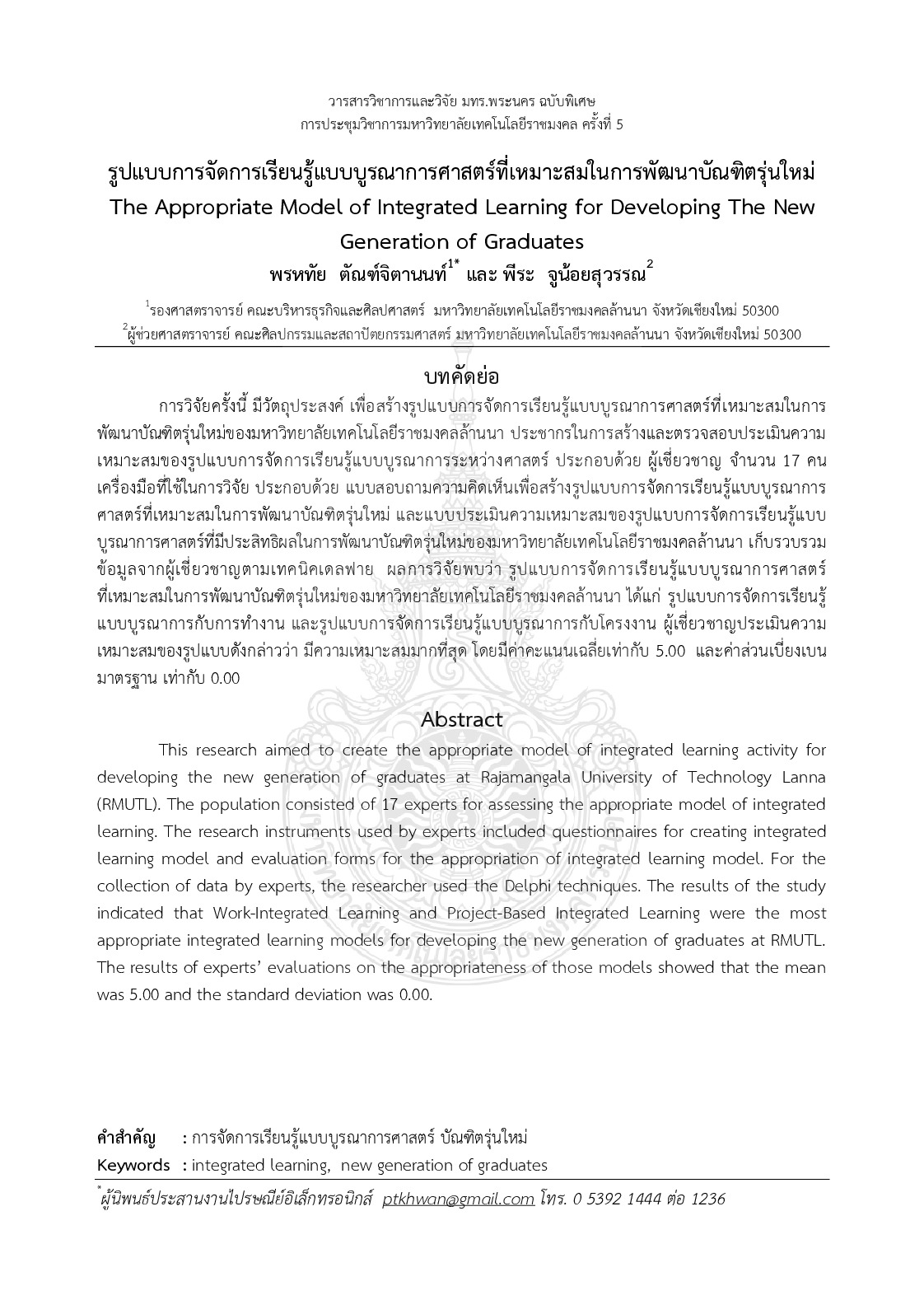
This research aimed to create the appropriate model of integrated learning activity for developing the new generation of graduates at Rajamangala University of Technology Lanna (RMUTL). The population consisted of 17 experts for assessing the appropriate model of integrated learning. The research instruments used by experts included questionnaires for creating integrated learning model and evaluation forms for the appropriation of integrated learning model. For the collection of data by experts the researcher used the Delphi techniques. The results of the study indicated that Work-Integrated Learning and Project-Based Integrated Learning were the most appropriate integrated learning models for developing the new generation of graduates at RMUTL. The results of experts’ evaluations on the appropriateness of those models showed that the mean was 5.00 and the standard deviation was 0.00.

แน้วโน้มความต้องการในการสำเร็จการศึกษามหาวิทยาลัยเทคโนโลยีพระนครเข้าทำงานสำหรับสถานประกอบการในเขตกรุงเทพมหานคร
การศึกษาความต้องการสำหรับผู้สำเร็จการศึกษาจากมหาวิทยาลัยเทคโนโลยีราชมงคลพระนครในการทำงานสำหรับสถานประกอบการในเขตกรุงเทพมหานครมีวัตถุประสงค์ที่จะศึกษา 1) ความต้องการสำหรับผู้สำเร็จการศึกษาจากมหาวิทยาลัยเทคโนโลยีราชมงคลพระนครในการทำงานสำหรับ 2 สถานประกอบการ) คุณสมบัติที่พึงประสงค์ของผู้สำเร็จการศึกษาจากมหาวิทยาลัยเทคโนโลยีราชมงคล พระนครจำเป็นโดยสถานประกอบการและ 3) ความสัมพันธ์ทางการของข้อมูลทั่วไปสถานประกอบการของคุณสมบัติที่พึงประสงค์ของผู้สำเร็จการศึกษาจากมหาวิทยาลัยเทคโนโลยีราชมงคลพระนครจำเป็นโดยสถานประกอบการและความต้องการสำหรับผู้สำเร็จการศึกษาจากมหาวิทยาลัยเทคโนโลยีราชมงคลพระนครในการทำงานสำหรับสถานประกอบการในเขตกรุงเทพมหานคร แบบสอบถามที่ถูกสร้างขึ้นด้วยความตรงตามเนื้อหาและความน่าเชื่อถือเป็นเครื่องมือในการเก็บรวบรวมข้อมูลจากการจัดตั้งที่ 306 ผู้สำเร็จการศึกษาจากมหาวิทยาลัยเทคโนโลยีราชมงคลพระนครได้ทำงาน สถิติที่ใช้ในการวิเคราะห์เป็นแจกแจงความถี่ร้อยละค่าเฉลี่ยส่วนเบี่ยงเบนมาตรฐานและสมการการวิเคราะห์โครงสร้างแบบ: SEM ผลการวิจัยชี้ให้เห็นว่าส่วนใหญ่ของสถานประกอบการในกลุ่มตัวอย่างเป็นบริษัทจำกัดที่ทำงานบนธุรกิจอุตสาหกรรมที่มีทุนเริ่มต้น 1-5 ล้านบาท 21-50 พนักงานที่มีประกาศนียบัตรวิชาชีพและอาชีวศึกษาสูงได้รับการทำงานที่นั่น ผู้ถือหุ้นของการจัดตั้งเหล่านี้แต่ละคนเป็นคนไทยอย่างสมบูรณ์และลูกค้าเป้าหมายทั้งในและออกจากประเทศไทย ในสถานประกอบการส่วนใหญ่มีมากขึ้นตรีบัณฑิตปริญญาจากมหาวิทยาลัยเทคโนโลยีราชมงคลพระนครกว่าปริญญาโทเป็น แนวโน้มของความต้องการสำหรับผู้สำเร็จการศึกษาจากมหาวิทยาลัยเทคโนโลยีราชมงคลพระนครในการทำงานสำหรับสถานประกอบการใน 2011 -2013 เป็นคนที่จบการศึกษาระดับปริญญาบัณฑิตในคณะวิศวกรรมศาสตร์และปริญญาโทสาขาบริหารธุรกิจ โดยทั่วไปที่พึงประสงค์ของการศึกษาระดับปริญญาบัณฑิตและมหาบัณฑิตที่สำเร็จการศึกษาปริญญาจากมหาวิทยาลัยเทคโนโลยีราชมงคลพระนครเป็นที่ต้องการในระดับสูง ข้อมูลทั่วไปของสถานประกอบการมีความสัมพันธ์กับความต้องการในการศึกษาระดับปริญญาตรีและปริญญาโทที่สำเร็จการศึกษาปริญญาจากมหาวิทยาลัยเทคโนโลยีราชมงคลพระนครที่จะทำงานเพื่อการจัดตั้งที่นัยสำคัญทางสถิติที่ระดับ 0.05% นอกจากนี้คุณสมบัติ d irable ของผู้สำเร็จการศึกษาจากมหาวิทยาลัยเทคโนโลยีราชมงคลพระนครจำเป็นโดยการจัดตั้งความสัมพันธ์กับความต้องการศึกษาต่อระดับปริญญาตรีและปริญญาโทที่สำเร็จการศึกษาปริญญาจากมหาวิทยาลัยเทคโนโลยีราชมงคลพระนครที่จะทำงานเพื่อการจัดตั้งที่นัยสำคัญทางสถิติที่ระดับ 0.05%
The trend of demand and factors affecting seleetion of business administration graduates from Rajamangala University of Technology Phra Nakhon to work for commercial banks in bangkok and metropolitan area
The study on the trend of demand and factors affecting selection of Business Administration graduates from Rajamangala University of Technology Phra Nakhon to work for commercial banks in Bangkok and metropolitan area was aimed at studying 1) the trend of demand for Business Administration graduates to work for commercial banks 2) factors affecting selection of Business Administration graduates from Rajamangala University of Technology Phra Nakhon to work for commercial banks and 3) analysis of satisfactory characters affecting selection of Business Administration graduates from Rajamangala University of Technology Phra Nakhon to work for commercial banks in Bangkok and metropolitan area. The questionnaires were constructed and passed internal consistence test of alpha method with more than 0.70. They were used as a tool for collecting data from 400 branch managers of Thai and foreign commercial banks. The statistics used for analysis were SPSS with frequencies distribution percentage mean standard deviation and exploratory factor analysis. The research finding indicated that 1) in 2005 the commercial banks in the sample group are planning to acquire new staff who graduated Administration Business from both Bachelors degree and Masters degree with Thai or English program. They mostly required the ones graduated from Finance and Banking and also Accounting Marketing General Management respectively. The Business Administration graduates from Rajamangala University of Technology Phra Nakhon were required the most and the second was from public universities and the third was from private universities. 2) the first-ranked factor affecting selection of Business Administration Bachelors graduates from Rajamangala University of Technology Phra Nakhon to work for commercial banks in the sample group was morality and honesty and for Masters ones was leadership 3) Working ability affecting selection of Business Administration both Bachelor and Masters graduates from Rajamangala University of Technology Phra Nakhon to work for commercial banks in Bangkok and metropolitan area at highest level with a variance of 14.074% and 13.501% respectively.
Evaluation of curriculum for the bachelor of science program in computer technology of Rajamangala University of Technology Phra Nakhon
The purpose of this study was to Evaluation of Curriculum for the Bachelor of Science Program in Computer Technology of Rajamangala University of Technology Phra Nakhon. The CIPP Model was used as evaluated model. The samples in this research were 125 undergraduates 14 Instructors 17 graduates and 11 employers of graduates. The 4 questionnaires of rating scales was used as the research instrument. Percentage mean standard deviation were statistical method to analyze data. The results were as follows: 1. The samples agreed with the Context Evaluation in the aspect of curriculum objectives curriculum structure curriculum content were in moderate levels. 2. The samples agreed with the Input Evaluation in the aspect of Characteristics of undergraduates and Characteristics of instructors were in high levels supporting education was in moderate levels. 3.The samples agreed with the Process Evaluation in the aspect of curriculum Management. teaching Management experience training were in high levels . 4 . The sample’s satisfaction towards Input Evaluation in the aspect of professional knowledge and Professional Characteristics were in moderate levels Ethics was in high levels .