จำนวน Repository ( 44 )
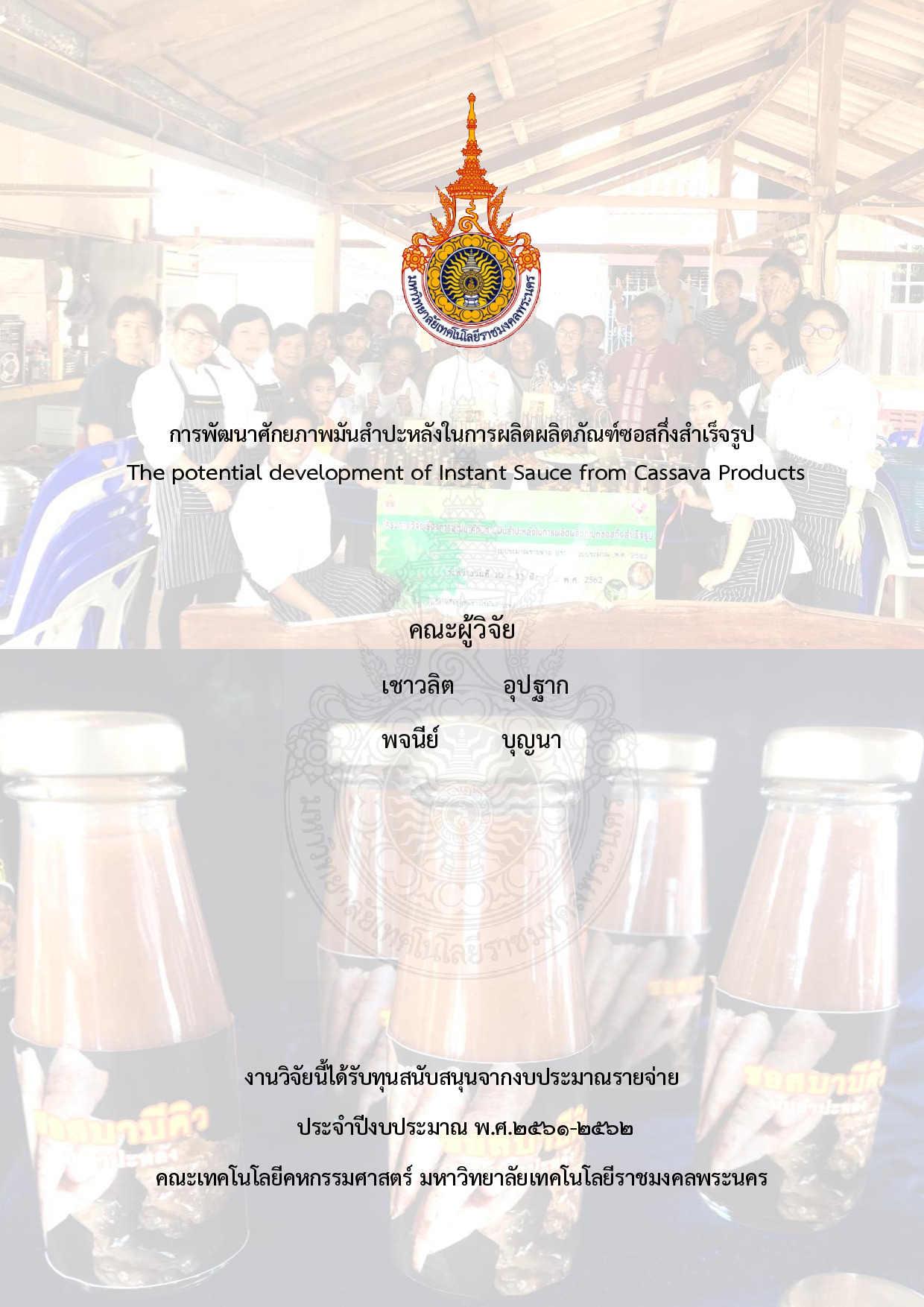
การพัฒนาศักยภาพมันสำปะหลังในการผลิตผลิตภัณฑ์ซอสกึ่งสำเร็จรูป
This research has objectives to study about production process of four types of finished sauce product made from cassava to study about quality of finished sauce product made from cassava to study about consumer test towards finished sauce product made from cassava. From the test it was found that study about quantity of suitable cassava supplement to the four types of finished cassava product by testing about acceptance of testers who were 40 instructors in field of Food and Nutrition field of Food and Nutrition Science and field of Food Service Industry. The method was to give marks for favor in type of 9-point hedonic scale by supplementing cassava into Teriyaki Sauce at levels of 0 20 40 and 60 percent of total ingredient. It was found that the testers accepted the sauce at level of 20 percent which was in the most favorite level. Semi-finished frying sauce supplemented with cassava at level of 0 40 60 and 80 percent of total ingredient; it was found that the testers accepted the level of 60 percent of Barbeque sauce supplemented with cassava at level of 0 40 60 and 80 percent of total ingredient; it was found that the testers accepted level of 40 percent in the level of much favor of semi-finished flavored fermented frying sauce supplemented with cassava at level of 0 20 40 and 60 percent of total ingredient it was found that the testers accepted the sauce at level of 40 percent which is in the level of much favor. Nutritional value of semi-finished sauce product it was found that Teriyaki sauce for 20 percent has moisture value of 78.66 percent fat value of 1.08 percent fiber for 1.36 percent ash for 2.29 percent and protein for 3.34 percent. Semi-finished frying sauce it was found that semi-finished frying sauce supplemented with cassava for 60 percent had moisture value of 80.85 percent fat value of 0.55 percent fiber for 1.35 percent ash for 3.35 and percent and protein for 3.29 percent. cassava for 60 percent it was found that chemical quality had moisture for 82.31 percent fat value for 0.75 percent fiber for 1.51 percent ash for 2.41 percent and protein for 3.37 percent. Semi-finished fermented flavored sauce it was found that semi-finished fermented flavor sauce supplemented with cassava for 40 percent it was found that chemical quality had moisture value for 83.67 percent fat value for 0.07 percent fiber 4.54 percent ash for 4.54 percent and protein for 2.42 percent. However supplementing of cassava into process of finished food products of 4 types; supplementing can be made but there shall be realizing about chemical elements of starting components for example moisture and fat quantity. These components may have effect on physical features for example smell smell and taste and texture. These features affected acceptance of products. The result of study about acceptance of consumers (Consumer test) towards product of semi-finished sauce supplemented with cassava and 100 consumers in Faculty of Home Economics Technology Rajamangala University of Technology Phra Nakhon and people in Tevet Market. Feeling towards acceptance of semi-finished sauce product supplemented with cassava it was found that consumers were satisfactory towards Teriyaki sauce product in moderate favor level having feeling on product in appearance color smell smell and taste in moderate favor level. Feeling towards acceptance of semi-finished sauce product it was found that consumers were satisfactory towards semi-finished frying sauce product 60 percent in moderate favor level having feeling on product in appearance color smell smell and taste in moderate favor level. Feeling towards acceptance of semi-finished fermented sauce product it was found that consumers were satisfactory towards semi-finished fermented sauce product 75 percent in moderate favor level having feeling on product in appearance color smell smell and taste in moderate favor level. Result of technology transfer in project of cassava potential development in production of semi-finished sauce product Tapioca Farmer Community Enterprise Group 480 Khon Buri District and Nong Bunmak District Nakhon Ratchasima Province 45 trainees; most were female having age of 36-45 years to be 96.00 percent. From evaluation it was found that 45 respondents used knowledge to be 100 percent and satisfactory of service receivers in academic aspect and professional aspect towards benefit from service of trainees in level from much to the most to be 100 percent.

การพัฒนากลยุทธ์ทางการตลาดของธุรกิจอาหารคลีนสำเร็จรูปในเขตกรุงเทพมหานคร
This research was aimed to identify personal factors and consumers’ needs of the marketing mix as well as to study of the strategy development of instant clean foods business in Bangkok Metro Metropolis. To obtain the data a questionnaire was designed to gather the information from the 400 samples in the study selected by convenience sampling in five out of 50 districts from 50 districts. In-depth interviews were also arranged among five respondents. The statistical analysis was completed by percentage mean and SD. The hypothesis was tested by the t-test F-test and Oneway ANOVA. To test differences in pairs LSD was applied at the level of statistical significance at the 0.05. This research employed mixed research method: the quantitative research looked into the quantitative data obtained from the respondents who consumed instant clean foods. Qualitative research relied on the data from the indepth interviews of the clean food business operators. Concerning the marketing mix the targets groups and marketing strategies the research revealed most respondents were single female who aged 21-30 years old with bachelor’s degrees. The average incomes were 10000 - 20000 baht. Their needs related to the marketing mix were the importance of products relevant with freshness and cleanness. They highly focused on food prices and made a wide variety of payments (cash credit card online etc.) The consumers also paid attention to distribution channels at a high level (store sale convenience stores various online channels etc.) and convenient to buy from various reasons such as stores that were close to work schools and shopping malls. The consumers also paid high focus on the clean food promotion.
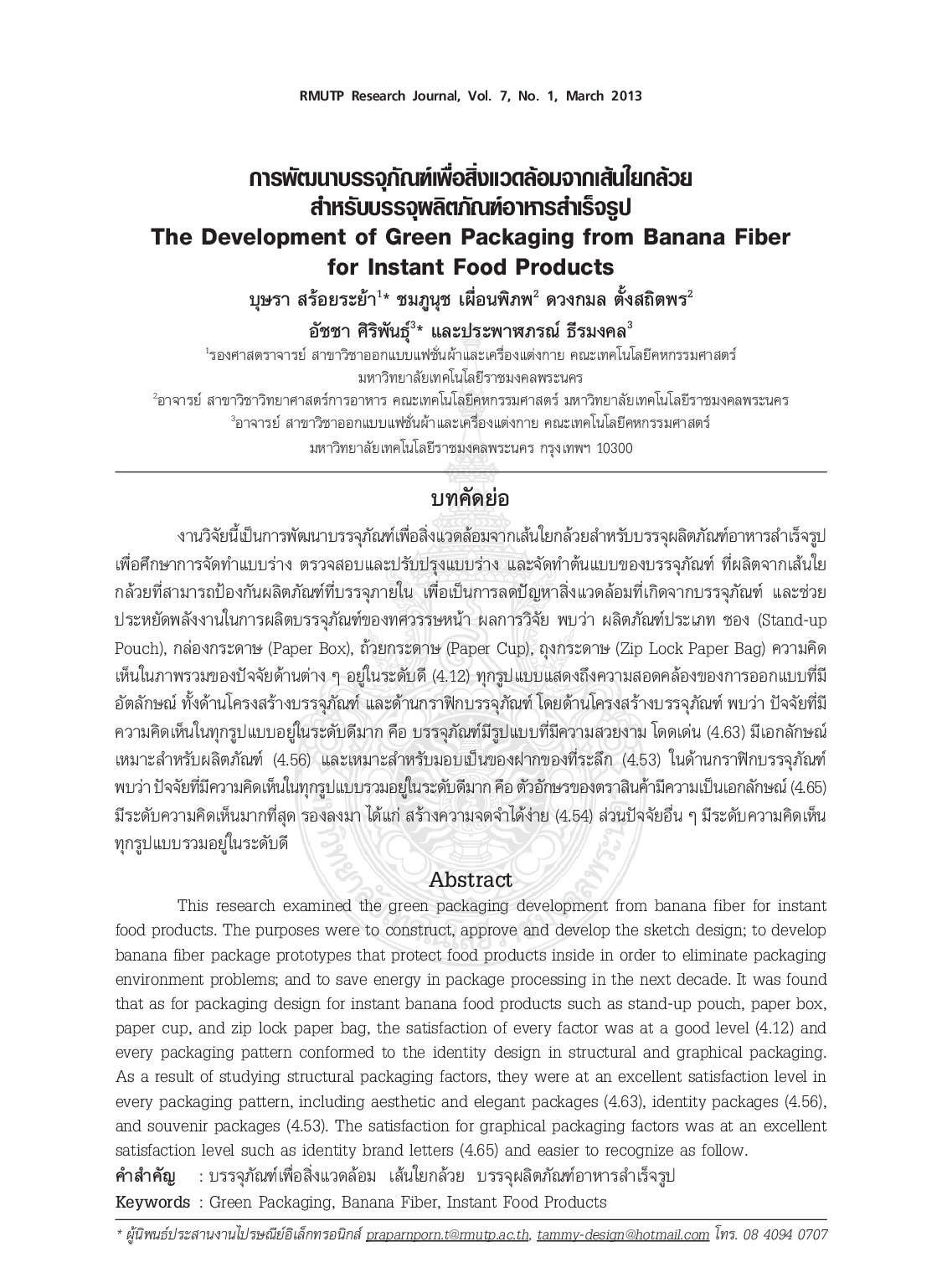
การพัฒนาบรรจุภัณฑ์เพื่อสิ่งแวดล้อมจากเส้นใยกล้วยสำหรับบรรจุผลิตภัณฑ์ต่ออาหารสำเร็จรูป
This research examined the green packaging development from banana fiber for instant food products.The purposes wrer to construct approve and develop the sketch design; to develop banana fiber package prototypes that protect food products inside in order to eliminate packaging environment problems; and to save energy in package processing in the next decade.It was found that as for packaging design for instant banana food products such as stand-up pouchpaper box paper cupand zip lock paper bag the satisfaction of every factor was at a good level (4.12) and every packaging pattem conformed to the identity design in structural and graphical packaging As a result of studying structural packaging factorsthey were at an excellent satisfaction level in every packaging pattern including aesthetic and elegant packages(4.63) identity packages(4.56) and souvenir packages(4.53). The satisfaction for graphical packaging factors was at an excellent satisfaction level such as identity brand letters(4.65) and easier to recognize as follow.
การพัฒนาผลิตภัณฑ์และบรรจุภัณฑ์อาหารจากสับปะรด สำหรับกลุ่มสหกรณ์การเกษตรหุบกะพง จำกัด
This research aims to develop food product from pineapple along with its packaging and to transfer pineapple processing technology to the Hubkapong Agricultural Cooperation Group Limited Khaoyai subdistrict Cha-am district Phetchaburi province. Results of the study showed that dehydrated pineapple and pineapple syrup could be processed to add more value and to extend shelf life. In dehydrated pineapple processing a study of different levels of sugar concentration (20 30 and 40%) indicated that concentration level of the beginning sugar concentration caused the increase of water loss and sugar level in the product. Concerning ratio of pineapple juice and water (1:1 1:1.25 and 1:1.5) and amount of pectin (0.25 0.50 and 0.75 %) in pineapple syrup processing it was found that the increased level of sugar caused the increase of total soluble solid in pineapple syrup. The increased level of pectin also affected the increase of viscosity of pineapple syrup. The processing technology was transferred through a training course for 40 members of Hubkapong Agricultural Cooperation Group Limited Khaoyai subdistrict Cha-am district Phetchaburi province. Results indicated that the finishing food products from pineapple of every groups were in good level with average score range of 4.00-4.36. The trainees regarded the training process as highly suitable (average score of 4.31) and the trainers as most suitable (average score of 4.66). The training materials apparatus document and venue and the training management aspects were regarded as highly suitable with average score of 4.16 and 4.10 respectively.