จำนวน Repository ( 44 )
การใช้เทคโนโลยีสำหรับชุมชนในการพัฒนาผลิตภัณฑ์ คอนกรีตบล็อก ลดอุณหภูมิจากเศษหินพัมมิซ
This research aims to produce scrap page kaolin of brick construction. The kaolin clay ratio of 100: 0 80:20 60:40 50:50 40:60 20:80 and 0: 100 by volume Add mixed with rice husk and rice 15 percent by weight A total of seven ratios. According to standard tests or TIS. 77-2545 ordinary story brick building. The moisture content and water absorption is increasing. While density Thermal conductivity resistance flexural and compressive strength tends to decrease. The best ratio of 80:20 by volume with compressive strength 43.16 kg / cm 2 and 24.93 percent water absorption. Criteria standard of TIS. 77-2545 requiring compressive strength not less than 35 kg / cm2 and water absorption must not be higher than 25 percent. Can be used in the manufacture of brick construction including building decorative wall can be developed into products. Because skin color and beautiful

Electrical conservation and development of energy management system for public building
This research was a study of energy management in public building. The goals of this project are to decrease energy consumption and to enhance energy management system of the building. Regarding the energy survey the building lights are turned on for 24 hr. per day in order to satisfactorily serve the customers. In the study it was found that the energy consumption of electric light on the fourth floor roof can be reduced by changing the light “Floodlight MH. 4x250W” to be “High bay LED 4x150W” For the merit this project can save the energy around 6632570 baht per year and switching towards high-efficiency lanterns and replacing FL. T8 light bulbs installed in the walkways with FL. T5 models. This reduces lighting cost by 361425 baht per year. Moreover the energy management system was analyzed by using SWOT Analysis. As a result we observed the barriers to communication must be overcome to promote energy conservation. One approach is to increase the performance through the use of communication strategies within organizations. This method will help align employees understanding and participating in activities of conserve energy.
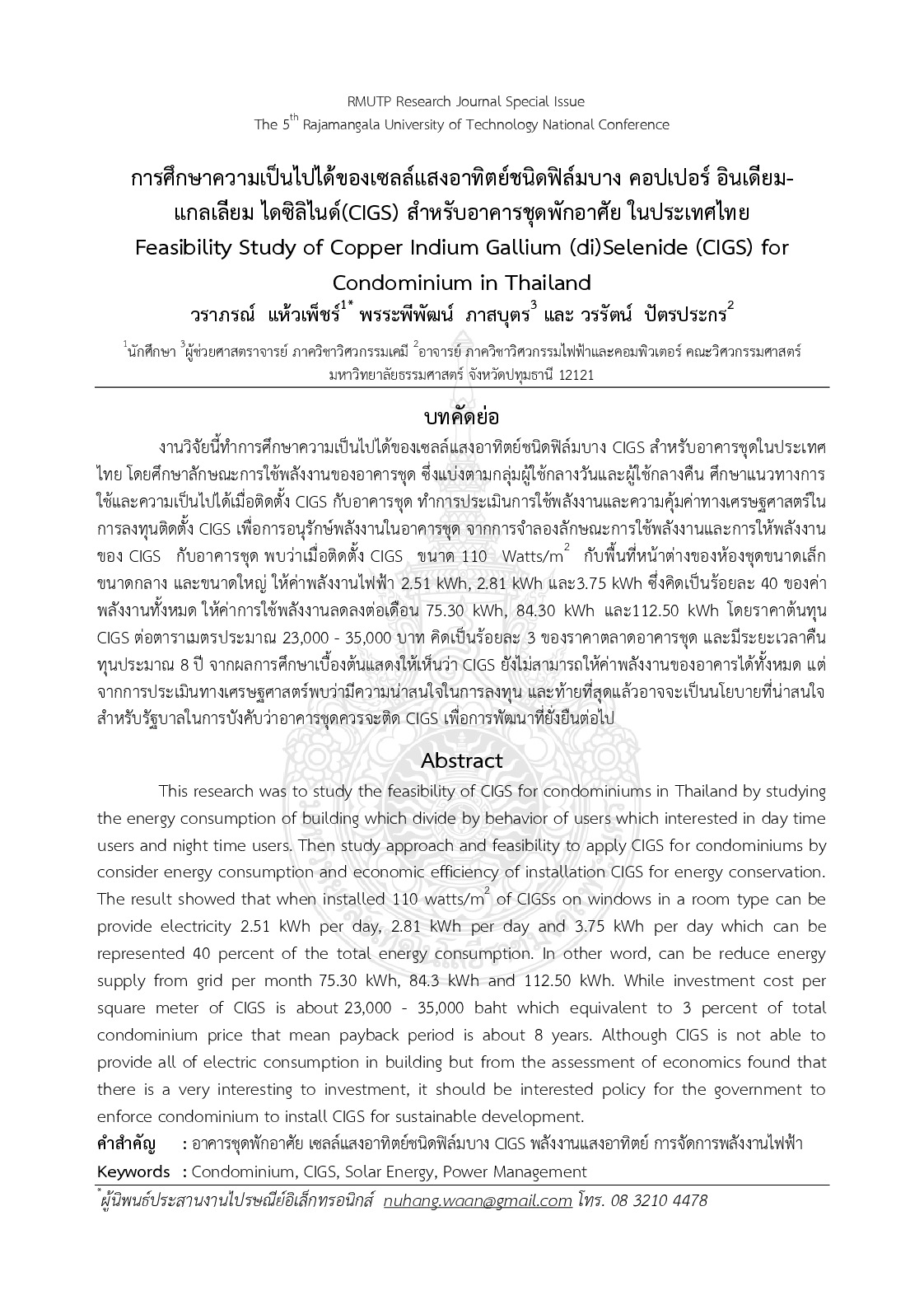
Feasibility study of copper indium gallium (di)selenide (CIGS) for condominium in thailand
This research was to study the feasibility of CIGS for condominiums in Thailand by studying the energy consumption of building which divide by behavior of users which interested in day time users and night time users. Then study approach and feasibility to apply CIGS for condominiums by consider energy consumption and economic efficiency of installation CIGS for energy conservation. The result showed that when installed 110 watts/m2 of CIGSs on windows in a room type can be provide electricity 2.51 kWh per day 2.81 kWh per day and 3.75 kWh per day which can be represented 40 percent of the total energy consumption. In other word can be reduce energy supply from grid per month 75.30 kWh 84.3 kWh and 112.50 kWh. While investment cost per square meter of CIGS is about 23000 - 35000 baht which equivalent to 3 percent of total condominium price that mean payback period is about 8 years. Although CIGS is not able to provide all of electric consumption in building but from the assessment of economics found that there is a very interesting to investment it should be interested policy for the government to enforce condominium to install CIGS for sustainable development.
Cost of safety system in building construction
The goal of this study is to study the cost of safety system in building construction by studying multipurpose building with durable goods project. The cost of safety system in building construction is divided into two categories are the safety measure cost and the safety program cost in construction. From the study it is found out that the value of safety measure cost is approximately 1.85 % of a project cost and the value of safety program cost is approximately 0.98 % of a project cost. To sum up the cost of safety system in building construction is approximately 2.83 % of a project cost .Moreover the study found out that the safety measure cost is higher than the safety program cost about 1.88 as much. From the data of this study it can be used as the guideline in estimating the cost of safety system in building construction for the future project.