จำนวน Repository ( 61 )

Properties of footpaths slab agasse Ash Concrete
This research was aimed to studying the effect of bagasse ash on the properties of footpaths concrete slabs. Using bagasse ash a waste from the manufacture of ethanol instead of the OPC type I 10 20 30 40 and 50 percent by weight. Test results revealed that the compressive strength of concrete bagasse ash mixtures was less than the plain OPC type I concrete And decreased by the content of the bagasse ash. The flexure strength of the footpaths concrete slabs was laid in the same direction. Comparison flexure strength of footpaths concrete slabs on the standard (TIS 378-2531) found that can used 40% replacement of bagasse ash replacing in cement. For the percentage of water absorption of footpaths concrete slabs in bagasse ash concrete mixtures were higher than the plain OPC type I concrete mixture and every mixture is not exceeding standard. It was also found that the replacing cement with bagasse ash content increased the cost of footpaths concrete slabs were lower down. When replacing cement with bagasse ash in 40% cheaper than the cost of plain cement were up to 31% and according to the standard
Graphical method and database development for computer programming to reinforced concrete slab analysis and design
This research was to apply graphical method as the input data combined with using database for developing reinforced concrete slab analysis and design. Visual Basic language was used for creating the GUI (graphic user interface) and coding and database file was used for storing data. The position of beam column and slab can define by drawing on GUI and this program will automatic translate to be the distances for using as data in process of analysis and slab design. Results from analysis and design were compared with manual calculation that they are a litter bit error because of rounding error. Moreover they can be more economically and more conveniently than results from VisStructure 4
Development of concrete boat by using lightweight concrete
The objective of this study aims to develop a concrete boat by using lightweight concrete. The use of granular foam replaced the aggregate in various quantities to reduce the weight of boat. The replacement ratios of aggregate by the granular foam were 0 25 50 75 and 100% by volume of aggregate. The test results of compressive strength tensile strength modulus of rupture and unit weight of concrete were used to find out the appropriate mixture for producing the concrete boat. The results indicated that the appropriate mixture for producing concrete boat was the replacement of aggregate by granular foam at 100% which had the compressive strength at 28 days of 50.59 kg/cm2 and the unit weight was 949.71 kg/m3. The weight of lightweight concrete was lighter than the normal concrete about 57%. The prototype of lightweight concrete boat which had 1.04 m wide 2.20 m long and 0.38 m height had about 50 kg of weight. The maximum weight capacity of the boat was 240 kg. The cost of a lightweight concrete boat was about 650 baht
Effect of binders on shrinkage cracking behavior of concrete
This research was aimed to study the effect of binders on cracking behavior of high strength concrete under restrained shrinkage condition. The cracking behaviors of concrete that study were cracking age in uniaxially restrained shrinkage test shrinkage rate free shrinkage crack propagation and strength of concrete. The binders used in this study were fly ash and limestone powder. The weight percentage of replacement of cement by fly ash and limestone powder were 30 and 10% respectively. The water to binder ratios was 0.35. The results indicated that the influence parameters of shrinkage cracking were type of binder amount of free shrinkage shrinkage rate and tensile creep of concrete. The use of fly ash and limestone powder could reduce free shrinkage and shrinkage rate of concrete and result in the longer cracking age than cement-only concrete. The tensile creep of cement-only concrete was higher than that of limestone powder concrete and fly ash concrete respectively
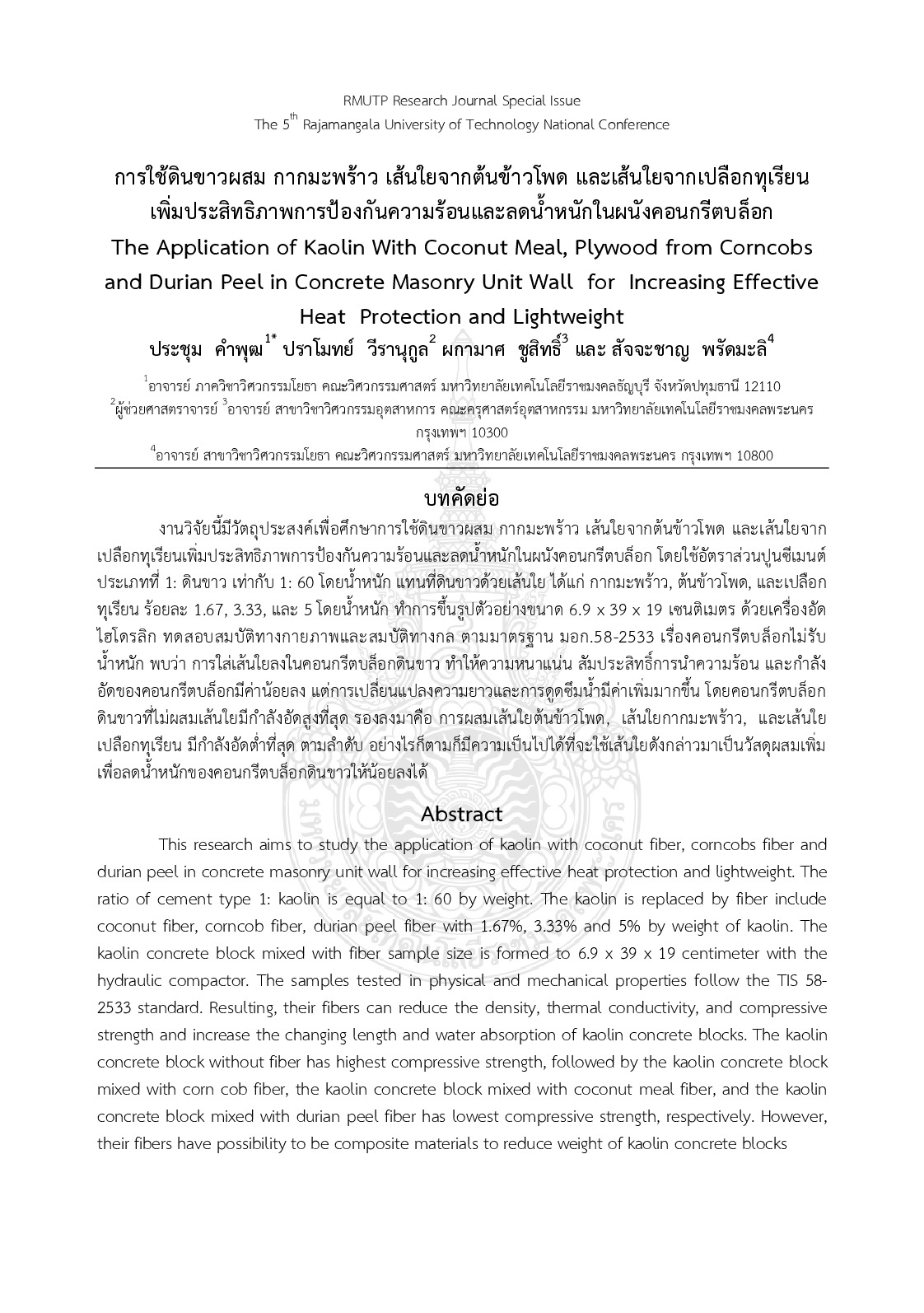
The application of kaolin with coconut meal, plywood from corncobs and durian peel in concrete masonry unit wall for increasing effective heat protection and lightweight
This research aims to study the application of kaolin with coconut fiber corncobs fiber and durian peel in concrete masonry unit wall for increasing effective heat protection and lightweight. The ratio of cement type 1: kaolin is equal to 1: 60 by weight. The kaolin is replaced by fiber include coconut fiber corncob fiber durian peel fiber with 1.67% 3.33% and 5% by weight of kaolin. The kaolin concrete block mixed with fiber sample size is formed to 6.9 x 39 x 19 centimeter with the hydraulic compactor. The samples tested in physical and mechanical properties follow the TIS 58-2533 standard. Resulting their fibers can reduce the density thermal conductivity and compressive strength and increase the changing length and water absorption of kaolin concrete blocks. The kaolin concrete block without fiber has highest compressive strength followed by the kaolin concrete block mixed with corn cob fiber the kaolin concrete block mixed with coconut meal fiber and the kaolin concrete block mixed with durian peel fiber has lowest compressive strength respectively. However their fibers have possibility to be composite materials to reduce weight of kaolin concrete blocks