จำนวน Repository ( 54 )

การออกแบบและพัฒนารูปแบบบรรจุภัณฑ์สำหรับผลิตภัณฑ์จากผ้าไหมสุรินทร์
This research work has the objectives to study the designing and development of package patterns products from Surin Silk: such as; silk materials homestead textile products men’s-women’s clothes and bag products. On this research the researcher had studied the context of the society in various weaving groups in Surin Province textile product patterns package patterns materials and techniques package production process in concordance with the intellects and production potentials of the community and the sampling group population in this research work subject is the people weaving group producing textile products of Surin Province and buyers of textile products made from Surin silk used in this research is weaving group of the Village of Takook Khewasinrin District Surin Province. Result of the research on this subject found that most of the populations make their livings in agriculture which is their primary occupation whereas weaving is their secondary occupation. Weaving group in Surin is desirous of having the packages for containing their textile products for their own group while management problems and hindrances of the group are found to be circulating capital and marketing as well as their lacks of knowledge and understandings in designing the packages. On designing the packages of Surin silk weaving group the researcher placed the emphasis focally on data analysis primarily on the weaving group due to the reason that the weaving group has a very limited production cost of the packages. The researcher adopted the participating active research method by exchanging ideas jointly working between the weaving group and the researcher in order to cause the problem analysis and find the ways in solving the problems and found that packages for containing Surin silk textile products must be in accordance with the specifications of the community product standard or One Tambon One Product (OTOP) where the pattern of production is not complicate; production cost is low; diversified goods can be contained in; goods contained in the package can be seen; the package is durable; can well cover the goods and express the specific identity of the group. It can be concluded that the package pattern is the exotic and novel pattern of its kind. The box and covering package exclusively of each unit is suitable for a show and transportation of the goods. Primary materials used as the structures of the package are papers and plastic sheets manually shaping up the structures of the package both by the method of gluing and ungluing. Package graphic expressing the unique identity specifically of the group is the mixture of the cloth designs and the weaving equipments by lessening the details in order to facilitate the shortening of the designs to their smaller sizes that will be a lot easier for printing process and must be easily communicable with the consumers by fully expressing the unique identity of Surin Province. On the part of the indication on and the details of the goods it shall be in accordance with the specifications of the OPTOP standard. The graphic production technique is by way of photocopying print by printer on papers or stickers and silkscreen printing. Obviously such technique is an economized technique which can help reduce the production cost which evidently is harmoniously compatible with the potentials and resources available in the community.
การพัฒนาลวดลายผ้ามัดหมี่ : กรณีศึกษาเส้นกรอบนอกของปราสาทศีขรภูมิเพื่อนำมาใช้ในการออกแบบลายผ้า
The aims of this study are to 1.) develop a new woven Mudmee pattern which inspired by optical art integrated with the silhouette of Prasat Si Khoraphum in Surin province 2.) use the developed Mudmee pattern to improve clothing design influenced from 1960s fashion 3.) test the satisfaction level of the finished Mudmee clothes from the sample group. There are 7 textiles professionals including pattern designers textile artists Mudmee textile specialists and 5 fashion designers as supervisors in screening the patterns and designs. The sample group is selected from the staffs who work in Rajaphat Surindra University and Rajamangala Northeast (Surin Campus). The tool in this research are the fabric pattern sketches inspired by optical art integrated with the silhouette of Prasat Si Khoraphum the 1960 fashion clothing design sketches and the satisfaction survey. The satistical package for the social science program was employed fro mean and percentage. This study found that the most selected designs from 7 textiles professionals were Pra Sart Moom Soong 1 pattern Nammatam1pattern and Rekhakanit 4 pattern. There were 9 jacket sketches that had been selected. The level of satisfaction on the clothing design from 1960 era of 213 women staff who work in Rajabhat Surindra University and Rajamangala Northeast University (Surin Campus) showed that the Pra Sart Moom Soong 1 pattern gained the highest level of satisfaction (4.78) The Rekhakanit 4 pattern was the most aesthetics pattern (4.70). Finally the sample group satisfied the color and pattern of Nammatam1 the most (4.73). In Chon-Phoa group the most aesthetic jacket patterns were Pra Sart Moom Soong 1 (4.67) and Nammatam1 (4.70). While the Rekhakanit 4 pattern appeared to has the highest level of correlation between pattern and clothing design (4.74). In the uniform group the most aesthetic 1960 jackets pattern were Pra Sart Moom Soong 1 (4.74) and Nammatam1 (4.71). While the Rekhakanit 4 pattern appeared to has the highest level of correlation between pattern and clothing design (4.73). In Art and Fashion group highest level of correlation between pattern and clothing designs for each pattern were Pra Sart Moom Soong 1 pattern(4.67) Rekhakanit 4 pattern (4.69) and Nammatam1 (4.70).
การศึกษาเปรียบเทียบเทคนิควิธีการมัดย้อมเพื่อพัฒนาลวดลายผลิตภัณฑ์ผ้ามัดย้อม
The purposes of this research were 1) the comparison of tie-dye methods; Binding technique folding technique and stitching technique and 2) three kinds of fabric dyed; cotton linen and rayon comparison and 2 pattern design groups; geometrics and naturalistic patterns. There are 8 motifs were used; quadrangle trianglecircle heart form flower leaf butterfly and worm. The research tools were used; The assessment for 15 connoisseurs (connoisseurship model). Data were analyzed by the statistical package for the social science program and using mean percentage standard deviation one-way ANOVA and chi-square.The result of the study were that binding technique had mean 4.20the second was stitching technique had mean 4.10 and the last was folding technique had 3.69. The result of the tie-dye technique suitability comparative ranking for massproduct that the best technique is binding. The second was stitching technique and the last was folding technique. In this study there were comparative in 5 parts as follows 1.tie-dye method 2. pattern design 3. colour of fabric dyed 4. overall image of fabric dyed 5. capability of techniques.Binding technique folding technique and stitching technique on Cotton were much points in tie-dye method and capability of techniques. Binding technique and stitching technique on Cotton were much points in pattern design and overall image of fabric dyed. Binding technique and stitching technique on Linen were much points in 5 parts. Folding technique on Linen were much points especially in tiedye method and capability of techniques. Binding technique and stitching technique on Rayon were much suitable in 5 parts. Folding technique on Rayon were much especial points in 5 parts except overall image of fabric dyed. Comparison of three kinds of fabric and two pattern groups were that cotton linen and rayon fabrics in geometrics and naturalistic patterns had average the best in binding technique. To compare tie-dye techniques and fabrics and pattern groups had different for some parts statistically significant at level of .05
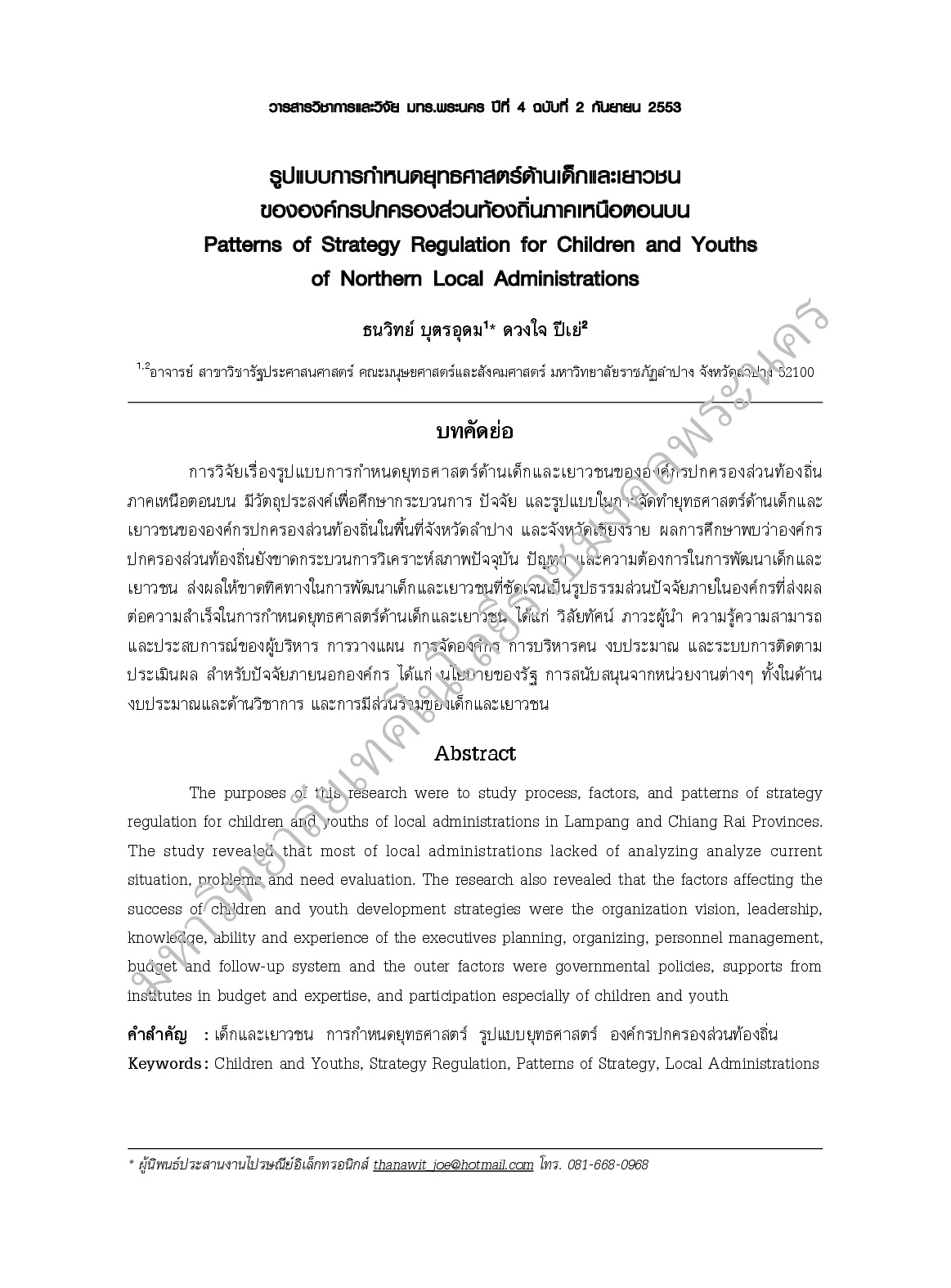
รูปแบบการกำหนดยุทธศาสตร์ด้านเด็กและเยาวชนขององค์กรปกครองส่วนท้องถิ่นภาคเหนือตอนบน
The purposes of this research were to study process factors and patterns of strategy regulation for children and youths of local administrations in Lampang and Chiang Rai Provinces. The study revealed that most of local administrations lacked of analyzing analyze current situation problems and need evaluation. The research also revealed that the factors affecting the success of children and youth development strategies were the organization vision leadership knowledge ability and experience of the executives planning organizing personnel management budget and follow-up system and the outer factors were governmental policies supports from institutes in budget and expertise and participation especially of children and youth
The Comparative Study of Tie-Dye Methods for Pattern Design Development of Tie-Dye Products
The purposes of this research were 1) To compare to the distinctly motifs of Tie-dye methods: binding technique folding technique and stitching technique. 2) To compare the dyeing results of the characteristics of cotton linen and rayon in geometrics patterns design group and naturalistic patterns design group. There are 8 motifs were used; quadrangle triangle circle heart form flower leaf butterfly and worm. The research Instruments were used; 1) tie-dye fabrics dyed in 3 tie-dye methods. The tie-dye methods were bind fold and stitch amount of 120 pieces 2) The assessment for 15 connoisseurs (connoisseurship model). Data was analyzed by the statistical package for the social science program and using mean percentage standard deviation one-way ANOVA (Scheffe) and chi-square. The results of the study were found that binding technique was at mean 4.20 including stitching technique at mean 4.10 and folding technique at mean 3.69. The best technique was binding technique because this technique could produce products in a large quantity. The stitching technique was aesthetic elegant and valuable. The folding technique could produce many patterns in one time. Binding technique folding technique and stitching technique on cotton were much suitable in tie-dye method and capability of techniques. Binding technique and stitching technique on cotton were much suitable in pattern design and overall image of fabric dyed. Binding technique and stitching technique on linen were much suitable in 5 parts. Folding technique on linen were much especial suitable in tie-dye method and capability of techniques. Binding technique and stitching technique on rayon were much suitable in 5 parts. Folding technique on rayon were much especial suitable in 5 parts except overall image of fabric dyed. Comparison of three kinds of fabric and two pattern groups were that geometrics and naturalistic patterns on cotton linen and rayon fabrics had average the best in binding technique. To compare tie-dye techniques and fabrics and pattern groups had different for some parts statistically significant at level of .05 This study was the experimental methods of tie-dye and 3 kinds of fabrics; cotton linen and rayon. The method of dyed in the study was vat dye (Indigo dye) the result found that the best fabric absorption dyed was rayon the second best fabric absorption dyed was cotton and linen. The vat dye in different kinds of fabric were dyed at the same quantity. They were dyed in the nearly different shade. Rayon was the best dye than another kind. Cotton and linen were dyed as the same shade.