จำนวน Repository ( 55 )
Design and Product Development Ceramics Using for Making Wall of Energy Conservation Building
This research aims to study and develop ceramics material using in the wall construction which can be used to proof the heat and water reduce absorbed humidity in the building. The product can save the energy especially the building which is set the air conditioning. The experiment found that the proportion of clay body can be developed and the result of thermal conductivity (K- value) was 0.111 W/ m. /K the permeability was 7 percent the glaze can be used to proof water. The product was compared to three kinds of construction materials which are brick concrete masonry unit and autoclaved aerated concrete found that K- value and permeability were lower. Moreover it can proof water and save more energy for the air conditioning building.

Risk Assessment of Damages for Equipments in the Building
This paper presents risk assessment of damages for equipments in the building based on IEC standards and ITU-T recommendations. The study of risk assessment of damages for equipment in the building includes of 6 main topics: calculation of frequency of damages due to lightning discharges calculation of risk of damage calculation of risk areas estimation of probability factors consequential damage factor acceptable risk levels and mitigation methods to reduce the influence of power line induction affecting to equipment. Also the implementations of surge protective devices (SPDs) at the entrance of power lines into the building contribute to a further decrement of damage.
ปัจจัยที่ส่งผลต่อความล่าช้าของโครงการก่อสร้าง
The research is aimed to 1) study the level and priority of the factors affecting the delay of construction projects and 2) provide suggestions in relation to the prevention of such delay. The sample is 520 people who were working for different construction projects. They were project managers project engineers field engineers and foremen. The data were collected by using online questionnaires and analyzed to find out mean standard deviation (SD) frequency correlation coefficient and confirmatory factor analysis. The findings reveal two significant aspects. First those who were working in the construction projects concerned about the factors affecting the delay of the projects at high level. Respectively the factors related to design resource external factors and others were taken into consideration. The factor regarding to work performance is regarded affecting the project delay at the highest level. Other factors i.e. the design external factors and others and resource have the affects at the lower level. Second the work-related factors can help prevent the project delay. In other words the construction plan and methods as well as the project management should be well-implemented in accordance with the design. The construction site should be on inspection considering its drawing. Regarding the external factors and others the public voices of those living around the construction site should be taken into consideration. Furthermore the effective use of the resources can be carried out by sufficiently preparing all materials tools and equipment for constructing any project effectively as a consequence.
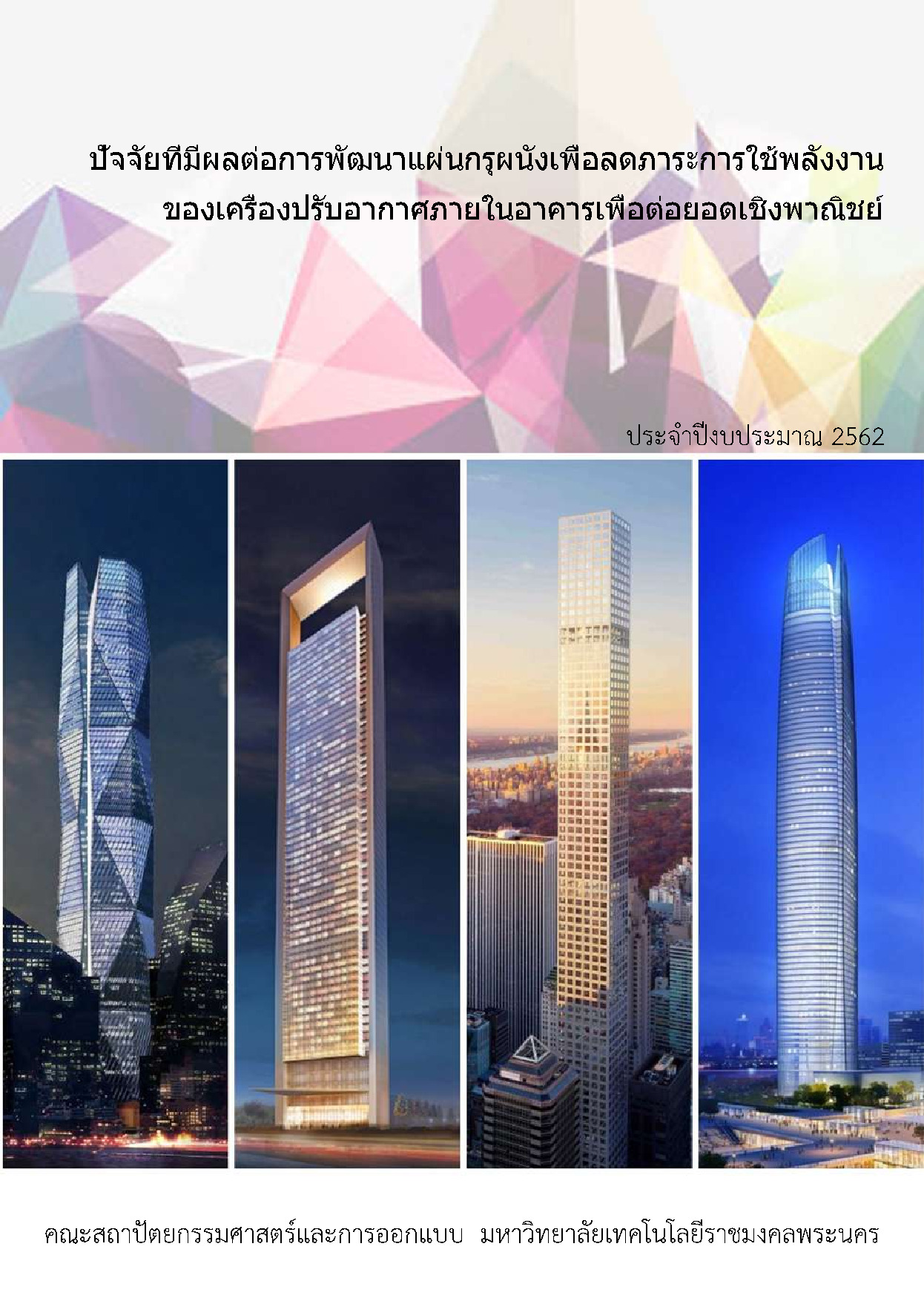
ปัจจัยที่มีผลต่อการพัฒนาแผ่นกรุผนังเพื่อลดภาระการใช้พลังงานของเครื่องปรับอากาศภายในอาคารเพื่อต่อยอดเชิงพาณิชย์
This research approach to study the development of interior wall for reduce energy consumption by air conditioning in the building. In order to be a prototype in the development of an industrial system for the export of green architecture in order to generate income for the community or entrepreneurs to bring money into the country to upgrade the industrial economy to be sustainable It is an architectural material that is compatible with the weather in Thailand. It can be used as a guideline for people interested in applying it to their own home building or disseminating through various media to reduce energy costs for a comfortable living. The objective is to study the factors that affect the development of wall paneling in order to reduce the energy burden of the air conditioner in the building in order to further the commercial production. The researcher collected data for the past 6 months not including other thermal energy. Used to calculate the energy consumption index for 2 building groups it was found that the electricity consumption of green buildings were 531100 kilowatt hours. And an average of 5.31 kilowatt hours per square meter While the non-green building has an average of 653360 kilowatt hours. And an average of 6.53 kilowatt hours per square meter As for the results of the data analysis the damage level is mostly at level 1 which is the wall surface and no obvious damage. Especially the 4th and 5th height is 1.55 meters and 1.85 meters from the floor level in the building. Damage level 3 is found at the height level 3 at a height of 1.00 meters from the floor level in the building. Assessment of damage caused to the interior wall of the building that occurred in 3 levels. The results of the data analysis showed that most damage levels were at level 1 namely the wall surface without obvious damage. Especially the 4th and 5th height is 1.55 meters and 1.85 meters from the floor level in the building. Damage level 3 is found at the height level 3 at a height of 1.00 meters and from the results of collecting moisture content in the exterior wall materials And analyzed to find the average for each of the 5 levels of height which are 0.55 meters 0.75 meters 0.95 meters 1.55 meters and 1.85 meters found that the buildings have different moisture content in each wall level (p <0.05). In conclusion this green building index equation can be applied to other buildings to reduce energy consumption and meet the standards of the green building. From the equation the electricity consumption can be predicted using the electricity usage index and systematically designed energy management in buildings. The area with the most damage will find the humidity in the range of 47% -98% the highest damage level 3 at an elevation of 0.80 meters from the floor level in the building
พัฒนาวัสดุคอมโพสิตพรุนจากดินลูกรังและทรายผสมพลาสติกเป็นวัสดุกรอง
จากการทดลองวิจัยพบว่าดินเป็นชั้นคุณภาพ A4 ประเภทของดินทรายแป้ง (Silty Soils) ผลการขึ้นรูปตามอัตราส่วนของ ดินลูกรัง – พลาสติก-ทราย ดินลูกรังและทรายที่ไมมีเรซินเป็นตัวประสานไมสามารถขึ้นรูปได้ และ ดินลูกรังและทรายที่มีเรซิน น้อยกว่า 20 % ไม่สามารถขึ้นรูปได้เนื่องจากปริมาณตัวประสานไมสามารถยึดเกาะกันระหว่างมวลกับพลาสติก กำลังอัดของ คอมโพสิตพรุน ขนาด 1 CM. สามารรับกำลังอัดตำสุดที่สามารขึ้นรูปและทดสอบได้อยู่ที 0.67 Ksc. และสูงสุดอยู่ที 6.37 Ksc. กำลังอัด คอมโพสิตพรุน ขนาด 2 CM. สามารรับกำลังอัดตำสุดที่สามารขึ้นรูปและทดสอบได้อยู่ที 2.1 Ksc. และสูงสุดอยู่ที 79.1Ksc.คอมโพสิตพรุน ขนาด 3 CM. สามารรับกำลังอัดตำสุดที่สามารขึ้นรูปและทดสอบได้อยู่ที 6.77 Ksc. และสูงสุดอยู่ที 132.03Ksc.คอมโพสิตพรุนขนาด 4 CM. สามารรับกำลังอัดตำสุดที่สามารขึ้นรูปและทดสอบได้อยู่ที 4.6 Ksc. และสูงสุดอยู่ที 138.17Ksc. คอมโพสิตพรุน 5 CM. สามารรับกำลังอัดตำสุดที่สามารขึ้นรูปและทดสอบได้อยู่ที 22.3 Ksc. และสูงสุดอยู่ที 143.20 Ksc.ความสามารถในการดูน้ำความชื่นลดลงตามปริมาณเรซิ่นที่เพิ่มขึ้นตำสุดที่สามารขึ้นรูปและทดสอบได้อยู่ที 0.0%. และสูงสุดอยู่ที 20.02% อ๊อกซีเจนในน้ำ (Dissolved) ของดินคอมโพสิตพรุน ทุกขนาก มีค่ามากกว่า 3 ปลอดภัย นำไปใช้เป็นวัสดุเพิ่มค่า อ๊อกซีเจนในน้ำเลียงสัตว์น้ำได้ อัลคาไลนิตี้ (Total alkalinity) kH ค่าทีน้อยทีสุดได้สูงสุดอยู่ที่ 238 มิลิกรัมต่อลิตร สูงสุดอยู่ที 549 มิลิกรัมต่อลิตร ทุกอัตราส่วนไม่สามารถ ลดค่าแอมโมเนีย (Ammonium) ให้ได้ตามมาตราฐาน ค่า ไนไตรท์ (Nitrite) ทุกอัตราส่วนสามารถ ลด ได้ตามมาตราฐาน ค่า PH กรด-ด่าง (PH indicator strips) เป็นตามมาตราฐาน 6.50-8.50 ค่าอยู่ที่ 7 – 9 ดังนั้นการเลื่อกใช้งานให้เหมาะกับคุณสมบัตของวัสดุแต่ละขนาดและอัตราส่วนผสม