จำนวน Repository ( 83 )

Nutritive values evaluation of moringa leaves meal for broiler feed ingredient
Nutritive values moringa leaves meal were evaluated and compared with luecaena leaves meal which has similar chemical compositions in order to use moringa leaves meal as broiler chicken feed ingredient. Thirty 3-week old chickens were divided into 3 groups of 10 birds (5 males 5 females) each. Each chicken was randomly fed with experimental diet that was composed with cassava powder (for endogenous nitrogen analysis) powdered moringa Leaves meal and powdered luecaena Leaves meal. The chickens were raised individually in metabolic cage where feed and water were provided ad libitum and both feed intake and feces weight were recorded. Experimental diets and excreta were sampled and subjected to proximate analysis for chemical compositions and gross energy. T-test comparison was used for statistical analysis. Results indicated that nutrients utilization of moringa Leaves meal (utilization percentage of dry matter organic matter protein crude fiber nitrogen free extract energy and metabolizable energy) were higher than those of luecaena Leaves meal (P<0.01). However there was no statistical difference (P>0.05) between moringa Leaves meal and luecaena Leaves meal in utilization percentage of ether extract. Moreover usable energy of moringa leaves meal was also higher than that of luecaena leaves meal (p<0.01). Therefore moringa Leaves meal could be one of potential feedstuffs for use in broiler diet production.
The reduction of organic compounds by using the biological reaction substance of the effluents from palm oil mill to produce singe cell protein
The objectives of this research were to study the reduction of organic compounds by the biological action substance of the effluents from palm oil mil to produce singe cell protein. The wastewater taken from the third pond of the wastewater treatment system which was already used for biogas production was found to have pH 6.5. The organic matter like COD (3679 mg/L) Oil& grease (133 mg/L) as well as the total solids and the minerals were much lower than those of the decanter effluent. The reduction of organic compounds by using the biological action by Candida tropicalis TISTR 5146 5045 and C. lipolytica TISTR 5151 were studied. The results indicated that C. tropicalis TISTR 5146 which was cultivated in palm oil mill at initial pH 5.5 and diluted with water to the ratios of 1:5 at agitation on the shaker of 150 rpm at room temperature gave the highest yield of biomass of 2.52 g/L and COD reduction of 94.38 % after 3 days of cultivation. The optimal condition for C. tropicalis TISTR 5146 cultivation was that the ratio of palm oil mill effluent to diluted water was 1:5 containing 10 g/l glucose and 10 g/l yeast extract at initial medium pH 5.5 in the shaking flask of 150 rpm at room temperature. The highest biomass obtained was 12.53 g/L while the cell consisted of protein and fat for 43.12 % and 0.34 % respectively.
Hazards of reused cooking oil
Reused cooking oil is the oil which is used more than one time and contains less than 25% (by weight) of polar compounds. Degenerative reused cooking oil is the oil which is used more than two times and contains more than 25% (by weight) of polar compounds. Major raw material of fried foods is oil. Therefore usefulness of consumed fried foods depends on the quality of cooking oil. When the oil is heated up while cooking chemical change occurs due to the reactions of hydrolysis oxidation and polymerization. These reactions cause degeneration of the oil i.e. black color rancid smell lower smoke point bubbled increased viscosity and generation of toxic substances called polar compounds. This substance can cause high blood pressure heart disease and coronary artery disease. Furthermore the reused cooking oil also contains polycyclic aromatic hydrocarbons (PAHs) - toxic mutagens which can cause cancer.
Development on the use of oil palm fronds as roughage feed source for thai native cattle
An experimental design was a completely randomized design (CRD). Fifteen Thai native cattle were randomly allocated into 5 treatment groups with 3 animals in one group and one cattle was one replication assigning to be fed with various roughages: (1) fresh Napier grass (NP) (2) fresh oil palm fronds (OPF) (3) oil palm fronds silage (4) OPF silage with 2% of molasses and (5) NaOH treated OPF (1.5% by weight OPF). All treatments were supplemented with concentrate feed consisting of 14% of crude protein at the rate of 1% of live weight (BW). The experimental period was 120 days. The data were analyzed with analysis of variance and mean comparisons among treatments were Duncan’s multiple range test (DMRT). The results showed that no significant differences (p>0.05) were observed among 5 treatments in feed intake of dry matter digestibility of crude protein digestibility of neutral detergent fiber feed conversion ratio and growth rates. However the lowest production cost for 1 kg gain was obtained from the cattle fed with NaOH treated OPF.
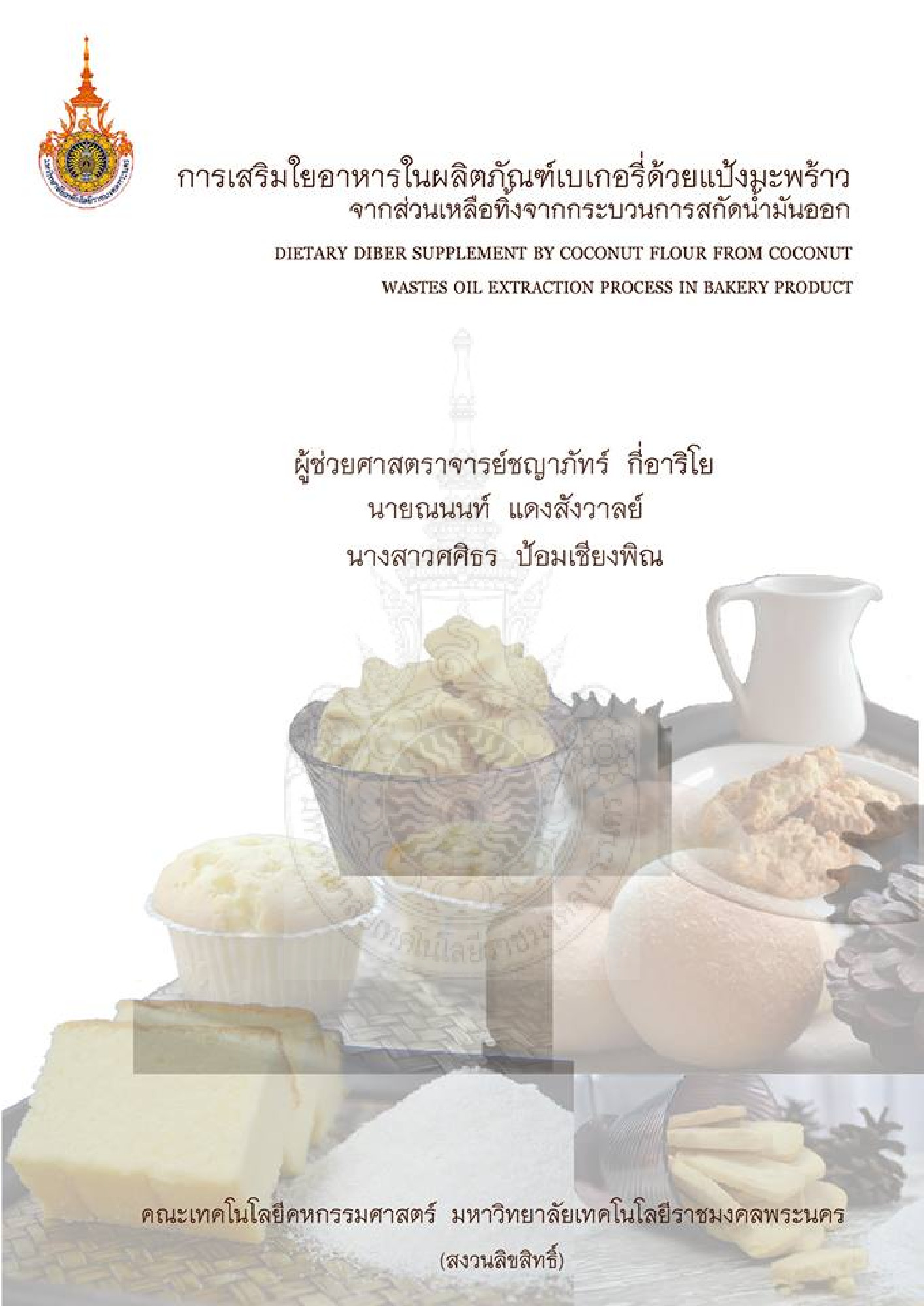
การเสริมใยอาหารในผลิตภัณฑ์เบเกอรี่ด้วยแป้งมะพร้าวจากส่วนเหลือทิ้งจากกระบวนการสกัดน้ำมันออก
The studies of Dietary Fiber Supplement by coconut flour from coconut Wastes Oil Extraction process in Bakery Product was investigated Production of coconut flour from coconut wastes oil extraction drying at 55 ° C for 12 hours and then grinding to powder gave the off-white fine powder. The chemical compositions of coconut flour were 57.70 % carbohydrate 29.4 % fat 6.23 % moisture 5.20 % protein and 1.48 % ash by dye weigh. Butter cake making experiment by substitution of wheat flour with coconut flour at 5 % of wheat flour weigh which has the highest sensory scores comparing butter cake with the control found that increase dietary fiber 1.34 g. /100 g. The majority of the tested consumers (92%) accepted butter cake with 5 % of coconut flour substitution. Muffin making experiment by substitution of wheat flour with coconut flour at 15 % of wheat flour weigh which has the highest sensory scores comparing muffin with the control found that increase dietary fiber 2.34 g /100 g. The majority of the tested consumers (81%) accepted muffin with 15 % of coconut flour substitution. Cornflake cookie making experiment by substitution of wheat flour with coconut flour at 20 % of wheat flour weigh which has the highest sensory scores comparing cornflake cookie with the control found that increase dietary fiber 3.54 g. /100 g. The majority of the tested consumers (94 %) accepted cornflake cookie with 20 % of coconut flour substitution. Butter cookie making experiment by substitution of wheat flour with coconut flour at 10 % of wheat flour weigh which has the highest sensory scorescomparing butter cookie with the control found that increase dietary fiber 3.04 g. /100 g. The majority of the tested consumers (94 %) accepted Butter cookie with 10 % of coconut flour substitution. Frozen cookie making experiment by substitution of wheat flour with coconut flour at 20 % of wheat flour weigh which has the highest sensory scores comparing cookie with the control found that increase dietary fiber 4.02g. /100 g. The majority of the tested consumers (93 %) accepted 20 % of coconut flour substitution. Butter bread making experiment by substitution of wheat flour with coconut flour at 15 % of wheat flour weigh which has the highest sensory scores comparing butter bread with the control found that increase dietary fiber 2.22 g. /100 g. The majority of the tested consumers (75 %) accepted 15% of coconut flour substitution. Whole wheat bread making experiment by substitution of wheat flour with coconut flour at 15 % of wheat flour weigh which has the highest sensory scores comparing whole wheat bread with the control found that increase dietary fiber 2.09 g. /100 g. The majority of the tested consumers (79 %) accepted 15 % of coconut flour substitution. Pie crust making experiment by substitution of wheat flour with coconut flour at 15 % of wheat flour weigh which has the highest sensory scores comparing pie crust with the control found that increase dietary fiber 2.91 g. /100 g. The majority of the tested consumers (82 %) accepted 15 % of coconut flour substitution.