จำนวน Repository ( 75 )
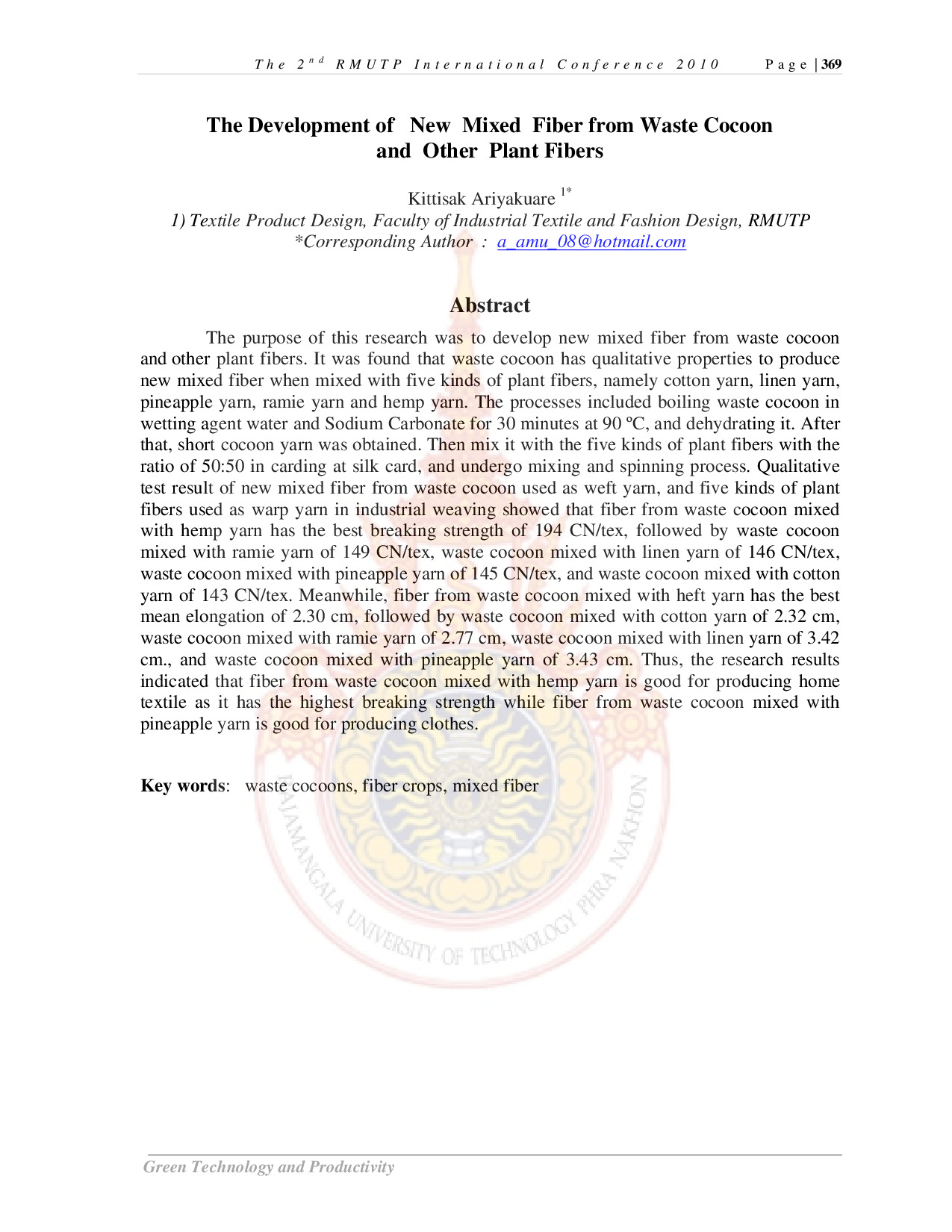
The Development of New Mixed Fiber from Waste Cocoon and Other Plant Fibers
The purpose of this research was to develop new mixed fiber from waste cocoon and other plant fibers. It was found that waste cocoon has qualitative properties to produce new mixed fiber when mixed with five kinds of plant fibers namely cotton yarn linen yarn pineapple yarn ramie yarn and hemp yarn. The processes included boiling waste cocoon in wetting agent water and Sodium Carbonate for 30 minutes at 90 ºC and dehydrating it. After that short cocoon yarn was obtained. Then mix it with the five kinds of plant fibers with the ratio of 50:50 in carding at silk card and undergo mixing and spinning process. Qualitative test result of new mixed fiber from waste cocoon used as weft yarn and five kinds of plant fibers used as warp yarn in industrial weaving showed that fiber from waste cocoon mixed with hemp yarn has the best breaking strength of 194 CN/tex followed by waste cocoon mixed with ramie yarn of 149 CN/tex waste cocoon mixed with linen yarn of 146 CN/tex waste cocoon mixed with pineapple yarn of 145 CN/tex and waste cocoon mixed with cotton yarn of 143 CN/tex. Meanwhile fiber from waste cocoon mixed with heft yarn has the best mean elongation of 2.30 cm followed by waste cocoon mixed with cotton yarn of 2.32 cm waste cocoon mixed with ramie yarn of 2.77 cm waste cocoon mixed with linen yarn of 3.42 cm. and waste cocoon mixed with pineapple yarn of 3.43 cm. Thus the research results indicated that fiber from waste cocoon mixed with hemp yarn is good for producing home textile as it has the highest breaking strength while fiber from waste cocoon mixed with pineapple yarn is good for producing clothes.
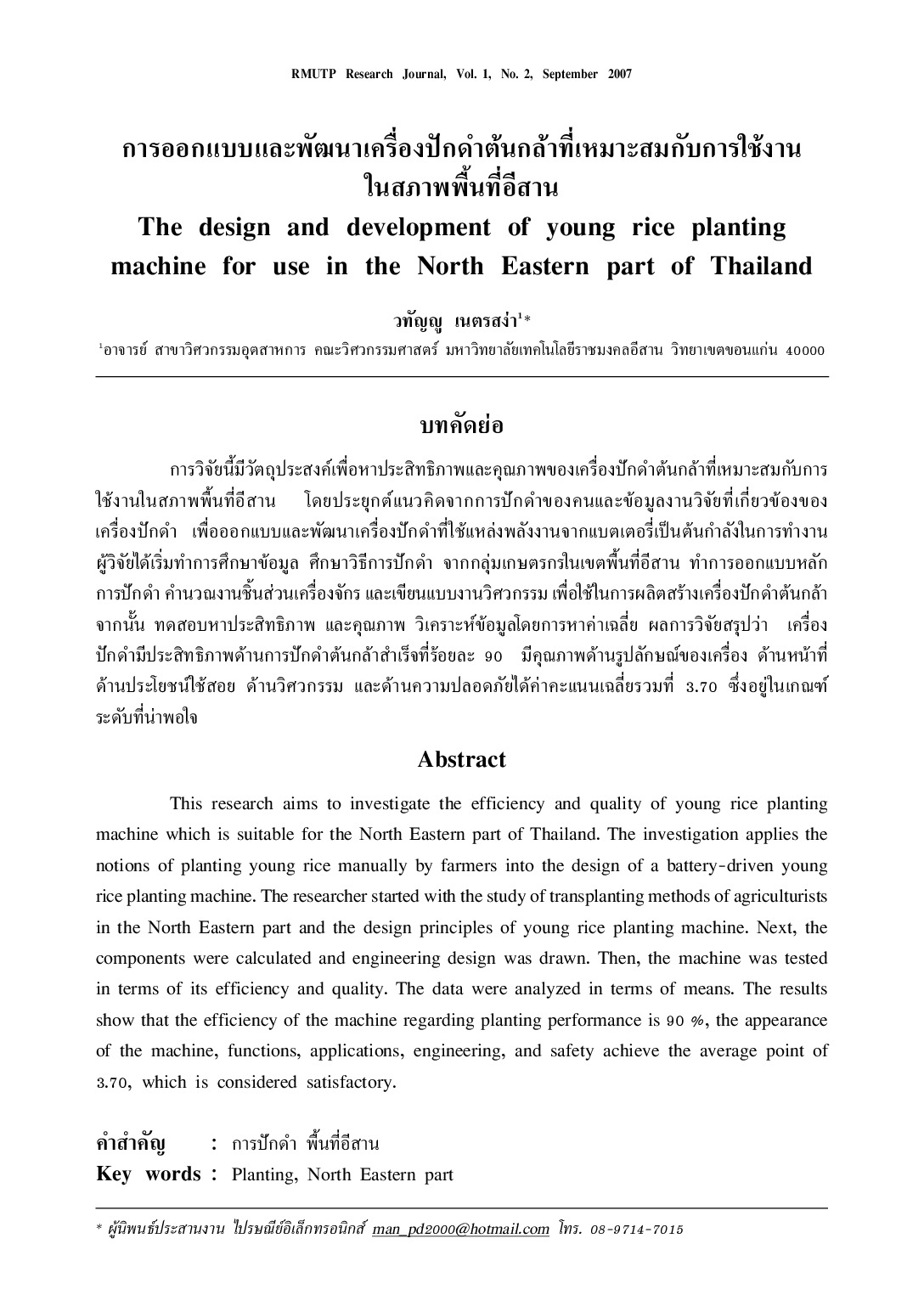
The design and development of young rice planting machine for use in the North Eastern part of Thailand
This research aims to investigate the efficiency and quality of young rice planting machine which is suitable for the North Eastern part of Thailand. The investigation applies the notions of planting young rice manually by farmers into the design of a battery-driven young rice planting machine. The researcher started with the study of transplanting methods of agriculturists in the North Eastern part and the design principles of young rice planting machine. Next the components were calculated and engineering design was drawn. Then the machine was tested in terms of its efficiency and quality. The data were analyzed in terms of means. The results show that the efficiency of the machine regarding planting performance is 90 % the appearance of the machine functions applications engineering and safety achieve the average point of 3.70 which is considered satisfactory.
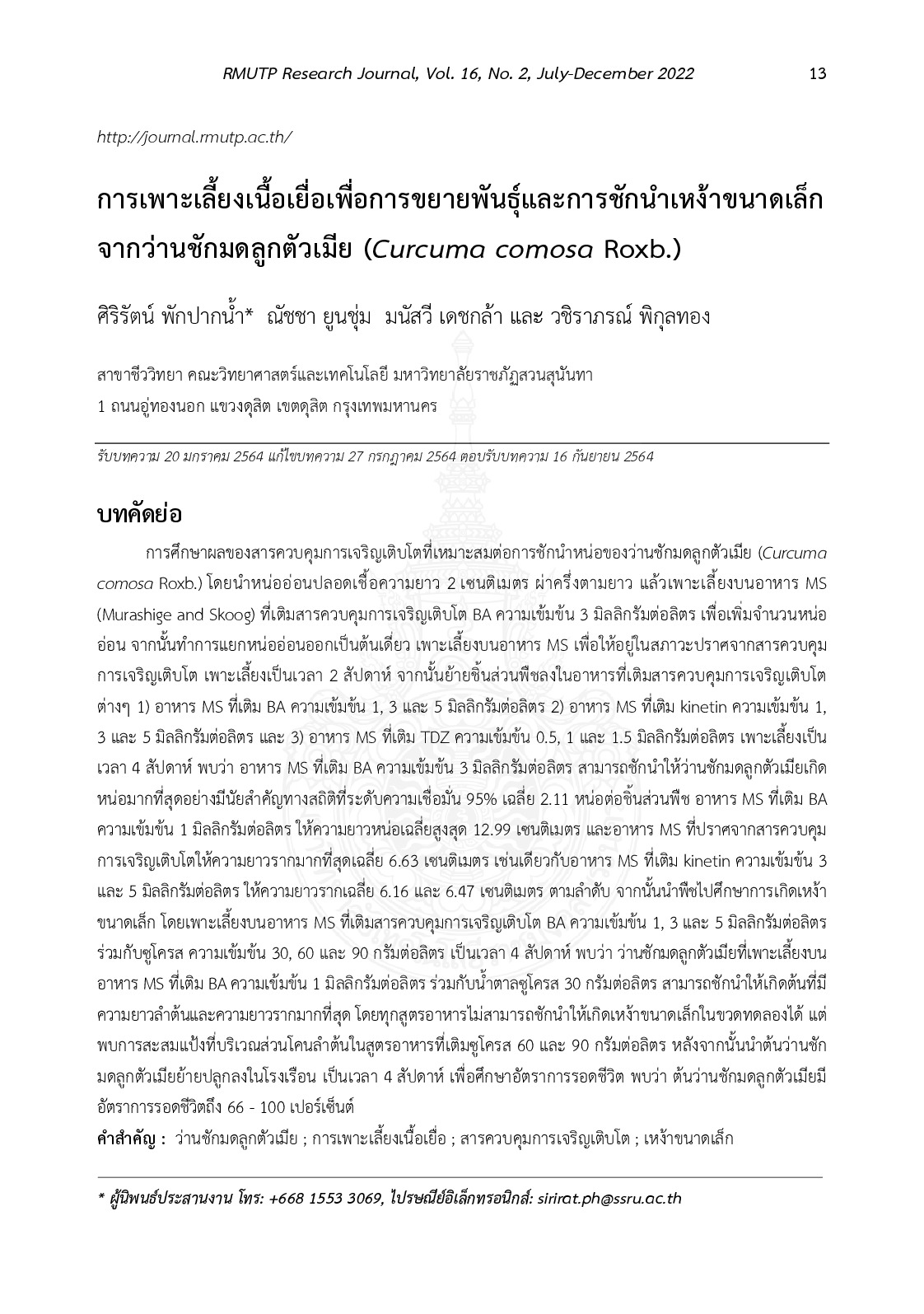
การเพาะเลี้ยงเยื่อเพื่อการขยายพันธุ์และการชักนำเหง้าขนาดเล็กจากว่านชักมดลูกตัวเมีย Curcuma comosa roxb
This study was conducted to determine the effects of plant growth regulators on in vitro propagated plantlets and microrhizome inductions of Curcuma comosa Roxb. for an efficient development of plant regeneration. In vitro sprouted shoots (2 cm length) of C. comosa were incised in longitudinal section and subcultured on MS media supplemented with 3 mg/L BA for shoot multiplication and plant regeneration. Subsequently the regenerated plants were transferred to MS medium with various concentrations of plant growth regulators; BA (1 3 5 mg/L) kinetin (1 3 5 mg/L) and TDZ (0.5 1 1.5 mg/L). The result showed that MS medium supplemented with 3 mg/L BA was the most effective in shoot induction with the significantly maximum average number of 2.11 shoot buds per responding explant. Moreover MS medium supplemented with 1 mg/L BA produced the longest average of shoot bud explants (12.99 cm) while the basal MS medium induced the longest average of root multiplication (6.63 cm). Furthermore microrhizome induction was produced under in vitro conditions derived young shoot buds upon transfer to MS medium containing various combinations of 1 3 and 5 mg/L BA and 30 60 and 90 g/L sucrose concentrations. The optimum combination in the induction of significantly highest average length of both stem (18.32 cm) and root (7.52 cm) multiplication was obtained on MS basal medium supplemented with 1 mg/L BA and 30 g/L sucrose for 4 weeks. Although microrhizome formation was not produced by the different amount of BA and sucrose in induction medium starch accumulation was found at the base of the stem explants cultured on MS medium containing 60 and 90 g/L sucrose concentrations. Additionally in vitro propagated C. comosa plantlets through microrhizome induction were grown under greenhouse conditions for 4 weeks and further developed into normal plants resulting in successfully high survival rates of 66 – 100% in the cultivated C. comosa.
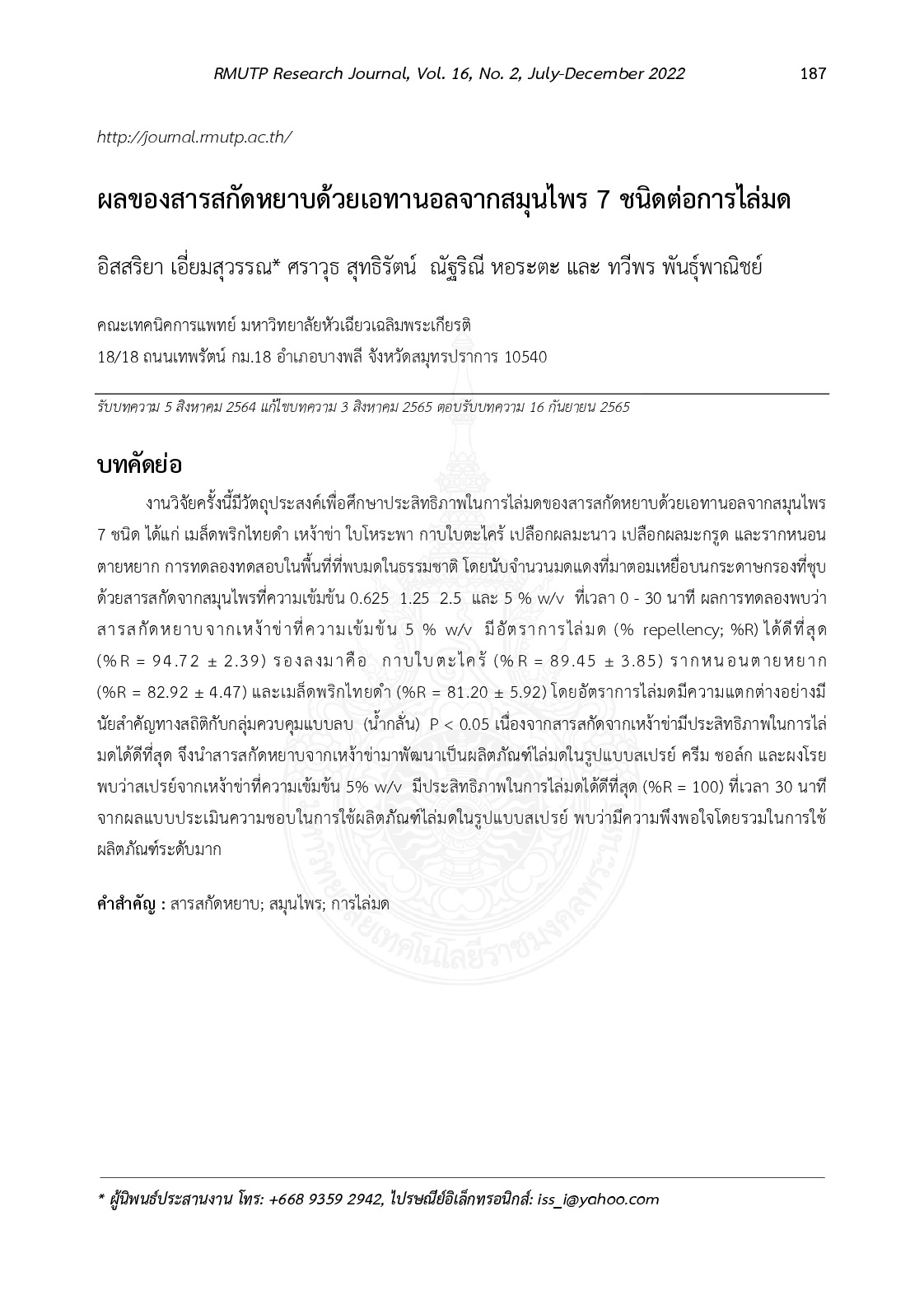
ผลของสารสกัดหยาบด้วยเอทานอลจากสมุนไพร 7 ชนิดต่อการไล่มด
This research aims to study the ant repellent effects of the crude ethanolic extracts from 7 herbs; Piper nigrum Linn. Alpinia galanga (L.) Willd Ocimum basilicum L. Cymbopogon citratus Stapf Citrus aurantiifolia (Christm.) Swingle Citrus hystrix DC and Stemona collinsae Craib. Whatman filter paper was dipped with each concentration of the crude ethanolic extracts (0.625 1.25 2.5 and 5 % w/v) and placing the bait on a treated filter paper. The experiments were conducted in the natural. The numbers of weaver ants were recorded at 0 - 30 minutes. From the results the crude ethanolic extracts at 5% w/v of A. galanga was the most effective for repellent the ant (repellent rate; %R = 94.72 ± 2.39) followed with C. citratus (%R = 89.45 ± 3.85) S. collinsae (%R = 82.92 ± 4.47) and P.nigrum (%R = 81.20 ± 5.92). The repellent rates of those crude ethanolic extracts were significantly difference from distilled water which use for the negative control (P < 0.05). The crude ethanolic extract of A. galanga at concentration 5% w/v was prepared as spray cream chalk and powder. At 30 minutes of the observation the ethanolic extracts of A. galanga spray was the best ant repellent effect (%R = 100). The result from questionnaires reveals that a spray preparation was the more satisfaction for the using ant repellent products.
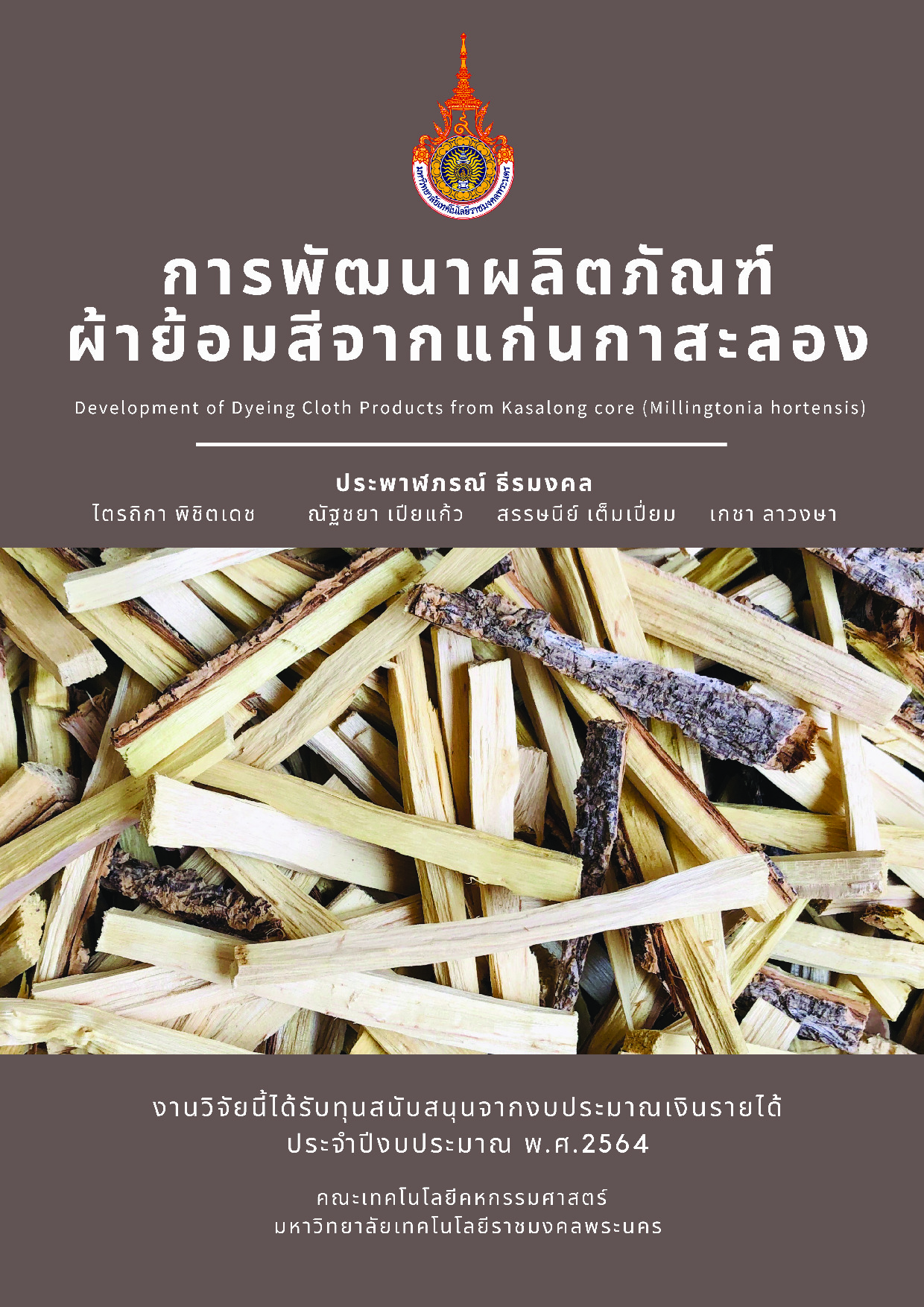
การพัฒนาผลิตภัณฑ์ผ้าย้อมสีจากแก่นกาสะลอง
Promotion of handicrafts in the field of natural dyes in the country. Increase the potential of the community and use the strengths of the cultural community. way of life and wisdom by finding ways to develop textile products by using creative textile innovations based on local wisdom in sustainable community areas To add added value to products in the ECO PRODUCT and ZERO WASTE product groups from the aforementioned concept To conserve plant genetics that exist throughout the country. The researcher therefore studied the process of dyeing fabrics by natural methods. By taking natural ingredients that are locally available and transforming them into environmentally friendly home products. This research is to study the natural dyeing of cotton fabric from Kasalong core. have a purpose Study on the effect of dyeing and the use of adjunctive agents in natural dyeing from Kasalong kernels. To develop dyed fabric products from Kasalong core and to pass on the knowledge and technology of developing dyed fabric products from Kasalong core for the general public. The result of dyeing cotton with natural dyes from Kasalong core. Four types of adhesives were used at a concentration of 20 percent as tamarind juice lime juice lime juice ash water and to test the washing fastness and sunlight resistance with the AATCC standard. The results can be summarized as follows. 1. The results of the study found that from the extraction of color from Kasalong kernels and then filtered with cloth. The color water extracted from Kasalong essence is brown. and when left for 24 hours the water color is dark brown and in this research using hot dyeing methods. 2. The result of dyeing cotton with natural dyes from Kasalong core without mordant using was found to yellow-brown but after washing the color intensity on the fabric fades slightly. 3. The result of dyeing cotton with natural color from Kasalong core. It was found that after washing the color intensity on the fabric was moderately fading. 4. The color measurement L* a* b* found that when the dye was measured in the CIELab system L* = 26.81 a* = 33.33 b* = 45.69 dL = 0.36 and dE*ab = 0.85 water. The resulting color from Kasalong will be reddish yellow. 5. Make the research prototypes as 10 of bag products. 6. Conducting technology transfer by organizing workshops dyeing course and sewing durating of the workshop for students and the general public was 1 day. Most of the participants had the highest level of satisfaction in all questions.