จำนวน Repository ( 822 )
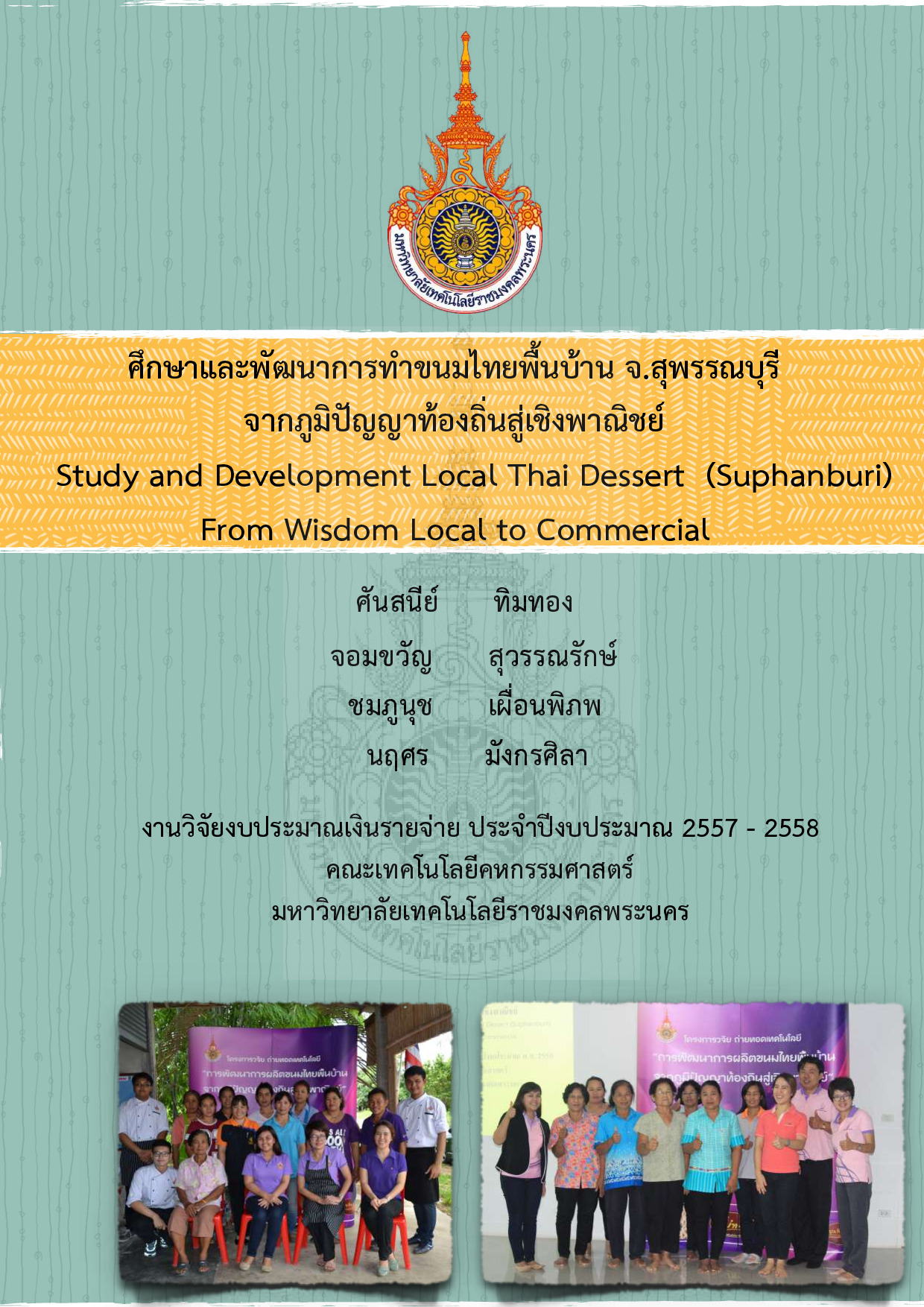
ศึกษาและพัฒนาการทำขนมไทยพื้นบ้าน จ.สุพรรณบุรี จากภูมิปัญญาท้องถิ่นสู่เชิงพาณิชย์
This research aims to gather the wisdom of the local confectionery. Suphanburi study based products to guide development toward commercialization. Transferring knowledge to To those related to benefits. Data were collected from five local groups five produce of wheel cake / fried beans sesame sheet / rice cracker with flossy pork / Chinese cake / fish eggs cake By interview Try making Bring samples Sensory evaluation and microbiological analysis found that wheel cake / fried beans sesame sheet / rice cracker with flossy pork and fish eggs cake. The average scores in all areas was good.The results determine the microbiological quality up to standard in the past. But Chinese Cake with yeast and mold beyond the standard set of standards Assistant. 115/2549 regarding Chinese Cake researchers to develop recipes Chinese Cake training and knowledge transfer processes. wheel cake / fried beans sesame sheet / rice cracker with flossy pork / Chinese cake / fish eggs cake. Education shelf wheel cake / fried beans sesame sheet / rice cracker with flossy pork / Chinese cake shredded and packed in a clear plastic bag PS (Polystyrene) and stored at room temperature. Sensory evaluation of appearance color aroma taste and texture every two days were shredded wheel cake and rice cracker with flossy pork as a second storage product to use in frying oil. Fried beans sesame sheet and Chinese cake plates five-day shelf life packaging foil bag metallic highlights. And a desiccant sachet You can help extend the life products. The present state of our knowledge as to the significance of the product that provide high energy can be details as ancient fried bean at 604 kilocalories rice cracker with flossy pork at 516 kilocalories wheel cake at 470 kilocalories Chinese cake at 427 kilocalories and fish eggs cake at 258 kilocalories respectively. Package design and branding while maintaining a modern Thailand with. The study of consumer behavior and consumer acceptance of products as a tourist in Thailand. Suphanburi Community food product purchase behavior found a place to buy a product that was also the most popular. Shop in the center of the deposit. Reasons to buy most products. To subsidized products from the community Factors buy Is packaging Test results emptied from local products developed into a commercial product both 5 rating in every type of consumer. At a high level Except for the ease of purchase. Because it is manufactured locally friendly. Stock trading is a friendly community. The agency also lacks support the market. Is the only product that consumers rated at a high level. Chinese cake to its consignment to the main tourist attractions. Suphanburi is also available on the website of One Tambon One Product. The five types of products and also to support local products. In most. After the development stage to commercial-oriented agency already has implemented. The transfer of knowledge and technology to manufacturers of theoretical knowledge and technologies. Local Thai Dessert And Packaging Workshop and to develop process to standards. The workshop on nutrition labeling packaging distribution channels overall satisfaction of participants in the highest level.
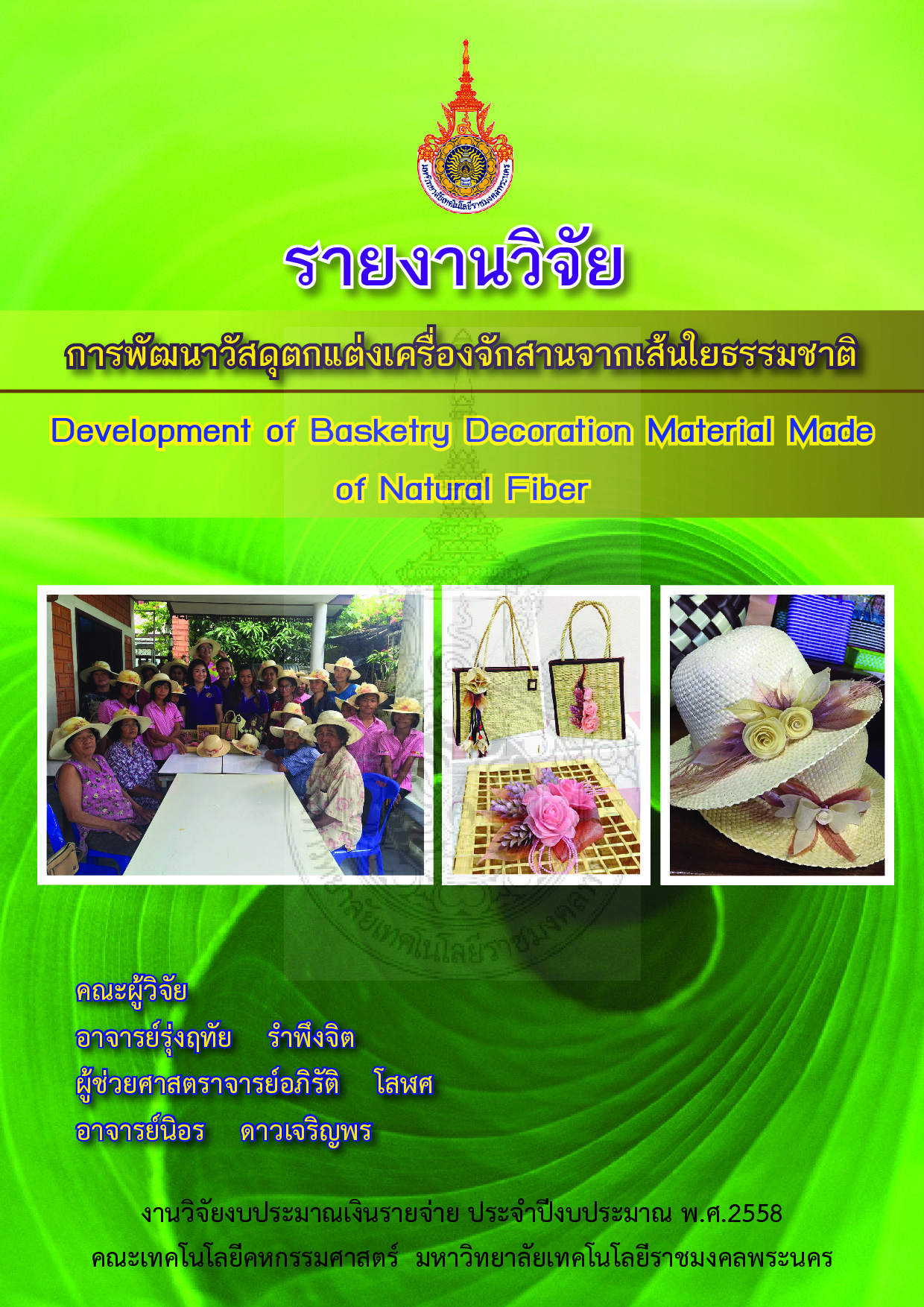
การพัฒนาวัสดุตกแต่งเครื่องจักสานจากเส้นใยธรรมชาติ
The study was aimed to investigate the production of banana fiber that was suitable for decorating handicraft basketry examine its effectiveness develop decorative handicraft materials for basketry from fibrous layer on the trunk of the banana tree and promote the obtained knowledge in the community of Plasticseeroong Baanmor Promburi District Singburi Province. The research result could be summarized that the most appropriate production process of dry fibrous layer on the trunk of the banana tree mixed with fibrous layer of paper mulberry was done through mechanical process. After bleaching the mixed fibrous layer was stirred by Hollander beater with the proportion of wet fibrous layer and water at 1:40; 10% of dry of paper mulberry was boiled for three hours in sodium hydroxide at 100 degree Celsius then bleached with 1.5% of hydrogen peroxide with 4% of the dry fibrous layer weight at 90 to 95 degree Celsius for two hours. The mixture of wet fibrous layer on the trunk of the banana tree with wet fibrous layer of paper mulberry was 70:30 which was considered appropriate for decorating handicraft basketry. Concerning the examination of mechanical properties of banana tree fibrous layer according to the standard of TAPPI T it was found that the folding endurance of paper value was 144 (N. m/g); the tensile strength value was 32.16 (N. m/g); the tear resistance value was 26.56 (mN.m2/g); and the bursting strength value was at 1.94 (KPa.m2/g). The fibrous layer obtained from on the trunk of the banana tree was fabricated into decorative basketry materials for example flowers palm leave hats flower key chains bags and paraffin coated flowers for bamboo boxed. The attendants’ satisfaction on the training of the production of decorative handicraft materials of basketry from fibrous layer on the trunk of the banana tree to 30 members of the community of Plasticseeroong Baanmor Promburi District Singburi Province concerning the training service speakers training procedures facilities and training benefits was at high level (90.67%) and at average level (9.33%).
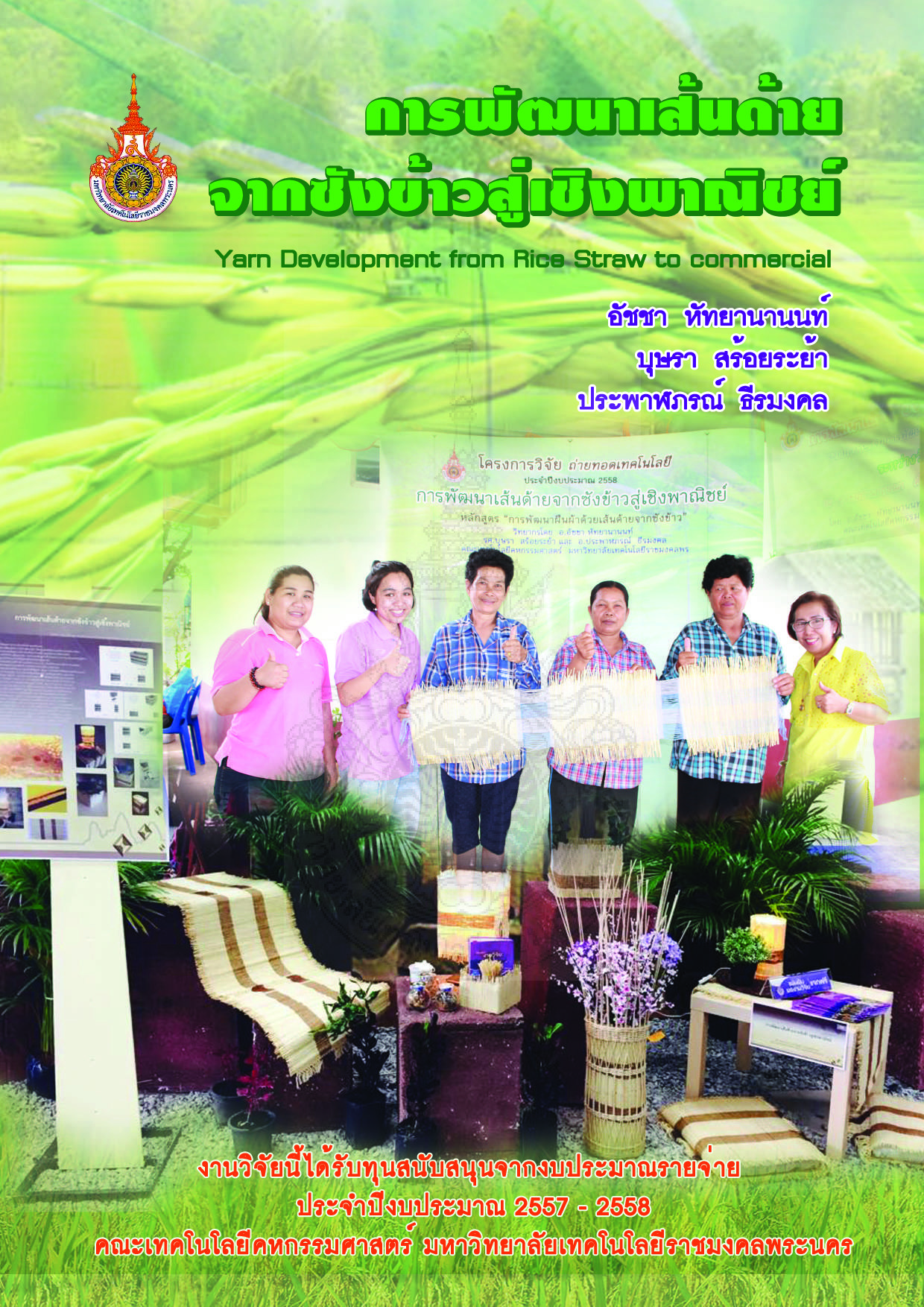
การพัฒนาเส้นด้ายจากซังข้าวสู่เชิงพาณิชย์
This research is Yarn Development from Rice straw to commercial. It aims to study the process of seperating fibers from rice straw. To study the physical properties of fibers from rice straw and to study the process of manufacturing yarn from rice straw fibers. The research material is rice straw fibers after that data was analyzed byphysical textile testing laboratory. The result of the first year’s research was the rice straw yarn has been developed as woven and develop into commercial products to promote. The process of separating fibers from rice straw which dried the sun for a few days. Selecting the rice straw fiber length at least 30 cm. to subtract the joints of the lower end of the stem by hand. peel off the rice straw fiber and place flat on a horizontal line. Then Rice straw fiber were tested in the physical laboratory was found that it is cellulose fibers tensile strength (Newton) at 28.18 elongation (percent) is at 2.01. The amounts of metals has plenty of CADMIUM at 0.1 mg/kg CHROMIUM (TOTAL) / (VI) at 0.5 mg/kg COPPER at 0.5 mg/kg and LEAD at 0.1 mg/kg which was not found to be risk for using. The fiber cross-section of rice straw fiber were found to be oval the middle is clearly. The fiber length is smooth and transparent when viewed from the side to see the clarity of the fiber. Rice straw fiber was weave in plain structure. Warp yarn uses a special brown cream and brown flat yarns. We use rice straw fiber with the same type of yarn. There are 2 warp yarn and using natural color without blench. Rice straw fabric was dyeing with dried hibiscus flowers (Kaa-Jeab herb) and mordant as ashes. The result is red light because of rice straw fiber surface is smooth and lustrous. Therefrom When woven as a fabric to develop be 4 products prototype : table lamps tablecloths in Japanese style potted plants and Accessories Box The result of the second year’s research there are focus group inquire for people it is interesting in this research and Date for transfer knowledge as: Ban-Krit-Sa- Na community Krit-Sa-Na sub-district bang-pra-ma district in Supanburi province. To plan the schedule and set the date place amount of participate and lectures 34 people The range of time to transfer as 3 days on 3 – 5 May 2015 and asking for consumer satisfaction of the curriculum and lecture for “transfer knowledge Yarn Development from Rice straw to commercial” by Questionnaire of participate satisfaction. Last the evaluation data was analyzed by using SPSS program in mean and percentage. The second year found that mostly participates were female aged under 21 years old finished the secondary school and also there are farmer. The participates are their income under 5000 baht and no income. For the participates questions relation to technology transfer of “Yarn Development from Rice straw to commercial” about course divided into 3 parts: The purpose The curriculum and The knowledge. The satisfaction of participates about project divided into 3 parts: Service process Lecturer and Facilities found that have been satisfied at maximum average and highest level of satisfaction in every parts of both satisfied participates questions. The participants are mainly used to provide benefits to themselves for one month to apply the gained after the training. Satisfaction with the benefits of technology transfer and utilization. Satisfaction at the highest level the participants used knowledge to apply with local and waste material. Moreover the participates make product as soon as finish course and they are planning to produce the table Hand Woven for weaving the Rice straw yarn fabric and push it to be OTOP products. The comments and suggestions of the participants found that they need for re-training again. They would like to have a longer period of training in order to gain more knowledge. All lecturer can transfer knowledge during the training as well.
การพัฒนารูปแบบของการสร้างหลักสูตรฝึกอบรมวิชาชีพระยะสั้น ด้านคหกรรมศาสตร์ กลุ่มอาชีพสหกรณ์ศิลปะประดิษฐ์ ตำบลเกาะเกร็ด จังหวัดนนทบุรี
This research aimed to study 1) the demand for short-term vocational training courses in home economics 2) create a training curriculum of home economics profession short of demand. Handicrafts Cooperative Occupational Groups Ko Kret Nonthaburi and her 3) the effects of short-term vocational training courses in home economics created The population in this study were selected purposively is a group of professional arts cooperative. Koh Kret Nonthaburi number 30 was used in the questionnaire and short-term training courses in home economics. Data analysis and statistics used were percentage average and standard deviation. The results were as follows: The population with an interest in the course of the invention include most academic inventor gift followed by molding the dough flowers Thailand. And the flowers The average score of 4.57 4.30 and 4.20 respectively Thus the curriculum invention gift. Style stuffed owl The concept of Taba comprises seven stages: 1) analysis of problems and needs for 2) define the aims of the course 3) selection of content 4) held a substantive 5) selection of a learning experience 6) experience. Learning and 7) evaluation of the course created consisting of five plans include 1) a basic knowledge about the inventor of the gift 2) materials and fabrication techniques stuffed owl onion 3) Knowledge of design creation. 4) the invention onions stuffed owl 5) costing and pricing onion stuffed owl. The six-hour period The results of the program found that participants with a performance favorably (83.33 percent) and a rating of the portfolio is in good shape (90.00 percent) from the satisfaction of the participants are. the most satisfied are averaging 4.58
การพัฒนาผลิตภัณฑ์วุ้นกรอบจากน้ำตาลสด
Fresh coconut syrup is a product from coconut spadix which has unique sweet taste and odor. Due to its short storage life it is usually processed into palm sugar. Development of new product from fresh coconut syrup would add more value by using it to produce crispy jelly. A suitable formula selected as a basic formula used 42.11 percent of refined sugar 56.14 percent of water and 1.75 percent of jelly powder. The basic formula was adjusted by calculating amount of water and soluble solids. Then a study was conducted to determine suitable amount of refined sugar heating period and drying temperature. It was found that a higher ratio of refined sugar and heating period led to increased concentration level of the mixture. As a result the crispy jelly had higher amount of sugar chips on the jellys surface and higher level of hardness. The highest score given by testers was for crispy jelly which used a ratio of fresh coconut syrup and refined sugar at 1:0.6 and 1:0.8 heating period of 5 minutes. Drying crispy jelly at higher temperature resulted in decreased drying period and higher degree of hardness. Drying at 70 degree Celcius produced crispy jelly with good quality which received the highest likeness score from testers. A study that kept crispy jelly in plastic box for at least 8 weeks showed that the tested condition could effectively maintain good quality of the crispy jelly.