จำนวน Repository ( 1087 )
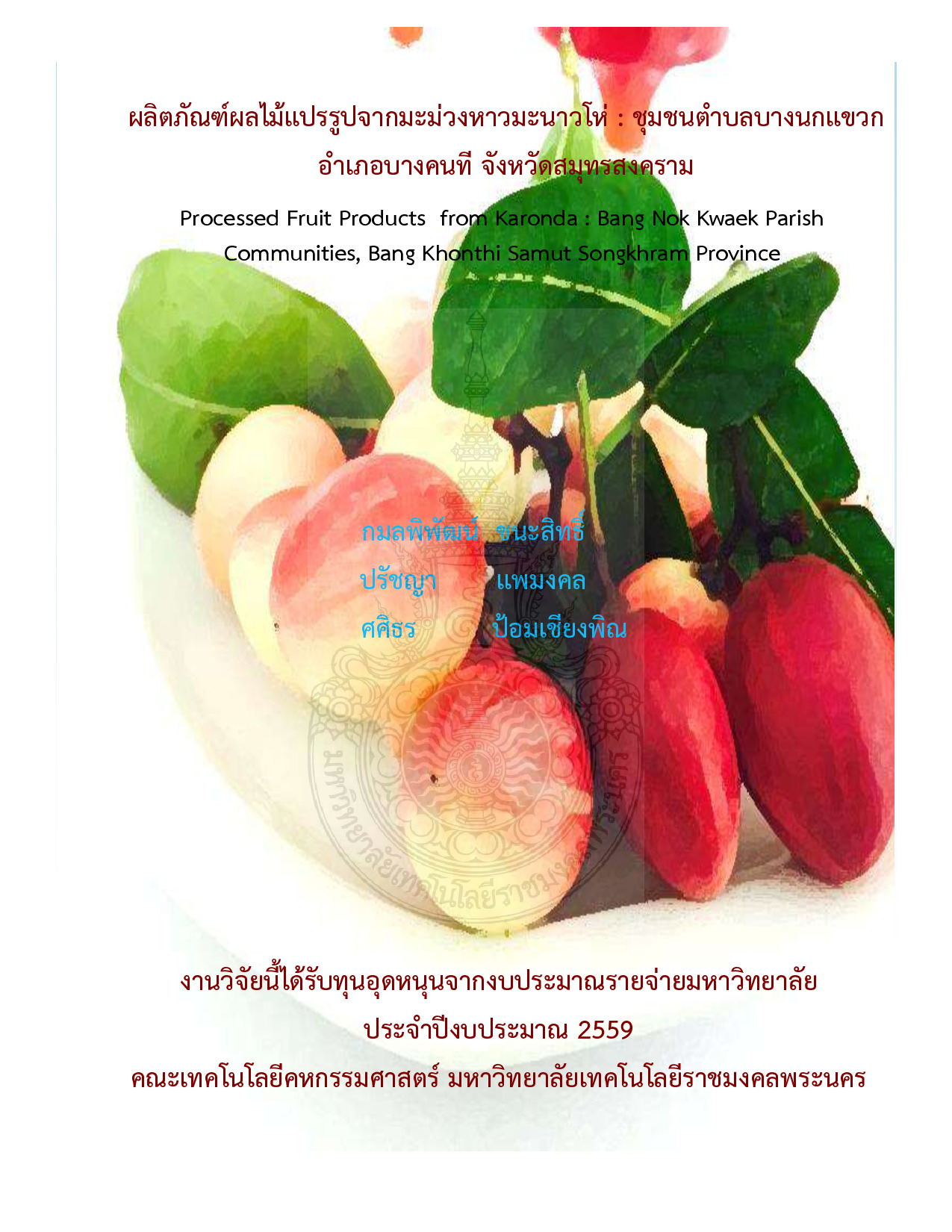
ผลิตภัณฑ์ผลไม้แปรรูปจากมะม่วงหาวมะนาวโห่ : ชุมชนตำบลบางนกแขวก อำเภอบางคนที จังหวัดสมุทรสงคราม
The purpose of the study of processed fruit products from Karonda : Bang Nok Kwaek parish communities Bang Khonthi Samut Songkhram Province is to study the proper quantity of the Koranda fruit in the product the quality in the product’s process and the consumers’ acceptance (Consumer Test) in the product. The processed products are Karonda fruit jelly instant pasteurized Karonda fruit juice with extra fiber Karonda fruit sorbet Karonda fruit yoghurt ice-cream and concentrated juice (sauce) for drink mixing. The product has been tested by Randomized Complete Block Design (RCBD) method. The process was consisted with offering a tasting and evaluated in color scent taste matter and overall satisfaction by giving 9 point Hedonic scale from 70 consumers. And has been compared the difference of average means at 95% trustiness by Duncan’s New Multiple Range Test (DMRT) by an instant statistical analysis software. The result information is as the followings; The physical properties indicates of Karonda fruit the total acidity of 2.30 with the pH and the color was found that the brightness (L *) of 16.52 fee (a *) equal to 8.95 and (b. *) equals 5.37. The study of the chemical quality of Karonda fruit amount of energy in calories carbohydrates 73.2 percent 18.3 percent protein 1.57 percent 1.32 percent humidity fats fiber 83.7 percent ash 4.26 percent and 0.75 Vitamin C is found. The duration of ripening fruit yawning lemon booed affect the vitamin C in the fruit of the mango yawning lemon booed the oil will have more vitamin C than ripe to t 2 so I scratched the reduction of vitamin C may. Is due to be deployed as a compound to breathe. And led to the synthesis of new carbon structures during ripening. Karonda fruit jelly. The most acceptances level for Karonda fruit juice in the product is at 1:6 for its best flexibility. Since the juice concentration affects the jelly as it lowers the matter (flexibility). Too much of acid in Karonda fruit juice is able to unstabilize jelly matter. From the study of Pectin quantity the consumer has the most acceptance at the level of 10 grams which is the best recipe that keeps the good jelly matter (flexibility) stabilized. The physical properties indicates that there are the level of color hue at 5R color brightness at Value 4 Chroma at 14 sweetness at 35 Brix and pH at 3.05. The study of the chemical quality of Karonda fruit jelly in each 100 grams provides 120 kilocalories of energy 69.60 grams of humidity 0.11 gram of fat 29.80 grams of carbohydrate 0.41 gram of fiber 0.50 gram of ash and 0.45 gram of acidity. The consumer satisfaction is at 97.30 percent. Instant pasteurized Karonda fruit juice with extra fiber. The acceptance is at 100 percent of replacing Okra fruit juice by Karonda fruit juice. The acceptance study shows that the most proper fiber quantity adding to Karonda fruit juice is at 15 percent. The acceptance study shows that the most proper Pectin quantity affecting coconut jelly spreading is at 3 percent. The analysis results of the physical properties indicate that instant pasteurized Karonda fruit juice with extra fiber has color hue level at 5R value at 4 and Chroma at 12 which rendered the product to dark red. Also the pH level is at 3.29 sweetness is at 17 Brix firness g force 1 is at 11.29 g Viscosityag.sec AREA F-T 1:2 is at 339.507 ag.sec. The study of the chemical quality of Karonda fruit juice in each 100 grams provides 63.3 kilocalories of energy 83.9 grams of humidity 0.01 gram of fat 0.10 gram of protein 15.8 grams of carbohydrate 0.41 gram of fiber 0.24 gram of ash and 0.18 gram of pH balance. The consumer satisfaction to instant pasteurized Karonda fruit juice with extra fiber is at 98.66 percent. Karonda fruit sorbet. The most proper quantity of Karonda fruit juice is at 30 percent. The physical properties of Karonda fruit sorbet contain the brightness level at L*34.32 red color level at a*41.26 yellow color level at b*21.18 meltable solid quantity at 30*Brix and pH balance at 2.40. The study of the chemical quality of Karonda fruit sorbet in each 100 grams provides 91.8 kilocalories of energy 77.1 grams of humidity 0.15 gram of fat <0.20 gram of protein 22.6 grams of carbohydrate 0.11 gram of fiber and 0.12 gram of ash. The consumer satisfaction to Karonda fruit sorbet is at 100 percent. Karonda fruit yoghurt ice-cream. The most proper quantity of Karonda fruit added in the yoghurt ice-cream is at 10 percent of the whole ingredient. The consumers’ acceptance has been given the most for its scent taste matter (smoothness) and overall satisfaction which has the average mean at 7.24 7.77 7.17 and 7.67 consequently. The physical properties of Karonda fruit yoghurt ice-cream contain the viscosity level at 364.798 cps. color hue at 10P Value at 8/6 Chroma at N9/.5 overrun statistics at 4.55 and Karonda fruit yoghurt ice-cream melting rate at 89.90. The chemical quality of Karonda fruit yoghurt ice-cream in each 100 grams provides 214 kilocalories of energy 64.0 grams of humidity 14.6 gram of fat 3.14 gram of protein 17.5 grams of carbohydrate 0.76 gram of fiber 0.74 gram of ash and 5.67 pH balance. The consumer satisfaction to Karonda fruit yoghurt ice-cream is at 100 percent. Concentrated juice (sauce) for drink mixing. The most acceptance recipe is the strawberry sauce recipe number 1 with the replacement of Karonda fruit at 80 percent. The physical properties contain the viscosity level at 9.28 cps sweetness at 21 Brix color hue at 5R Value at 2 and Chroma at 4. The chemical quality of concentrated juice (sauce) for drink mixing in each 100 grams provides 91.1 kilocalories of energy 77.2 grams of humidity 0.30 gram of fat 0.1 gram of protein 22.3 grams of carbohydrate 0.76 gram of fiber 0.4 gram of vitamin C and 0.56 of pH balance. The consumer satisfaction concentrated juice (sauce) for drink mixing is at the maximum satisfaction at 92.0 percent as the concentrated juice (sauce) emphasizes the better taste of smoothie drink mixing and easy to consume.
ปัจจัยที่มีผลต่อการตัดสินใจศึกษาต่อระดับปริญญาตรี สาขาวิชาเทคโนโลยีการจัดการสินค้าแฟชั่น คณะเทคโนโลยีคหกรรมศาสตร์ มหาวิทยาลัยเทคโนโลยีราชมงคลพระนคร
This research aims to study the factors that influence the decision to study a Bachelor of Fashion Technology. Faculty of Home Economics Technology Rajamangala University of Technology Phra Nakhon Consisting of eight sides The expectations of the future. Curriculum and teaching activities in the environment and to the reputation and image quality. The features and benefits. Media and Public Relations The need to develop their own The family and the people around me. The population is Student Technology Management Fashion Floors 1-4 of the academic year 2557 73 people used the questionnaire prepared an assessment of the five levels. The results showed that Factors that influence the decision to study undergraduate Economics Faculty at the statistical level of significance. 01 are three factors in descending order of the factors affecting the descending. 1) the individual family and peers. 2) Media Relations and 3) the quality reputation and image of the three factors could explain the variability of the Faculty of Economics of Technology has 78.30 percent.
ความคาดหวังของผู้ปกครองที่มีต่อคุณภาพของผู้เรียน ในสาขาวิชาเทคโนโลยีการจัดการสินค้าแฟชั่น คณะเทคโนโลยีคหกรรมศาสตร์ มหาวิทยาลัยเทคโนโลยีราชมงคลพระนคร
This research aims to study and compare the level of expectations asked parents on the quality of the student division of Fashion Merchandising Technology. Faculty of Home Economics Rajamangala University of Technology Phra Nakhon in three aspects: Knowledge and professional skills attitudes moral and appropriate of value and social responsibility participation and adaptation in society happily. The population is parents of students at the Fashion Merchandising Technology 1-4 year 2557 was used questionnaire prepared. Data were analyzed by using percentage mean standard deviation and the T-Test F-Test. The results showed that the highly prospective parents on the quality of student in the Division of Fashion Merchandising Technology Home Economics Technology Rajamangala University of Technology Phra Nakhon These three aspects are average in high level (3.93). And expectations of the parents on the quality of the students Classified by personal background of parents was found. Did not differ significantly at 0.05
การพัฒนารูปแบบการสร้างชุมชนเข้มแข็งด้านการตลาดของ วิสาหกิจชุมชน จังหวัดสมุทรสงคราม
The study of Research and Development of Model for Building Strong Community on Marketing of Samutsongkram Community Enterprises. It was aimed to investigate factors affecting effectiveness of running this enterprise for further improvement and to figure out possible path for enhance productivity of small community enterprises. The subject of this study consisted producers Community Enterprises entrepreneurs who participating seminar in improving management and product designs. The participants included 149 community enterprises group 200 participants in total. The result stated that 1) Producing management ranked high level while each aspect yielded different results. Finance and accounting ranked the highest producing and cooperatingranked respectively lower. The administrative was estimated as following; 2) Considering factors affecting effectiveness of Community on Marketing of Samutsongkram Community Enterprises ranked the high level in overall. Looking at each aspect budgets and learning improvement ranked the highest while participants ‘knowledge and gathering budgets and resources ranked the lowest. 3) Factors influencing effectiveness of community enterprise included planning controlling cooperating marketing producing administrating accounting organization managing affected the overall efficiency of Samutsongkram Community Enterprises predicted at 97.60%. 4) Focus group analysis was done by SWOT Analysis presented strength weakness opportunity and threat of community enterprise planning from preparation implementation and application as following;Preparation step: Arranging seminar in designing and product design. Having financial support field trip for figuring out uniqueness of Samutsongkram Community Enterprises Implementation step: Supporting distribution channels enhancing production by increase machine capacity setting up standard guarantee center and encouraging new group of small and minor community enterprise Application step: Promoting products of Samutsongkram Community Enterprises by different channels of advertisement improving brand of the group and also information technology to support Samutsongkram Community Enterprises.

พฤติกรรมการมีวินัยในตนเองของนักศึกษาคณะบริหารธุรกิจ มหาวิทยาลัยเทคโนโลยีราชมงคลพระนคร
The research studies self-discipline behaviour of business administration student of Rajamangala University of Technology Phra Nakhon Pha Nakorn. There are 2 main points in objective: 1) To study the power to predict student’s self-discipline behaviour by psychological characteristic psycho-situational characteristic and social characteristic in collected group and subgroups. 2) To examine the interaction between psychological characteristic psycho-situational characteristic and social characteristic that relates to self-discipline behaviour in collected group and subgroups. The survey of 400 undergraduates was conducted to assess self-discipline behaviour of students. Moreover there are 6 independent variables in this research including 2 variables of psychological characteristic (future orientation and self-control and achievement motivation) 2 psycho-situational characteristic variables (perceived self-efficacy and attitude toward self-discipline behaviour and 2 variables of social characteristic (good role model from family and supportive rearing while the dependent variable is self-discipline behaviour. Basic statistics multiple regression analysis and two-way ANOVA were used to analyse. All of the analysis was also used in both collected group and subgroup according to socio-demographic characteristic. The results of this research are as follow: 1. 6 variables in term of psychological characteristic psycho-situational characteristic and social characteristic can predict self-discipline behaviour in collected group accounting for 59.5 per cent while subgroups are between 32.1 to 44.8 per cent. The most prediction is female group. Furthermore the most significant predicting factor is attitude toward self-discipline behaviour which is in equation in collected group and subgroups and it is the first significant predicting factor in collected group and male group as well as the student group who study in first and second years in bachelor’s degree. 2. Students who have high level of future orientation and self-control and good role model from family will have great self-discipline behaviour. In fact it is found that future orientation and self-control and good role model from family disconnect with student’s self-discipline behaviour at the level of significance of 0.05. However when analysing each independent variable self-discipline behaviour varies with future orientation and self-control. It appears on collected group and 4 subgroups which consist of male group female group the first and second year undergraduate group and the third and fourth year undergraduate group. In addition good role model from family influences self-discipline behaviour that can be found in collected group and 4 subgroups such as male group female group the first and second year undergraduate group and the third and fourth year undergraduate group. 3. The students who have high achievement motivation and supportive rearing are estimated to have great self-discipline behaviour. Whereas it is apparent that achievement motivation and supportive rearing do not interact with self-discipline behaviour at the level of significance of 0.05. On the contrary when considering each independent variable achievement motivation affects self-discipline behaviour in collected group and subgroups (male group female group the first and second year undergraduate group and the third and fourth year undergraduate group). At the same time self-discipline behaviour is also determined by supportive rearing that presents in both of collected group and subgroups which include male group female group the first and second year undergraduate group and the third and fourth year undergraduate group.