จำนวน Repository ( 1174 )
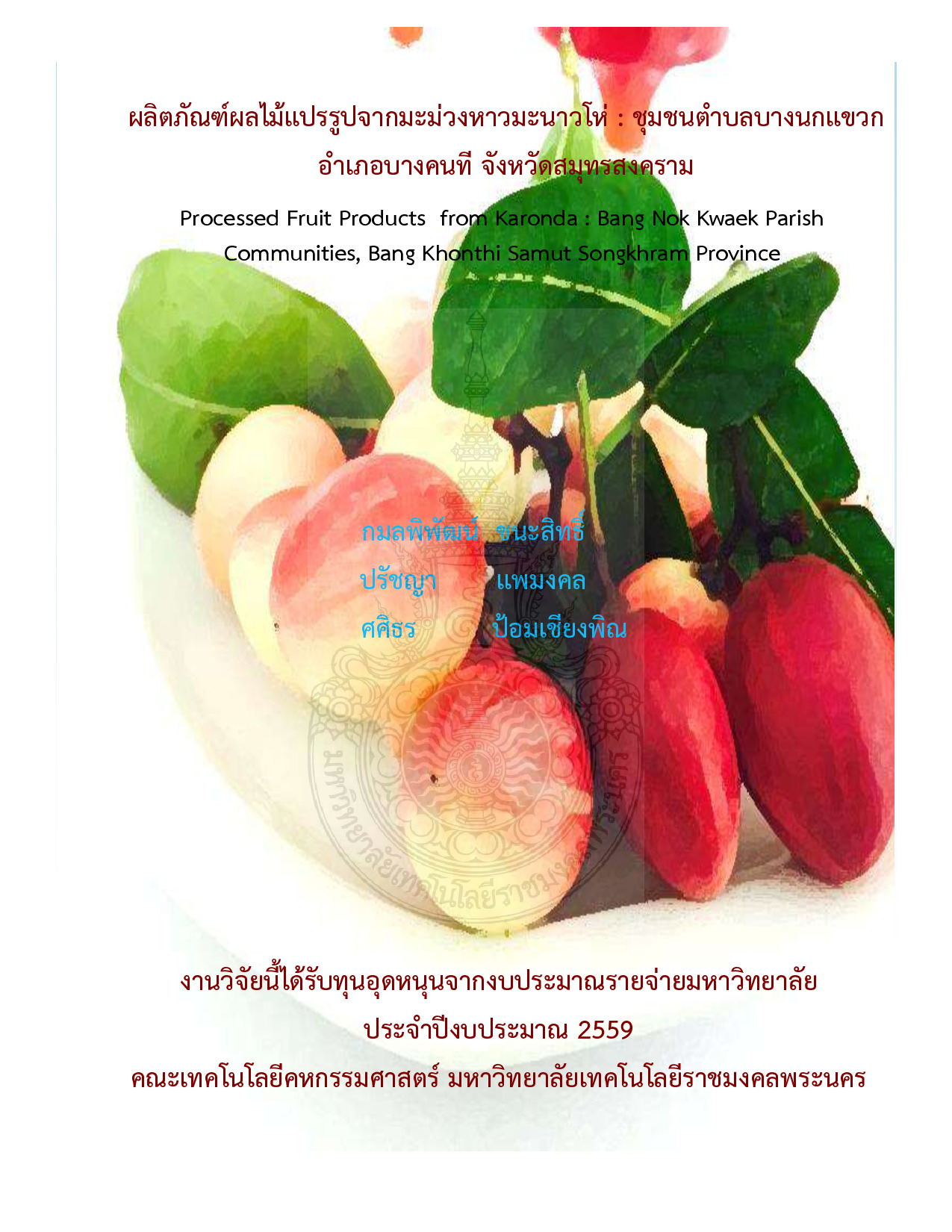
ผลิตภัณฑ์ผลไม้แปรรูปจากมะม่วงหาวมะนาวโห่ : ชุมชนตำบลบางนกแขวก อำเภอบางคนที จังหวัดสมุทรสงคราม
The purpose of the study of processed fruit products from Karonda : Bang Nok Kwaek parish communities Bang Khonthi Samut Songkhram Province is to study the proper quantity of the Koranda fruit in the product the quality in the product’s process and the consumers’ acceptance (Consumer Test) in the product. The processed products are Karonda fruit jelly instant pasteurized Karonda fruit juice with extra fiber Karonda fruit sorbet Karonda fruit yoghurt ice-cream and concentrated juice (sauce) for drink mixing. The product has been tested by Randomized Complete Block Design (RCBD) method. The process was consisted with offering a tasting and evaluated in color scent taste matter and overall satisfaction by giving 9 point Hedonic scale from 70 consumers. And has been compared the difference of average means at 95% trustiness by Duncan’s New Multiple Range Test (DMRT) by an instant statistical analysis software. The result information is as the followings; The physical properties indicates of Karonda fruit the total acidity of 2.30 with the pH and the color was found that the brightness (L *) of 16.52 fee (a *) equal to 8.95 and (b. *) equals 5.37. The study of the chemical quality of Karonda fruit amount of energy in calories carbohydrates 73.2 percent 18.3 percent protein 1.57 percent 1.32 percent humidity fats fiber 83.7 percent ash 4.26 percent and 0.75 Vitamin C is found. The duration of ripening fruit yawning lemon booed affect the vitamin C in the fruit of the mango yawning lemon booed the oil will have more vitamin C than ripe to t 2 so I scratched the reduction of vitamin C may. Is due to be deployed as a compound to breathe. And led to the synthesis of new carbon structures during ripening. Karonda fruit jelly. The most acceptances level for Karonda fruit juice in the product is at 1:6 for its best flexibility. Since the juice concentration affects the jelly as it lowers the matter (flexibility). Too much of acid in Karonda fruit juice is able to unstabilize jelly matter. From the study of Pectin quantity the consumer has the most acceptance at the level of 10 grams which is the best recipe that keeps the good jelly matter (flexibility) stabilized. The physical properties indicates that there are the level of color hue at 5R color brightness at Value 4 Chroma at 14 sweetness at 35 Brix and pH at 3.05. The study of the chemical quality of Karonda fruit jelly in each 100 grams provides 120 kilocalories of energy 69.60 grams of humidity 0.11 gram of fat 29.80 grams of carbohydrate 0.41 gram of fiber 0.50 gram of ash and 0.45 gram of acidity. The consumer satisfaction is at 97.30 percent. Instant pasteurized Karonda fruit juice with extra fiber. The acceptance is at 100 percent of replacing Okra fruit juice by Karonda fruit juice. The acceptance study shows that the most proper fiber quantity adding to Karonda fruit juice is at 15 percent. The acceptance study shows that the most proper Pectin quantity affecting coconut jelly spreading is at 3 percent. The analysis results of the physical properties indicate that instant pasteurized Karonda fruit juice with extra fiber has color hue level at 5R value at 4 and Chroma at 12 which rendered the product to dark red. Also the pH level is at 3.29 sweetness is at 17 Brix firness g force 1 is at 11.29 g Viscosityag.sec AREA F-T 1:2 is at 339.507 ag.sec. The study of the chemical quality of Karonda fruit juice in each 100 grams provides 63.3 kilocalories of energy 83.9 grams of humidity 0.01 gram of fat 0.10 gram of protein 15.8 grams of carbohydrate 0.41 gram of fiber 0.24 gram of ash and 0.18 gram of pH balance. The consumer satisfaction to instant pasteurized Karonda fruit juice with extra fiber is at 98.66 percent. Karonda fruit sorbet. The most proper quantity of Karonda fruit juice is at 30 percent. The physical properties of Karonda fruit sorbet contain the brightness level at L*34.32 red color level at a*41.26 yellow color level at b*21.18 meltable solid quantity at 30*Brix and pH balance at 2.40. The study of the chemical quality of Karonda fruit sorbet in each 100 grams provides 91.8 kilocalories of energy 77.1 grams of humidity 0.15 gram of fat <0.20 gram of protein 22.6 grams of carbohydrate 0.11 gram of fiber and 0.12 gram of ash. The consumer satisfaction to Karonda fruit sorbet is at 100 percent. Karonda fruit yoghurt ice-cream. The most proper quantity of Karonda fruit added in the yoghurt ice-cream is at 10 percent of the whole ingredient. The consumers’ acceptance has been given the most for its scent taste matter (smoothness) and overall satisfaction which has the average mean at 7.24 7.77 7.17 and 7.67 consequently. The physical properties of Karonda fruit yoghurt ice-cream contain the viscosity level at 364.798 cps. color hue at 10P Value at 8/6 Chroma at N9/.5 overrun statistics at 4.55 and Karonda fruit yoghurt ice-cream melting rate at 89.90. The chemical quality of Karonda fruit yoghurt ice-cream in each 100 grams provides 214 kilocalories of energy 64.0 grams of humidity 14.6 gram of fat 3.14 gram of protein 17.5 grams of carbohydrate 0.76 gram of fiber 0.74 gram of ash and 5.67 pH balance. The consumer satisfaction to Karonda fruit yoghurt ice-cream is at 100 percent. Concentrated juice (sauce) for drink mixing. The most acceptance recipe is the strawberry sauce recipe number 1 with the replacement of Karonda fruit at 80 percent. The physical properties contain the viscosity level at 9.28 cps sweetness at 21 Brix color hue at 5R Value at 2 and Chroma at 4. The chemical quality of concentrated juice (sauce) for drink mixing in each 100 grams provides 91.1 kilocalories of energy 77.2 grams of humidity 0.30 gram of fat 0.1 gram of protein 22.3 grams of carbohydrate 0.76 gram of fiber 0.4 gram of vitamin C and 0.56 of pH balance. The consumer satisfaction concentrated juice (sauce) for drink mixing is at the maximum satisfaction at 92.0 percent as the concentrated juice (sauce) emphasizes the better taste of smoothie drink mixing and easy to consume.

การพัฒนามาลัยจากผ้าด้วยเทคโนโลยีการตกแต่งกลิ่น
This research studies the development of fabric garland with fragrance addition technology by investigating the method of covering microcapsule fragrance on fabric which is the material of making garland. The result of the study shows that: The study of covering gelatin on polyester fabric shows that the small amounts of gelatin applied on polyester lower the strength of the fabric which is not suitable for marking garland. Due to the requirement of the strength in making garland by folding fabrics and passing them through thread into round shape lacking of the strength causes the difficulty for the making process. Gelatin provides stiffness and hardness to the fabric which is easy to form into various shapes. Before adding fragrance the result of stiffness test shows that the fabric has bending length of warp yarn at 5.9 centimeters and weft yarn at 4.1 centimeters; however after adding fragrance bending length of warp yarn is at 2.7 centimeters and weft yarn is at 1.9 respectively. Then the efficiency of covering microcapsule fragrance on fabric is tested by Scanning Electron Microscope (SEA). After adding fragrance the result shows that: (1) the numbers of microcapsule are higher (2) microcapsules form in round shape and (3) the size of microcapsules are similar. However after 30 day of applying microcapsule to the fabric it shows that (1) the numbers of microcapsule are lower and (2) microcapsules are not in complete round shape due to the deterioration. For the process of making garland with nonmicrocapsule and microcapsule fabric it demonstrates that microcapsule fabric does not impact the process of making garland but it adds the value for fragrance addition which is able to be considered as added value.

การพัฒนาผลิตภัณฑ์จากเปลือกนอกของก้านเผือกเหลือใช้ ในกลุ่มผู้ทานาเผือกอำเภอบ้านหมอจังหวัดสระบุรี เพื่อส่งเสริมเศรษฐกิจชุมชน
This research aims to produce paper and strands from taro fiber in order to develop into craft products and to transfer the body of knowledge and technology to community. The research consisted of 5 main steps: 1) development of paper – study concentration level of sodium hydroxide duration of pulp boiling suitable condition for breaching and softening reactive dyeing paper setting and physical testing of paper; 2) development of strand – stranding with machine strand spinning fiber combining and carding drawing reducing size of fiber and yarn spinning; 3) fiber property testing – cross-sectional test length crimp and fiber fineness; 4) product development – making evaluating and improving draft models of rubber-coated artificial flowers hanging clocks multipurpose boxes and product prototype development; and 5) transfer of technology to members of Talad Noi Agricultural Community Enterprise as well as nearby communities in Ban Moh district Saraburi province. Results of the study showed that the most suitable condition in separating fiber was boiling in 15 grams-per-liter sodium hydroxide solution at 100 Degree Celcius for 1 hour. Then breach with 9 grams-per-liter hydrogen peroxide solution at 100 Degree Celcius for 20 minutes. Next soften the fiber with 6 grams-per-liter anion softener at 60 Degree Celcius for 20 minutes. The use the fiber to set 40x40 centimeter piece of paper by spreading 20 grams of fiber equally. The resulting 0.237mg thick piece of paper was fairly resistance to piercing pressure and tearing force and was suitable to make craft products. In addition development of strands by yarn spinning method was suitable to produce strands which had more strength than strands from other plants. The strands were also suitable for further industrial production. The prototypes of utility and furnishing products were evaluated by consumers as highly suitable in 3 aspects - uniqueness of local product attractive design and size shape and weight – with mean values of 3.72 3.96 and 3.94 respectively. Price was evaluated as averagely suitable at a mean value of 3.12. Results of technology transfer showed that overall trainees were highly satisfied with the technology transfer process at a mean value of 4.55. Assessment of satisfaction and data for course improvement were both in the highest level with mean values of 4.60 and 4.51 respectively.

การพัฒนาสมรรถนะที่จำเป็นด้านการพัฒนาซอฟต์แวร์สำหรับบัณฑิตใหม่ก่อนเข้าสู่ภาคอุตสาหกรรมซอฟต์แวร์ไทย
The purposes of this study was to investigate the essential component of software development competency for new graduates before entering the Thai software industry sectors and to develop training courses software development competency. The sample of this study consisted of 402 software’s entrepreneurs and 30 new graduates in software development. The instruments used in research were questionnaire in-depth interview and the assessment of the satisfaction of trainees. The statistics used for data analysis were arithmetic mean standard deviation and Exploratory Factor Analysis (EFA). The findings of the data analysis indicate that there are seven competency factors: the software development on mobile devices individual factor for software career software testing and presentation use of software development tool knowledge of business process for software development concept of software development and English for communication and ASEAN knowledge. A software development on mobile devices was the most important competencies for software industry and therefore the training for new graduates was set up based on Application Development on Android. In addition the participants were satisfied with the training at very good level.

ปัจจัยที่ส่งผลต่อความต้องการเรียนรู้สื่อเทคโนโลยีของผู้สูงอายุในยุคหลอมรวมเทคโนโลยี
The objectives of this research to investigate 1) the level of elderly acceptance of technology and support. 2) Individual factors influence the elderly learning. The quantitative approach was applied by using questionnaire in data collection. Data was collected from 320 elderly people. Descriptive and inference statistics were used: percentage mean standard deviation Pearson correlation and multiply regression analysis. The findings indicates that there is the highest level of elderly acceptance of technology and support. The elderly people also use the Internet mainly to communicate with others followed by watching movies and listening to music. The most important technology support for the elderly is the Internet and computer use in a public place such as library hospital and elderly center with an expert encouragement. Provide knowledge and skills for the elderly using technology is the second most important technology support. Factors influencing the elderly learning in technology media are as follows: 1) Individual factors: the level of education occupation current salary and computer experience. This factor can explain the influence is 24.6 percent. 2) The elderly acceptance of technology 3) Technological support for the elderly. These two factors can explain the influence is 39.7 percent.