จำนวน Repository ( 1852 )
การพัฒนาผลิตภัณฑ์น้ำสลัดข้นจากข้าวหักไรซ์เบอรี่โดยใช้เลซิติน จากถั่วเหลืองเพื่อเป็นสารให้ความคงตัว
The stability study of salad dressing products from rice berry broken rice is aimed to study the appropriate amount of vinegar of thick salad dressing from riceberry broken rice. Broken Riceberry rice is further developed by studying the stability by using different amounts of lecithin by soybean lecithin content of 0.15 % Then the physical quality was found that the thickened salad dressing from broken riceberry using soy lecithin was a stabilizing substance with reddish-brown color with brightness (L*) 39.34 ± 0.07 red color value (a*) 11.48 ± 0.04 and yellow value (b*) 5.56 + 0.53. Salad dressing has a soluble solids 33.17 + 0.29 (ºBrix) consistency of stabilization value is 11.48 ± 0.04 cm. pH 3.60 ± 0.01 and titratable acidity 0.43 ± 0.02 %. Proximate analysis is 52.01 % moisture 30.22 % carbohydrate14.86 % fat 2.12 % fiber and 0.79 % ash. During storage at 4 ºC for 4 weeks the total amount of microorganisms and yeasts is less than 10 colonies per gram which pass the requirements of the Community Product Standards. 672/2547.
การศึกษาอุณหภูมิในการเผาเปลือกหอยลายเพื่อการปรับปรุงคุณภาพดิน
The purpose of this research was to study the temperature of burning surf clam shell for soil quality improvement. The experiment was divided two parts 1) the study of the optimum temperature for calcium oxide production by burning 800 900 1000 and 1100 °C 2) the study of using calcium oxide to improve soil qualities of acidic soil and saline soil. The parameters used in the analysis included elements of soil particles soil moisture pH conductivity total content nitrogen phosphorus and potassium. The results showed that the optimum temperature for the production of calcium oxide was 1100 °C since it provided the highest calcium oxide content of 90 % by weight. After applying calcium oxide into acidic soil the composition of soil particles was changed from sandy clay to sandy clay loam. In contrast the soil particle was not changed but the proportion was changed in saline soil. It was also found that calcium oxide reduced soil moisture and influenced the acidity of soil by increasing the pH from 3.39 to 6.92 in acidic soil and 6.49 to 9.11 in saline soil. In addition it was found that the electrical conductivity of the soil was related to salinity. In acidic soil the conductivity of before and after inputting calcium oxide were 0.87 and 1.24 dS/m respectively. In the case of saline soil the conductivity of before and after improvement were 14.37 and 18.80 dS/m respectively. Besides it was found that the total content of nitrogen phosphorus and potassium were reduced after the experiment.
การปรับปรุงสมบัติทางกลของพอลิแลกติกแอซิดด้วยเส้นใยปาล์มน้ำมัน
This research work was to study the improvement of toughness of polylactic acid (PLA) and the cost reduction of raw material with addition of untreated and treated oil palm fiber (OPF). The detail of this work was divided into two parts. The first was to find the suitable condition for surface treatment of OPF with sodium hydroxide (NaOH). The second part was to study the effect of untreated and treated OPF contents on the mechanical properties of PLA. For surface treatment of OPF NaOH concentrations and immersion times were varied from 0 to 15 wt% and 0 to 30 min respectively. Aspect ratio (L/D) and surface of untreated and treated OPF were investigated by using optical microscope and scanning electron microscope (SEM) respectively. The result suggested that the most suitable condition for surface treatment of OPF was NaOH concentration of 10 wt% at immersion time of 20 min. Treated OPF was occurred microporous and had more rough as compare to untreated fiber. For the effect of untreated and treated OPF contents on the mechanical properties of PLA it was evaluated by tensile and impact testing. SEM was used for investigation of interfacial adhesion and fiber dispersion. The results showed that tensile modulus and impact strength tend to increase with adding 2.5 wt% OPF content and slightly changed at higher OPF content whereas ultimate tensile strength and elongation at break decreased with increasing fiber content. Surface treatment with NaOH led to enhancement of mechanical properties of composite due to improve interfacial adhesion and fiber dispersion.
การพัฒนาหลักสูตรระยะสั้นด้านการผลิตเคมีภัณฑ์ในครัวเรือน
The purpose of this research was to develop a short vocational training course on household chemical products and to develop a training course for shortterm vocational training in the production of household chemicals. Population groups Is a general public in Bangkok and metropolitan area by using the voluntary selection as follows. Trial of a short course on the production of household chemicals 10 participants. Evaluation of short courses in household chemical production 10 participants. Technology transfer the short-term training course on household chemical production 20 participants and five speakers. The tools used in the research are as follows: 1. Demand questionnaire 2. Short-term vocational training course 3. Satisfaction assessment. Data analysis using statistical software packages. The statistics used were mean ( X ) standard deviation (SD) and t-test. The research found that 1. Study and development of short courses in the production of household chemicals 1.1 selection of household chemicals that will lead to the creation of training courses based on components Where to buy Price per set Properties of components Safety and hazard Materials and equipment used for production storage use and distribution opportunities 1.2 Creating training courses training course components and training documents to have a sequence of steps that are easy and convenient for the learning of the general public 2. Trial of a short course on the production of household chemicals 2.1 Most trainees are satisfied with the short-term training program model as follows: Training procedures Training hours 1.30 hours per 1 course Short-term courses can be implemented and the curriculum can be used as a guideline for occupation at the highest level. As for the number of trainees four people per group per 1 course is at a high level. 2.2 Most of the trainees were satisfied with the speakers and short-term training. In explaining the various components of Household chemicals Explanation of the mixing process Household chemicals Integration of household chemical mixing techniques Explanation of caution In the mixing of household chemicals And explaining how to pack household chemicals at the highest level 3.Short-term evaluation of household chemical production 3.1 Most trainees are satisfied with the short-term training program model. The training process Training hours 1.30 hours per 1 course Short-term courses can be implemented and courses can be used as guidelines for their career at the highest level. As for the number of trainees four people per group per 1 course is at a high level. 3.2 Most of the trainees were satisfied with the speakers and short-term training. Explain the various components of household chemicals Explanation of the mixing process Household chemicals Integration of household chemical mixing techniques. Explanation of caution In the mixing of household chemicals And explaining how to pack household chemicals at the highest level 4.Technology transfer the short-term training course on household chemicalproduction 4.1 Most of the trainees were satisfied with the trainers for short-term training. Explain the various components of household chemicals Explanation of the mixing process Household chemicals Integration of household chemical mixing techniques Explanation of caution in the mixing of household chemicals and explaining how to pack household chemicals at the highest level 4.2 Most trainees were satisfied with the short-term training program model. Regarding the number of trainees four people per group Training procedures The number of training hours is 1.30 hours per course the highest level. Furthermore short courses can be implemented. As for the curriculum it can be used as a guideline for a career at a high level.
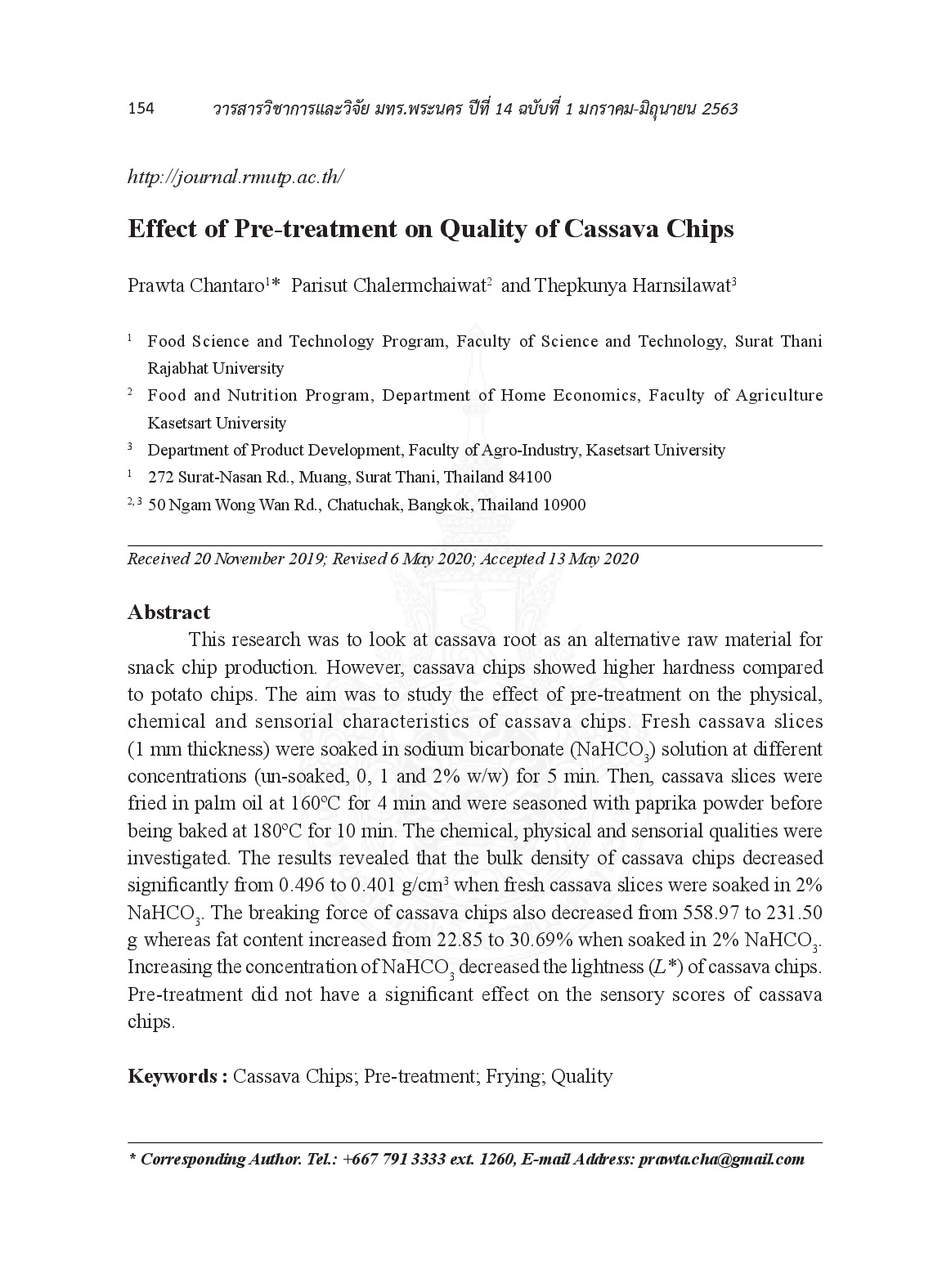
Effect of pre-treatment on quality of cassava chips
This research was to look at cassava root as an alternative raw material for snack chip production. However cassava chips showed higher hardness compared to potato chips. The aim was to study the effect of pre-treatment on the physical chemical and sensorial characteristics of cassava chips. Fresh cassava slices (1 mm thickness) were soaked in sodium bicarbonate (NaHCO3) solution at different concentrations (un-soaked 0 1 and 2% w/w) for 5 min. Then cassava slices were fried in palm oil at 160ºC for 4 min and were seasoned with paprika powder before being baked at 180ºC for 10 min. The chemical physical and sensorial qualities were investigated. The results revealed that the bulk density of cassava chips decreased significantly from 0.496 to 0.401 g/cm3 when fresh cassava slices were soaked in 2% NaHCO3. The breaking force of cassava chips also decreased from 558.97 to 231.50 g whereas fat content increased from 22.85 to 30.69% when soaked in 2% NaHCO3. Increasing the concentration of NaHCO3 decreased the lightness (L*) of cassava chips. Pre-treatment did not have a significant effect on the sensory scores of cassava chips.