จำนวน Repository ( 580 )
Development of Value Added Food Product from Freshwater Fish
Development of value added food product from freshwater fish aimed to develop processed food product from 5 types of freshwater fish. Because freshwater fish is found locally and cheap processed and value-added product from freshwater fish would enable a producer to have a wide range of market distribution. The findings of this study demonstrated that the most suitable products were fish sausage with Tom Yam flavour added developed by using seven-stripped carp fish partially substituted with spotted featherback fish at level 50% and 7.5% instant Tom Yum flavour. Pla-Yar produt with herbs product was developed by using Nile tilapia and 3.5% curry paste. Pla-Jor product was developed by using minced lard and thawing 2-week frozen Pla-Jor by microwave at heat level 70% for 1 minute. Fish flake from silver barb fish was developed by crushing to roll and sliding to sheet. Sauce of grilled silver barb fish paste and chill was developed by using silver barb fish partially substituted with shrimp at level 70% and the appropriate drying method was using tray dryer at 73 ◦C for 1 hour.
Rajamangala University of Technology Phra Nakhon and Social Aid: The Production of Prosthetic Equipments for the Disabled
Rajamangala University of Technology Phra Nakhon Technology Service section Institute of Research and Development with collaboration of Department of Tools and dye Technology Faculty of Engineering produced the prosthesis for the disabled since 2000. Rajamangala University of Technology Phra Nakhon has allocated annual budget for the ongoing operations of more than 350000 baht per year and has provided materials tools and components including the use of machine tools and university personnel for designing innovation. testing and manufacturing and delivering prosthetic equipments to government agencies that serve hopeless people who have no chance to servive and help the disabled who lost their arms or legs to live a normal life independently and would not be burden to the society.
The Comparative Study of Tie-Dye Methods for Pattern Design Development of Tie-Dye Products
The purposes of this research were 1) To compare to the distinctly motifs of Tie-dye methods: binding technique folding technique and stitching technique. 2) To compare the dyeing results of the characteristics of cotton linen and rayon in geometrics patterns design group and naturalistic patterns design group. There are 8 motifs were used; quadrangle triangle circle heart form flower leaf butterfly and worm. The research Instruments were used; 1) tie-dye fabrics dyed in 3 tie-dye methods. The tie-dye methods were bind fold and stitch amount of 120 pieces 2) The assessment for 15 connoisseurs (connoisseurship model). Data was analyzed by the statistical package for the social science program and using mean percentage standard deviation one-way ANOVA (Scheffe) and chi-square. The results of the study were found that binding technique was at mean 4.20 including stitching technique at mean 4.10 and folding technique at mean 3.69. The best technique was binding technique because this technique could produce products in a large quantity. The stitching technique was aesthetic elegant and valuable. The folding technique could produce many patterns in one time. Binding technique folding technique and stitching technique on cotton were much suitable in tie-dye method and capability of techniques. Binding technique and stitching technique on cotton were much suitable in pattern design and overall image of fabric dyed. Binding technique and stitching technique on linen were much suitable in 5 parts. Folding technique on linen were much especial suitable in tie-dye method and capability of techniques. Binding technique and stitching technique on rayon were much suitable in 5 parts. Folding technique on rayon were much especial suitable in 5 parts except overall image of fabric dyed. Comparison of three kinds of fabric and two pattern groups were that geometrics and naturalistic patterns on cotton linen and rayon fabrics had average the best in binding technique. To compare tie-dye techniques and fabrics and pattern groups had different for some parts statistically significant at level of .05 This study was the experimental methods of tie-dye and 3 kinds of fabrics; cotton linen and rayon. The method of dyed in the study was vat dye (Indigo dye) the result found that the best fabric absorption dyed was rayon the second best fabric absorption dyed was cotton and linen. The vat dye in different kinds of fabric were dyed at the same quantity. They were dyed in the nearly different shade. Rayon was the best dye than another kind. Cotton and linen were dyed as the same shade.
The Development for Product of Local Folk-weaving Material by the Weaving Group of Paihoochang Banglen, District, Nakhon Pathom Province
The objective of the study was to examine the opinions toward 5 products made of local folk material Paihoochang Banglen district Nakhon Pathom Province which were facial tissue boxes hanging hand towels bolster cushions bags tablecloths and to study the basic background of the customers who appreciated with handicraft. The research considered the styles sizes practical uses and attractiveness on different products. The 200 evaluators were accidentally sample from those interested in model handicraft presented in 4 department stores of Nakhon Pathom. The statistic analysis was done by using the computer program. The finding indicated that most of the evaluators were female who were about 31 – 40 years of age single and graduated in Bachelor degree level. Their occupations were running private business with over 20000 baht income per month. The purpose for buying products was the souvenirs. The motivation for buying was the practical use. The result of customer satisfaction affected handicraft product from local folk weaving showed that the average highest satisfaction in styles of product was the hanging hand towels B. The satisfaction of sizes of product showed the average highest were the hanging hand towels A B. The satisfaction of practical use of product showed the average highest was the hanging hand towels A.
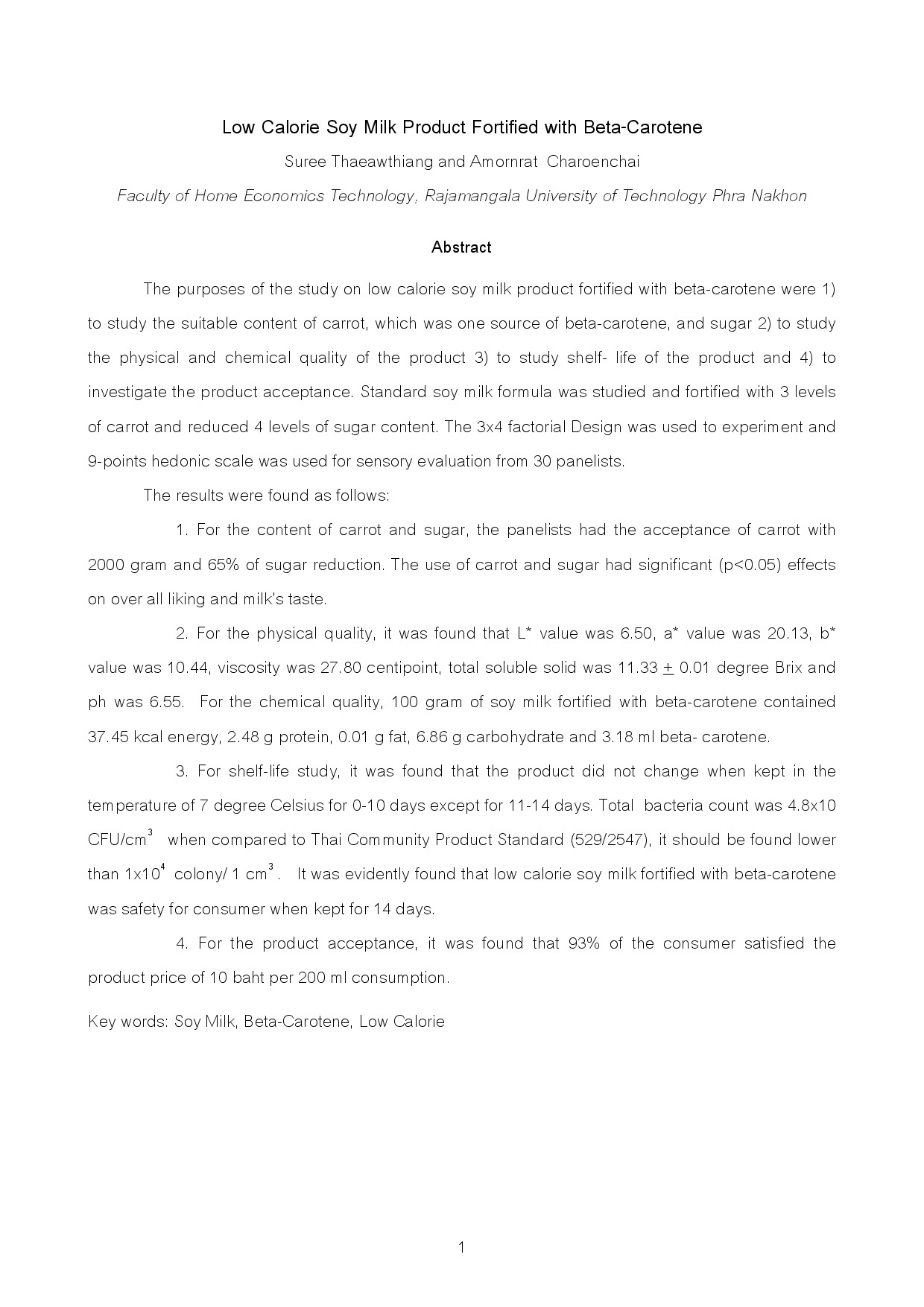
Low Calorie Soy Milk Product Fortified with Beta-Carotene
The purposes of the study on low calorie soy milk product fortified with beta-carotene were 1) to study the suitable content of carrot which was one source of beta-carotene and sugar 2) to study the physical and chemical quality of the product 3) to study shelf- life of the product and 4) to investigate the product acceptance. Standard soy milk formula was studied and fortified with 3 levels of carrot and reduced 4 levels of sugar content. The 3x4 factorial Design was used to experiment and 9-points hedonic scale was used for sensory evaluation from 30 panelists. The results were found as follows: 1. For the content of carrot and sugar the panelists had the acceptance of carrot with 2000 gram and 65% of sugar reduction. The use of carrot and sugar had significant (p<0.05) effects on over all liking and milk’s taste. 2. For the physical quality it was found that L* value was 6.50 a* value was 20.13 b* value was 10.44 viscosity was 27.80 centipoint total soluble solid was 11.33 + 0.01 degree Brix and ph was 6.55. For the chemical quality 100 gram of soy milk fortified with beta-carotene contained 37.45 kcal energy 2.48 g protein 0.01 g fat 6.86 g carbohydrate and 3.18 ml beta- carotene. 3. For shelf-life study it was found that the product did not change when kept in the temperature of 7 degree Celsius for 0-10 days except for 11-14 days. Total bacteria count was 4.8x10 CFU/cm3 when compared to Thai Community Product Standard (529/2547) it should be found lower than 1x10⁴ colony/ 1 cm3 . It was evidently found that low calorie soy milk fortified with beta-carotene was safety for consumer when kept for 14 days. 4. For the product acceptance it was found that 93% of the consumer satisfied the product price of 10 baht per 200 ml consumption.