จำนวน Repository ( 644 )
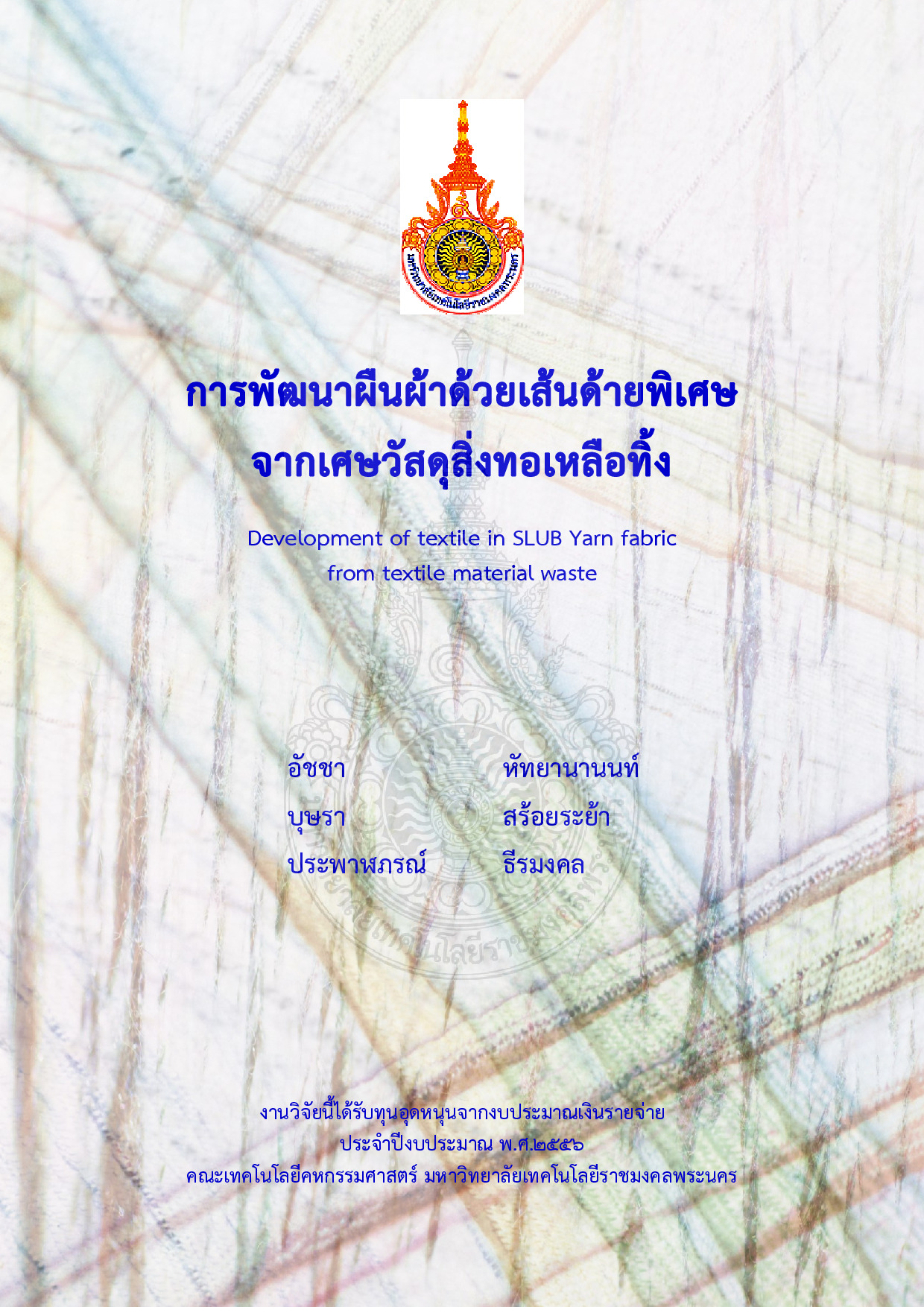
การพัฒนาผืนผ้าด้วยเส้นด้ายพิเศษจากเศษวัสดุสิ่งทอเหลือทิ้ง
The research aimed to Develop of textile in SLUB Yarn fabric from textile material waste. The purpose is to develop Fancy yarn (SLUB Yarn) from textile material waste. To develop woven with Fancy yarn (SLUB Yarn) textile material waste. To study Fancy yarn (SLUB Yarn) properties and woven with Fancy yarn (SLUB Yarn) from textile material waste. The First step is sorting and scouring textile material waste from silk yarn and to spin 2 types of Fancy yarn SLUB Yarn as 50 percent silk fiber blended with 50 percent Cotton and other type as 100 percent Silk. The Second steps is to testing of physical properties in the textile testing laboratory. The testing results are Silk Fancy yarn (SLUB Yarn) from textile material waste have twisted more than Silk blended with Cotton. It make textile material waste from Silk yarn smaller and stronger than Silk blended with Cotton and also more tenacity meanwhile it has highest tensile strength and elongation than Silk blended with Cotton. The Third steps to produce woven fabrics with plain weave structure. The weaving results have 2 fabrics the first types from Fancy yarn (SLUB Yarn) weaved by 50 percent Silk fiber blended with 50 percent Cotton in Industrial woven system and the second types from Fancy yarn (SLUB Yarn) weaved by 100 percent silk in hand woven system or with traditional weaving loom. The Last steps are to test the 8 topics physical properties of 2 woven in the textile testing laboratory. First Colorfastness to washing testing was found that Silk fabrics of Fancy yarn (SLUB Yarn) from textile material waste is durable to washing than 4.58 percent. Second Water absorbency Testing was found that both of two fabric types are equal to 60 (seconds). Third Moistures Management testing was found that the moisture absorption and wet textile as follows at 6 parts : the duration of the wet cloth was found that Silk fabrics of Fancy yarn (SLUB Yarn) from textile material waste is more absorbed than Silk fiber blended with Cotton and the duration of adsorption rate was found that Silk fiber blended with Cotton fabrics of Fancy yarn (SLUB Yarn) from textile material waste is better than Silk fabrics. The radial distribution of moisture on the both side of fabric surface was found that Silk fiber blended with Cotton fabrics of Fancy yarn (SLUB Yarn) from textile material waste is better and more effective and also there are the distribution and direction of motion better than Silk fabrics of Fancy yarn (SLUB Yarn) from textile material waste. MoreoverIt was humidity control overall properties. Forth Pilling Resistance Testing was found that both of 2 fabrics are Pilling Resistance fur and beads up on the surface slightly. Fifth Fabrics Thickness testing was found that Silk fabrics of Fancy yarn (SLUB Yarn) from textile material waste more over was 0.10 mm. Sixth Dimensional stability to washing after 5 times Testing (changes size after washing) was found that Silk fiber blended with Cotton fabrics of Fancy yarn (SLUB Yarn) from textile material waste was shrinkage after washing in the warp yarn more than -7.6 and shrinkage after washing in the weft yarn more than -7.0. Seventh pH-Acid Value Testing was found that Silk fiber blended with Cotton fabrics of Fancy yarn (SLUB Yarn) from textile material waste has pH-Acid less than 0.07. Eighth Heavy Metal Testing was found that Silk fiber blended with Cotton fabrics of Fancy yarn (SLUB Yarn) from textile material waste has 3 Heavy Metals such as chromium lead and copper while Silk fabrics of Fancy yarn (SLUB Yarn) from textile material waste has 2 Heavy Metals such as copper and lead.

การพัฒนาเว็บไซต์การจัดการองค์ความรู้ของคณะเทคโนโลยีราชมงคลพระนคร
The objectives of the research to gain an understanding of satisfaction feedbacks and needs of the users of knowledge management website of the Faculty of Mass Communication Technology Rajamangala University of Technology Phra Nakhon as well as to develop a proper knowledge management website. This research is a survey-based research which questionnaires are used as research tools. The research sampling consists of 256 lecturers students and staffs of the Faculty of Mass Communication Technology. Statistical methods used are average percentage standard deviation t-test Oneway ANOVA LSD chi-square and multiple regression analysis. The research findings are as follow: 1. Different demographics of the target group do not make much difference in satisfaction level. Factors such as sex status within the faculty age education monthly income and communication devices used do not effect user satisfaction. This fact does not correspond with our assumption. However there are some aspects that coincide statistically with our other assumptions for example age effects satisfaction level of website design while education effects satisfaction level of data utilization. 2. The access of knowledge management website is related to the utilization satisfaction. The relationship can be explained as follow: The access frequency of the Faculty of Mass Communication Technology’s knowledge management website has the maximum correlations of 10 while picture has 4 correlations which are device used for website access internet usage location usage time and access frequency of the website. Feedbacks and needs for website development has the maximum correlations of 4 in term of access frequency. In-depth knowledge has the maximum correlations of 2 in term of website development which are internet usage experience and access of knowledge management website. 3. Knowledge of the target group relates to the satisfaction feedbacks and needs of the knowledge management website development which can be explained as follow: Opinions and satisfaction in knowledge management site • Best Equation y = 1.457 +0.332 (faculty knowledge) +0.259 (knowledge attention) • Standard Equation ZY = 0.346 Z(faculty knowledge) + 0.264 Z(knowledge attention) Opinions and needs in the development of knowledge management site • Best Equation y = 1.391 +0.379 (faculty Knowledge) +0.235 (knowledge attention) • Standard Equation ZY = 0.386 Z(faculty knowledge) + 0.234 Z(knowledge attention)
การพัฒนาชุดการเรียนสำหรับผู้ขอใบอนุญาตประกอบวิชาชีพครูเพื่อเพิ่มสมรรถนะด้านการจัดการเรียนรู้กับความเป็นครู
การวิจัยเรื่องการพัฒนาชุดการเรียนรู้สำหรับผู้ขอใบอนุญาตประกอบวิชาชีพครู เพื่อเพิ่มสมรรถนะด้านการจัดการเรียนรู้กับความเป็นครู มีวัตถุประสงค์เพื่อพัฒนาชุดการเรียนรู้สำหรับผู้ขอใบอนุญาตประกอบวิชาชีพครู เพื่อเพิ่มสมรรถนะด้านการจัดการเรียนรู้กับความเป็นครู กลุ่มตัวอย่างเป็นนักศึกษาระดับประกาศนียบัตรบัณฑิตวิชาชีพครู ของมหาวิทยาลัยเทคโนโลยีราชมงคลพระนคร (ทั้งนี้เนื่องจากมหาวิทยาลัยเทคโนโลยีราชมงคลพระนคร ได้รับการรับรองหลักสูตรประกาศนียบัตรบัณฑิตวิชาชีพครู จากคุรุสภาเป็นแห่งแรก) จำนวน 45 คน โดยใช้วิธีเลือกแบบเจาะจง (Purposive Sampling) ผลการวิจัยพบว่า 1. ประสิทธิภาพของชุดการเรียนรู้สำหรับผู้ขอใบอนุญาตประกอบวิชาชีพครู เพื่อเพิ่มสมรรถนะด้านการจัดการเรียนรู้กับความเป็นครู มีประสิทธิภาพ เท่ากับ 88.97/88.43 ซึ่งสูงกว่าเกณฑ์ 80/80 ที่ตั้งไว้ 2. ผลสัมฤทธิ์ทางการเรียนของนักศึกษาหลังเรียนด้วยการใช้ชุดการเรียนรู้สำหรับผู้ขอใบอนุญาตประกอบวิชาชีพครู เพื่อเพิ่มสมรรถนะด้านการจัดการเรียนรู้กับความเป็นครู สูงกว่าก่อนเรียนอย่างมีนัยสำคัญทางสถิติที่ระดับ .05 3. ระดับความพึงพอใจของนักศึกษาที่มีต่อการใช้ชุดการเรียนรู้สำหรับผู้ขอใบอนุญาตประกอบวิชาชีพครู เพื่อเพิ่มสมรรถนะด้านการจัดการเรียนรู้กับความเป็นครู มีค่าเฉลี่ยโดยรวมทุกด้านอยู่ในระดับมาก (𝑥̅=4.30S.D.=0.69)
การพัฒนาแผ่นใยไม้อัดซีเมนต์จากการประยุกต์ใช้เส้นใยธรรมชาติจากกากมะพร้าวและต้นข้าวโพด
This research aims to study the application of coconut meal and corncob fiber as high density cement-bonded fiberboard. The cement: fine sand: coconut meal and corncob fiber: water ratio is equal to 1: 0.2: 0.05: 0.3. The fibers are taken from coconut meal and corncob that 5 ratios are used to all of fiber mixing. The fiberboard production use casting in normal temperature. Resulting the CN75 ratio (coconut meal and corncob fiber is equal to 0.0125: 0.0375) is suitable ratio which pass TIS 878- 2537 standard (cement bonded particle board) and has good physicalproperties mechanical properties and thermal insulation.
การพัฒนาระบบเทียบโอนรายวิชาในสถาบันอุดมศึกษา
การวิจัยครั้งนี้มีวัตถุประสงค์เพื่อ พัฒนาระบบการเทียนโอนรายวิชาในสถาบัน อุดมศึกษา หาประสิทธิภาพของระบบการเทียบโอนรายวิชาตามหลักสูตรครุศาสตร์อุตสาหกรรมบัณฑิต สาขาวิชาเครื่องกล (หลักสูตรใหม่ 2550) ผ่านระบบอินเตอร์เน็ต และหาความพึงพอใจของกลุ่มตัวอย่างที่มีต่อการใช้งานการเทียบโอนรายวิชา ผ่านระบบอินเตอร์เน็ต เครื่องมือที่ใช้สำหรับทดสอบหาคุณภาพโปรแกรม คือ แบบประเมิน ซึ่งแบบประเมินนี้เองได้ถูกสร้างขึ้นเพื่อใช้กับผู้เชี่ยวชาญ และกลุ่มตัวอย่าง ซึ่งการเก็บรวบรวมข้อมูลในโครงงานนี้ ได้แบ่งลักษณะการเก็บข้อมูลออกได้ 2 ด้าน คือ ด้านคุณภาพ และความพึงพอใจของผู้ใช้ ซึ่งหัวข้อในการประเมินออกเป็น 3 หัวข้อ มีรายละเอียดดังนี้ 1. ด้านรูปแบบของโปรแกรม 2. ด้านการใช้งานของโปรแกรมและอุปกรณ์ 3. ด้านประสิทธิภาพโปรแกรม จากผลของการวิเคราะห์ข้อมูลด้านรูปแบบโปรแกรม ของระบบการเทียบโอนรายวิชาตามหลักสูตรครุศาสตร์อุตสาหกรรมบัณฑิต (หลักสูตรใหม่ 2550) ผ่านระบบอินเตอร์เน็ต จากผู้เชี่ยวชาญ พบว่ามีค่าเฉลี่ย 4.77 ซึ่งอยู่ในเกณฑ์ดีมาก และ S.D.0.38 แสดงว่า ผู้เชี่ยวชาญมีความเห็นตรงกันว่าระบบการเทียบโอนราย วิชา ตามหลักสูตรครุศาสตร์อุตสาหกรรมบัณฑิต สาขาวิชาเครื่องกล (หลักสูตรใหม่ 2550) ผ่านระบบอินเตอร์เน็ตมีคุณภาพดีมาก ผลของการวิเคราะห์ข้อมูลการใช้งานของโปรแกรมและอุปกรณ์ของระบบการเทียบโอนายวิชา ตามหลักสูตรครุศาสตร์อุตสาหกรรมบัณฑิต สาขาวิชาเครื่องกล (หลักสูตรใหม่ 2550) ผ่านระบบอินเตอร์เน็ตจากผู้เชี่ยวชาญ พบว่ามีค่าเฉลี่ย 4.13 ซึ่งอยู่ในเกณฑ์ดี และ S.D. 0.57 แสดงว่า ผู้เชี่ยวชาญมีความเห็นตรงกันว่าระบบการเทียบโอนรายวิชาตามหลักสูตรครุศาสตร์อุตสาหกรรมบัณฑิต สาขาวิชาเครื่องกล (หลักสูตรใหม่ 2550) ผ่านระบบอินเตอร์เน็ต มีคุณภาพดี ผลของการวิเคราะห์ข้อมูลด้านประสิทธิภาพโปรแกรมของระบบการเทียบโอนรายวิชาตามหลักสูตรครุศาสตร์อุตสาหกรรมบัณฑิต สาขาวิชาเครื่องกล (หลักสูตรใหม่ 2550) ผ่านระบบอินเตอร์เน็ต จากผู้เชี่ยวชาญ พบว่ามีค่าเฉลี่ย 4.50 ซึ่งอยู่ในเกณฑ์ดีมาก และ S.D. 0.57 แสดงว่าผู้เชี่ยวชาญมีความเห็นตรงกันว่าระบบการเทียบโอนรายวิชาตามหลักสูตรมหาวิทยาลัยเทคโนโลยีราชมงคลพระนครผ่านระบบอินเตอร์เน็ต มีคุณภาพดีมาก สามารถนำเสนอได้อย่างมีประสิทธิภาพ