จำนวน Repository ( 1852 )
การผลิตและคุณลักษณะของแบคทีเรียลเซลลูโลสที่ผลิตด้วย Acetobacter xylinum TISTR 978 จากน้ำคั้นเปลือกสับปะรด
This research studies the production of bacterial cellulose from Acetobacter xylinum TISTR 975 with pineapple peel juice a low cost carbon source and coconut water as nutrient and carbon source. The factors influencing the production were studied including incubation time type of carbon sources and ratio of mixed carbon sources. In addition the characteristics of the produced bacterial cellulose were investigated using Fourier Transform Infrared Spectrophotometer (FTIR) Scanning Electron Microscope (SEM) Thermogravimetric Analyzer (TGA) Differential Scanning Colorimeter (DSC) and x-ray Diffractometer (xRD). It was found that the coconut water produced the amount of bacterial cellulose higher than the pineapple peel juice with 10 days of production. An addition of the coconut water into the pineapple peel juice increased the amount of bacterial cellulose. The characteristics of two bacterial celluloses from two different sources were nearly similar but the one from the pineapple peel juice had higher impurities. It can be concluded that the pineapple shell extract could be used as low cost carbon source for bacterial cellulose production.
Production and characterization of carboxymethyl cellulose from orange rind
It is known that orange rind is often discarded as garbage. This research examines the production of carboxymethyl cellulose (CMC) from orange rind. Cellulose was extracted from orange rind (2.0 g) through alkalization. The cellulose was extracted using 1.0 M NaOH at 80 ± 5oC for 60 min. The maximum yield of cellulose was obtained under this condition. The extracted cellulose was then alkalized and etherified to CMC using NaOH and chloroacetic acid after bleaching with H2O2. The resulting CMC was characterized through Infrared spectroscopy to determine the functional group of CMC. The presence of carboxyl group (COO-) at a wavenumber of 1586 cm-1 in the IR spectrum confirmed the conversion of cellulose to CMC. The surface morphology was also carried out through the SEM technique and the elemental analysis was performed using an EDX method. In addition the resulting CMC product was coated as a film on banana to observe for various reactions.
ผลของเปลือกหุ้มเมล็ดกาแฟและกากกาแฟต่อสมบัติของเชื้อเพลิงชีวมวลอัดเม็ด
The objective is to produce the biomass pellet fuel from coffee silverskin and spent of coffee grounds. To study the percentage of cassava powder as binder was mixed at 5 10 15 and 20% by weight and the best condition was chosen. Then to study the ratio of coffee silverskin and spent of coffee grounds was 5 ratios (100 : 0 75 : 25 50 : 50 25 : 75 and 0 : 100) on propertied of biomass pellet fuel. Characteristics and properties of raw materials and biomass pellet fuel were analyzed. The results found that the highest property of the biomass pellet fuel was 20% of cassava powder as binder. The biomass pellet from spent coffee grounds as main component was higher quality than coffee silverskin. The biomass pellet from spent coffee grounds was the maximum fuel property. The bulk density was 0.9699 0.0045 g/ cubic cm shatter index was 92.6510 ± 0.2102% heating value was 17.2772 ± 0.0319 MJ/kg and heat utilization efficiency was 16.59 ± 0.02%. The results from the part of coffee silverskin and spent of coffee grounds ratio showed that the best ratio from 2 raw materials was 25 : 75 that gave the highest quality. The heating value was 17.1544 ± 0.017 MJ/kg and heat utilization efficiency was 16.48 ± 0.01%. In addition the study also discovered that the biomass pellet had moisture contents in the levels acceptable under biomass standards. Thus in summary the coffee silverskin and spent coffee grounds had physical property and fuel property according to the standardization to be made into biomass pellet fuel. It considered to be one of alternative fuels in country permanently.
เทคนิคการสกัดน้ำมันและการผลิตไบโอดีเซลจากน้ำมันเมล็ดกระบก
This paper presents the experimental results of the oil extraction process from wild almond seeds by mechanical and chemical methods. The optimum conditions for the biodiesel production from the extracted oil via transesterification reaction using methanol and potassium hydroxide (KOH) are reported. Chemical extraction was found to be an effective technique for wild almond oil extraction. Simple distillation was used as oil extraction unit applying 140 ml of n-hexane as solvent at 70ºC for 20 min. The oil yield was 43.11±0.98%. This extracted oil was used as raw material for biodiesel production with the maximum yield of 83.20±1.11%. The optimum conditions for biodiesel production were the catalyst loading of 0.5 wt% and 9:1 molar ratio of methanol to oil in a controlled reaction temperature of 70ºC for 60 min. Finally the properties of biodiesel were analyzed and most properties met the requirements of the department of energy business standard.
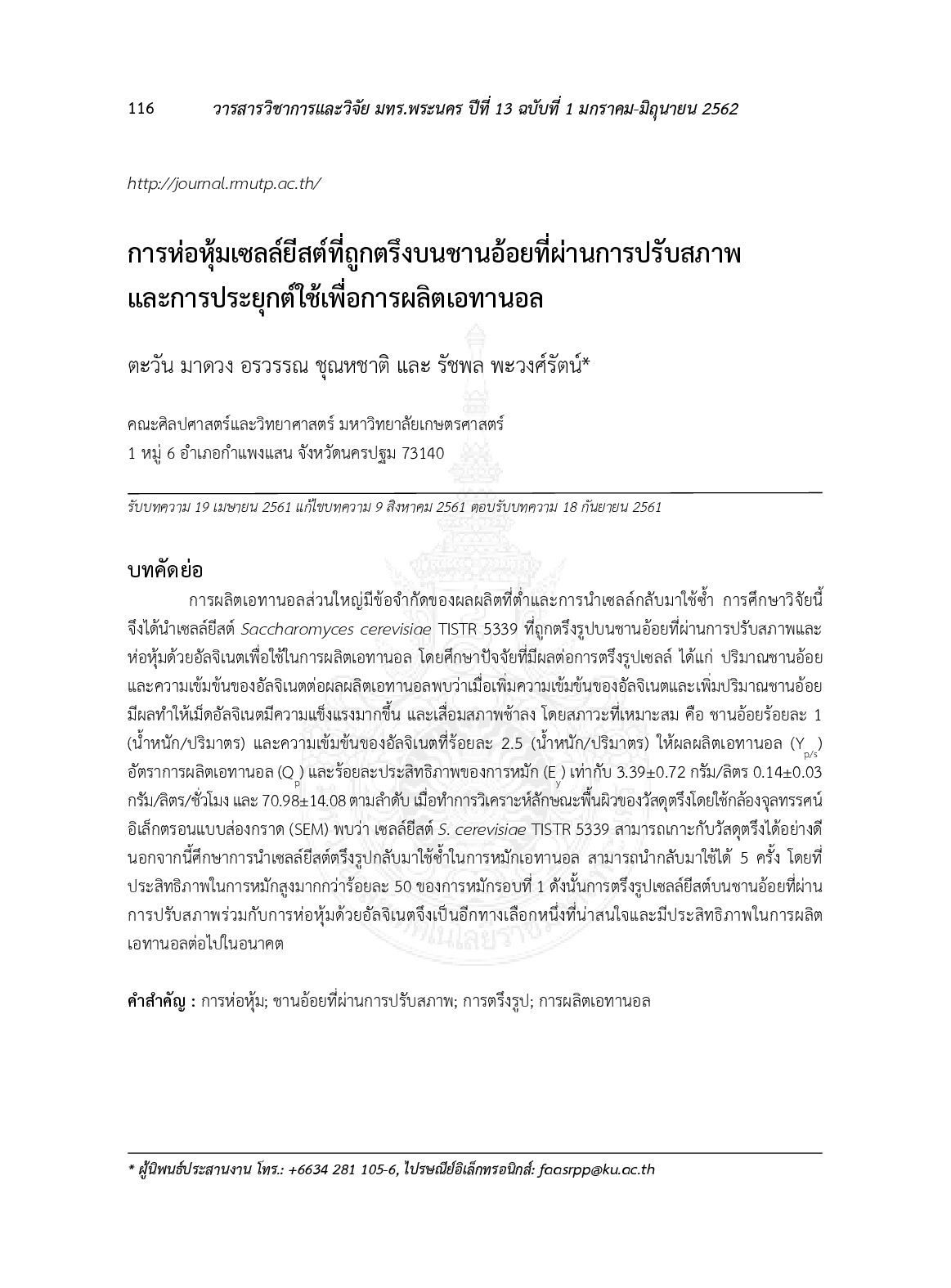
การห่อหุ้มเซลล์ยีสต์ที่ถูกตรึงบนชานอ้อยที่ผ่านการปรับสภาพและการประยุกต์ใช้เพื่อการผลิตเอทานอล
Most of ethanol production processes are limited by low ethanol production rate and recyclable problem of ethanologenic organisms. In the present study Saccharomyces cerevisiae TISTR 5339 entrapped in an aqueous mixture of alginate and pretreated-bagasse was used for ethanol production of immobilization parameter of yeast cells consisting of amount of bagasse and alginate concentration on ethanol production were investigated. The results showed that increase in alginate concentration and the amount of bagasse can increase structural strength and reduce deterioration of bead. The optimal condition of immobilization was 1.0% (w/v) bagasse and 2.5% alginate. Ethanol yield (Yp/s) ethanol production rate (Qp) and efficiency of fermentation (Ey) obtained from the bagasse-alginate immobilized yeast cell was 3.39±0.72 g/l0.14±0.03 g/l/h and 70.98±14.08% respectively. The ultrastructure obtained from SEM illustrated that S. cerevisiae TISTR 5339 was well incorporated within the bagasse-alginate matrix. Moreover the bagasse-alginate immobilized yeast cells were reusable at least 5 times with Ey higher than 50% of 1st round of fermentation. Therefore the pretreated bagasse-alginate immobilized yeast cells is an alternatively interesting techniques with effiiciency for ethanol production in the future.