จำนวน Repository ( 592 )
Influence of sucrose on the degradation of anthocyanins in makiang jam
The aim of this research was to study the influence of sucrose on the degradation of anthocyanins in makiang jam. Makiang flesh was prepared by three different methods. In the first method makiang flesh was mixed with sucrose at three different raitos (2:1 3:1 and 4:1) in the second method makiang flesh was soaked in sucrose solution (35 Brix) at three different ratios (1:1 1:1.5 and 1:2) and in the last method makiang flesh was prepared without addition of sucrose. After the jam processing makiang jams were stored at two different temperatures (the ambient temperature and 40 C) for 30 days to measure the degradation of anthocyanins. The results showed that the anthocyanins content in makiang jam decreased with increasing the storage time. The degradation of anthocyanins in makiang jam prepared by makiang flesh without addition of sucrose was higher than those prepared by mixing makiang flesh with sucrose or soaking makiang flesh in sucrose solution. Mixing makiang flesh with sucrose had lower anthocyanins degradation than soaking makiang flesh in sucrose solution. Makiang jam stored at the ambient temperature had lower anthocyanins degradation compared to those stored at 40 C.
The application of coconut meal, corncob and durian peel as wood-substituted biocomposites in medium density fiberboard
This research aims to study the application of coconut meal corncob and durian peel as wood-substituted biocomposites in medium density fiberboard. The fiber: urea formaldehyde glue: isocyanate glue with polymeric diphenymethane diisocyanate type (pMDI) ratio is equal to 1: 0.13: 0.003. The fibers are taken from coconut meal corncob and durian peel that 7 ratios are used to all of fiber mixing. The fiberboard production use 130?C of temperature with 20 – 50 kg/sq.cm of compressive pressure with 8 minutes per piece of rate. Their fiberboards have 603 – 856 kg/m of density that was tested follow the TIS 876-2547 standard. Resulting the MM33 ratio (coconut meal fibers: corncob fibers: durian peel fibers is equal to 0.33: 0.33: 0.33) and the CC50 ratio (coconut meal fibers: corncob fibers: durian peel fibers is equal to 0.50: 0.25: 0.25) can pass the standard in physical properties and mechanical properties. Moreover their fiberboards have good thermal insulation
Antibacterial activities of the crude extract of acrostichumaureum l. growing at Rajamangala University of Technology Srivijaya, Trang Campus
The aim of this research was to study the antibacterial activities of crude extract with hexane from the leaves stems corms and roots of Acrostichumaureum L. by disc diffusion method against the pathogens viz. Bacillus cereus TISTR687 Staphylococcus aureus TISTR1466 Escherichia coli TISTR780 and Salmonella typhimurium TISTR292. The results revealed that the leaves extracts showed antibacterial activity onall of fourtested pathogenic bacteria with the inhibition zone of 9.20 0.37 8.92 0.09 6.62 0.48 and7.82 0.56 mm.respectively. While the stems corms and roots extracts showed antibacterial activity ononly B. cereus with the inhibition zone of 8.02 0.25 8.51 0.21 and 10.87 0.13 mm. respectively. This preliminary screening results demonstrated the potential of the extracts from various parts of Acrostichumaureum L. to be used as antibacterial agent and to be further researched and developed into innovative pharmaceutical and cosmetic products.
Nutrient composition and ruminal degradability of arachis glabata using nylon bag technique in dairy cattle
Arachis glabata is new variety forage which tolerates drought and provide high protein.This kind of plant is suitable as dairy cow diet. The research was divided into 2 experiments Experiment 1 was conducted to study on nutritive value of Arachis glabata.The experimental design was Randomized Completely Block Design (RCBD) experiment with three treatments. Each treatment consisted of three blocks (three crops) and followed different three variety of Arachis glabata as Cv. Florigraze Cv. Arbook and Cv. Ecotart. Results showed that three variety of Arachis glabata were 28.26-30.75 % of dry matter (P>0.05). In addition Arachis glabata Cv. Arbook was grater 19.78 % of protein than other group of Arachis glabata (P<0.01). Furthermore Arachis glabata Cv. Florigraze was grater 17.63 of hemicelluloses and 3830.00 kcal/kg of gross energy significant different among other group of Arachis glabata (P<0.05). Experiment 2 was conducted to study on ruminal degradability of Arachis glabata using In situ technique in dairy cattle. The experimental design was Randomized Completely Block Design (RCBD) experiment with three treatments. Each treatment consisted of three blocks (three ruminally fistulated dairy cattle) and followed different three variety of Arachis glabata as Cv. Florigraze Cv. Arbook and Cv. Ecotart. Results showed that Arachis glabata Cv. Florigraze and Arachis glabata Cv. Arbook was grater dry matter organic matter and protein degradability at 0-4 hour and 24-28 hour than Arachis glabata Cv Ecotart (P<0.05). In addition kinetic of degradation (a b c and p) of dry matter organic matter and protein were not significant different (P>0.05) among three variety of Arachis glabata.
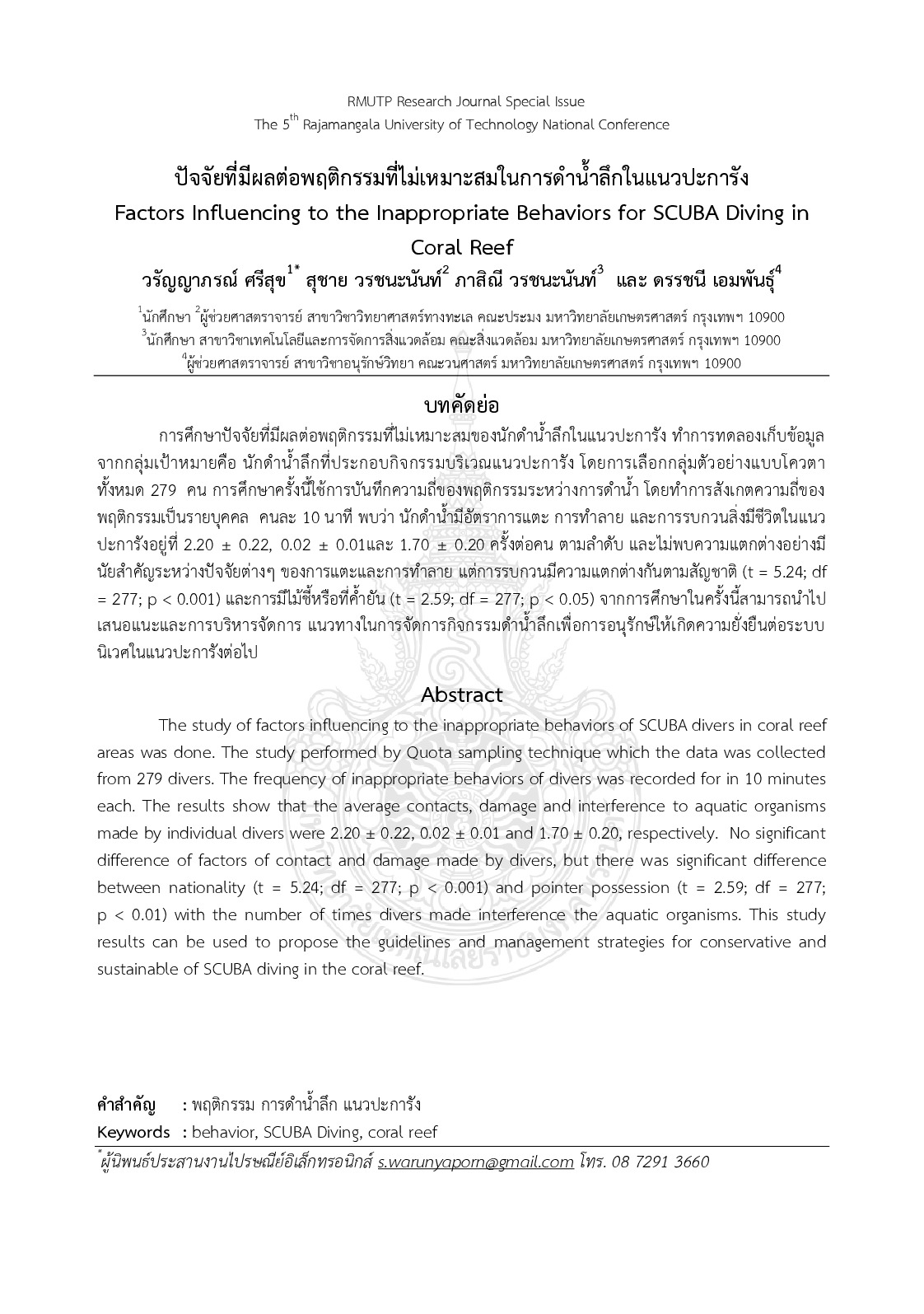
Factors influencing to the inappropriate behaviors for scuba diving in coral reef
The study of factors influencing to the inappropriate behaviors of SCUBA divers in coral reef areas was done. The study performed by Quota sampling technique which the data was collected from 279 divers. The frequency of inappropriate behaviors of divers was recorded for in 10 minutes each. The results show that the average contacts damage and interference to aquatic organisms made by individual divers were 2.20 0.22 0.02 ? 0.01 and 1.70 0.20 respectively. No significant difference of factors of contact and damage made by divers but there was significant difference between nationality (t = 5.24; df = 277; p < 0.001) and pointer possession (t = 2.59; df = 277; p < 0.01) with the number of times divers made interference the aquatic organisms. This study results can be used to propose the guidelines and management strategies for conservative and sustainable of SCUBA diving in the coral reef.