จำนวน Repository ( 2 )
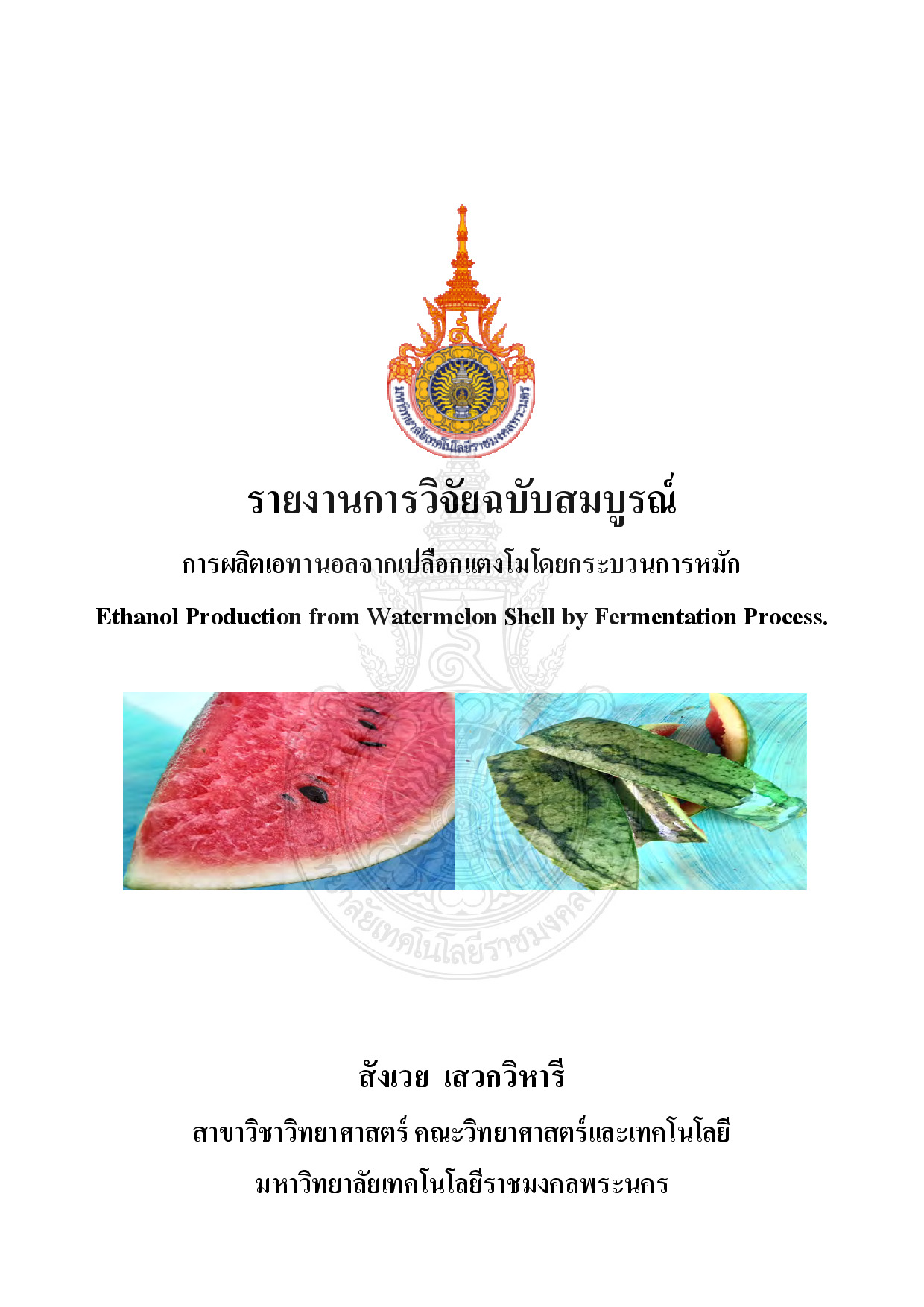
การผลิตเอทานอลจากเปลือกแตงโมโดยกระบวนการหมัก
Ethanol is a form of renewable energy. That can be used as fuel. Can replace gasoline or diesel. Fuel is an important factor driving the countrys economy. Ethanol can be produced from agricultural products garbage and various waste. his research uses watermelon rind. Which is waste from the community as a raw material for the production of ethanol by the fermentation process the microorganisms used in the fermentation process are ball flour. After fermentation for 6 hours it was found that the watermelon rind weighing 10 grams measured the concentration of alcohol. The concentration was 9.3 % VOL 18 Brix %. 20 grams of watermelon rind measuring the concentration of alcohol The concentration of 8.1 % VOL 16 Brix % of watermelon rind at 30 grams measured the concentration of alcohol. Get the concentration 8 % VOL 16 Brix % watermelon rind at 40 grams measure the concentration of alcohol get the concentration of 7.9 % VOL 15.1 Brix % and watermelon rind at 50 grams measure the concentration of alcohol the concentration of 7 % VOL 15 Brix %. Therefore it can be said that the watermelon rind which is waste from the community. Is a raw material with high potential for ethanol production to be used as a renewable energy source Instead of using raw materials from food plants and other energy crops.
การปรับสภาพขุยมะพร้าวเพื่อผลิตแก๊สชีวภาพโดยกระบวนการหมักแบบไม่ใช้ออกซิเจนร่วมกับมูลวัว
The optimal pretreatment condition of coconut husk by physicochemical methods for biogas production was investigated. The coconut husk was dried and ground into powder (~0.1 nm) and was then determined for chemical contents such as cellulose hemi-cellulose and lignin respectively. The chemical contents of cellulose hemi-cellulose and lignin were 35.67±2.02 7.41±0.69 and 40.82±0.62 w/w respectively. After pretreatment with 4 different methods the results showed that the pretreatment of sodium hydroxide 30 % (w/w) gave the highest chemical contents of cellulose hemi-cellulose and lignin with 43.30±0.03 33.69±7.48 and 27.36±0.03 w/w respectively. As for the biogas production the result showed that the ratio of coconut husk to cow dung of 1:4 with C:N ratio of 23:1 gave the highest cumulative biogas of 442.6 ml for 30 days. Methane and carbon dioxide contents were 46.1 and 23.1 %. Moreover the removal percentages of the total solids (TS) volatile solid (VS) suspended solids (SS) and COD were 69.3 32.5 50.0 and 58.4 % respectively. The coconut husk could be used as an alternative material for the application of biogas production with cow dung in the near future.