จำนวน Repository ( 5 )
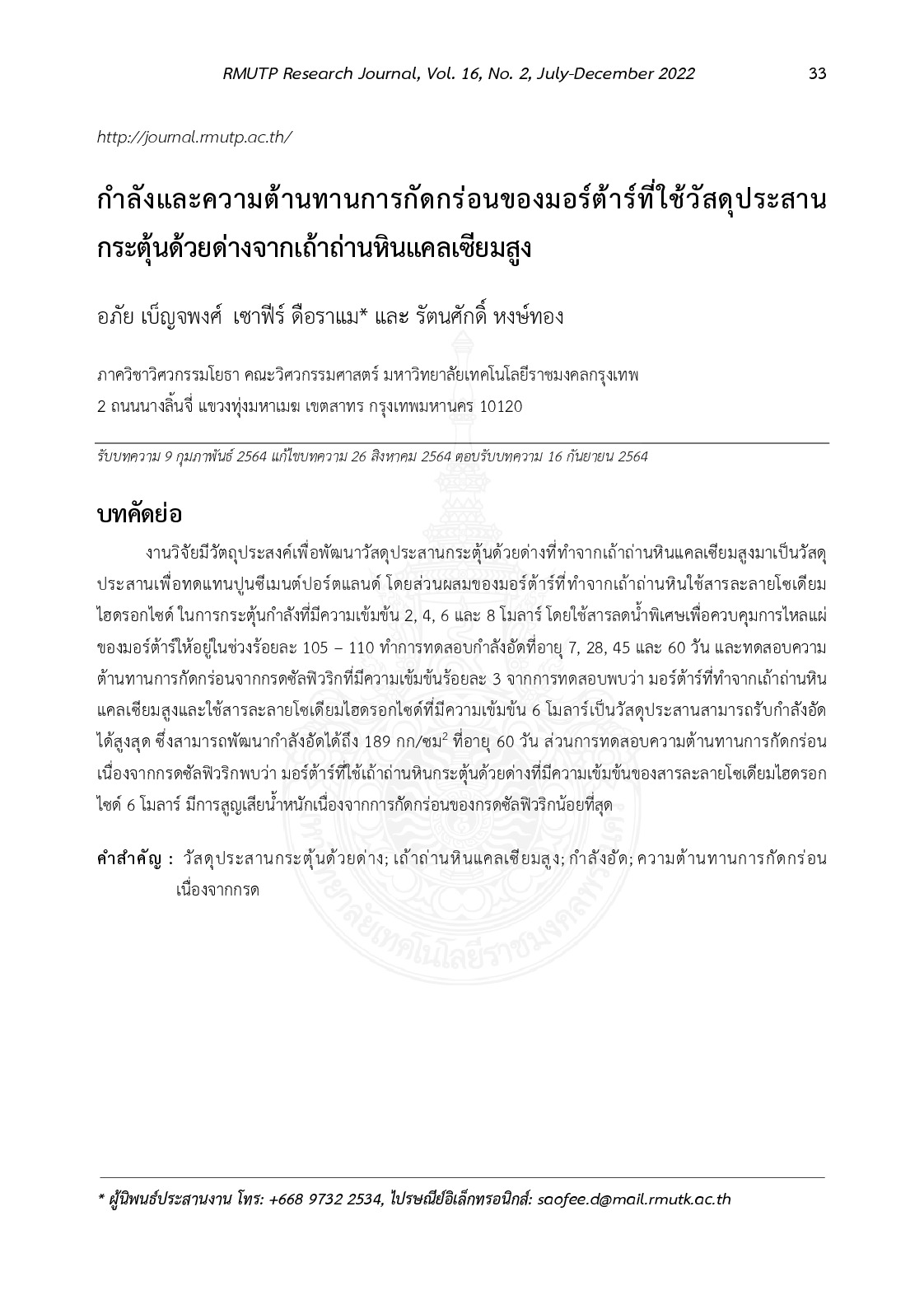
กำลังและความต้านทานการกัดกร่อนของมอร์ต้าร์ที่ใช้วัสดุประสานกระตุ้นด้วยด่างจากเถ้าถ่านหินแคลเซียมสูง
The aim of this study is developed of alkali activated high calcium fly ash to use as cementitious material to replace Portland cement. The mixture of mortar made from fly ash and sodium hydroxide solution (NaOH) was used to activate strength at concentrations of 2 4 6 and 8 molars. Superplasticizer was used to control the flow of mortar in the rage of 105 – 110. The compressive strength of mortar was determined at 7 28 45 and 60 days. The acid resistance of mortars due to sulfuric at a concentration of 3% were also investigated. The results showed the mortar made from high calcium fly ash with sodium hydroxide of 6 molar obtained the highest compressive strength which could be developed compressive strength up to 189 ksc at 60 days. For the acid resistance of mortar it was found that the of use 6 molar of NaOH activated high calcium fly ash binder had the least weight loss due to sulfuric acid attack.

การประเมินอัตราการกัดกร่อนของผิวเชื่อมพอกไส้ฟลักซ์เกรด x111-t5-k4 และ e71t-1ch8/t/9m-d
After a propeller shaft was damaged from chloride in sea water it has been fixed by MAG welding process with flux cored wire. Its service life after welded depends on the corrosion resistance of the weld metal. This research aimed to compare the corrosion resistance of two different weld metals between X111-T5-K4 and E71T-1CH8/T/9M-D flux core wire. The test specimens were prepared according to the ASTM G1-103 standard and tested by salt spray test conforming to the ASTM B 117 standard. The result of the test showed that the corrosion rate of the weld metal using X111-T5-K4 flux cored wire is lower than the weld metal of E71T-1CH8/T/9M-D flux cored wire which was 0.21 and 0.32 mm2/hr. respectively. The mass loss at 24 hours of E71T-1CH8/T/9M-D X111-T5-K4 flux core wire were 0.32 and 0.48 grams respectively. Therefore enhancing the service life of propeller shaft from chloride corrosion should use X111-T5-K4 flux core as weld metal
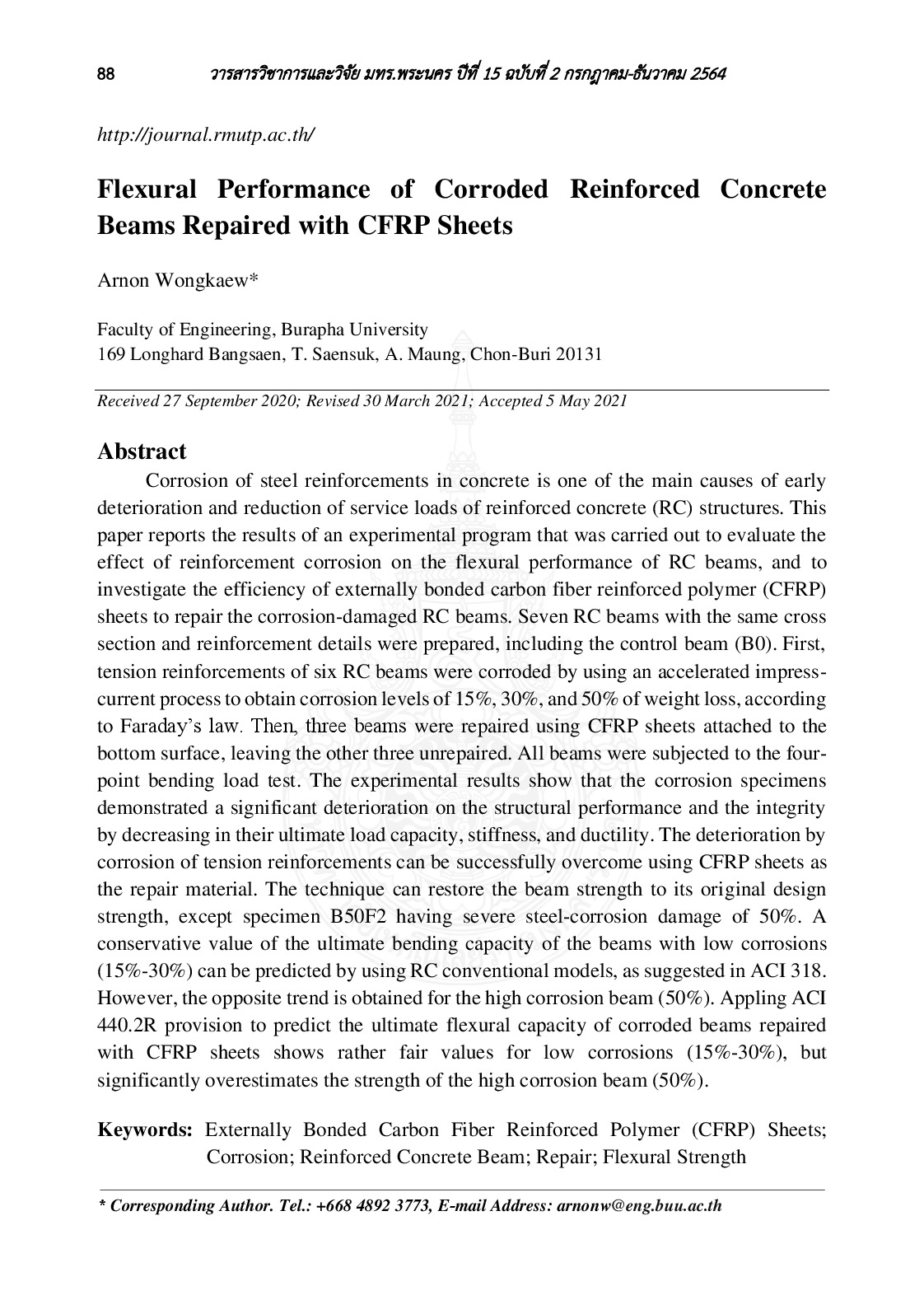
Flexural performance of corroded reinforced concrete beams repaired with CFRP sheets
Corrosion of steel reinforcements in concrete is one of the main causes of early deterioration and reduction of service loads of reinforced concrete (RC) structures. This paper reports the results of an experimental program that was carried out to evaluate the effect of reinforcement corrosion on the flexural performance of RC beams and to investigate the efficiency of externally bonded carbon fiber reinforced polymer (CFRP) sheets to repair the corrosion-damaged RC beams. Seven RC beams with the same cross section and reinforcement details were prepared including the control beam (B0). First tension reinforcements of six RC beams were corroded by using an accelerated impress-current process to obtain corrosion levels of 15% 30% and 50% of weight loss according to Faraday’s law. Then three beams were repaired using CFRP sheets attached to the bottom surface leaving the other three unrepaired. All beams were subjected to the four-point bending load test. The experimental results show that the corrosion specimens demonstrated a significant deterioration on the structural performance and the integrity by decreasing in their ultimate load capacity stiffness and ductility. The deterioration by corrosion of tension reinforcements can be successfully overcome using CFRP sheets as the repair material. The technique can restore the beam strength to its original design strength except specimen B50F2 having severe steel-corrosion damage of 50%. A conservative value of the ultimate bending capacity of the beams with low corrosions (15%-30%) can be predicted by using RC conventional models as suggested in ACI 318. However the opposite trend is obtained for the high corrosion beam (50%). Appling ACI 440.2R provision to predict the ultimate flexural capacity of corroded beams repaired with CFRP sheets shows rather fair values for low corrosions (15%-30%) but significantly overestimates the strength of the high corrosion beam (50%).
การตรวจสอบความเสียหายของถังเก็บน้ำมันด้วยการตรวจสอบแบบไม่ทำลายโดยใช้เทคนิคการปลดปล่อยคลื่นเสียง
Non-destructive test with Acoustic Emission technique was used for monitoring of the corrosion in the above ground oil storage tank. In the analytical characteristics of acoustic emission wave however Acoustic Emission test has to be prior used for the location detection of corrosion especially indication of the severity of corrosion. In this research the relationship between the corrosion rate and the sound wave energy was studied. The corrosion and damage detected on the surface of the aboveground storage tank was determined by the Acoustic Emission Test. Nine pieces of low carbon steel grade SS400 was soaked in sodium chloride solution in simulated tanks at concentrations of 1.5 3.5 and 5.5 wt%. Next the corrosion activity was checked by performing with the Acoustic Emission Testing for 1 hour and thus calculating the corrosion rate of the test specimens. From the experiment it was found that the rate of corrosion affects the Acoustic Emission Energy. The corrosion rate was increased with the concentrations of the solution increasing from the corrosion process. The corrosion rate was also increased with the sound wave power increases. Therefore in order to achieve the corrosion rate and the position of the defects on the inner surface of the tank non-destructive testing with acoustic emission technique can be factually chosen for this specific application.
นวัตกรรมคอนกรีตต้นทุนต่ำไหลเข้าแบบง่ายโดยการใช้เถ้าทิ่้ง
This research presents a study of the compressive strength porosity chloride penetration resistance to carbonation and corrosion of self-compacting concrete containing fly ash ground rice husk-bark ash and ground bottom ash. Portland cement (CT) is partially replaced with pozzolans 0-40% by weight of the cementitious materials. Fly ash ground rice husk-bark ash and ground bottom ash have a high potential to be used as a good cementitious material. The results show that the compressive strength and low porosity of self-compacting concrete improves substantially with partial replacement of Portland cement with fly ash. Self-compacting concrete mix cement containing 20-40% of pozzolans can be used to make cementitious materials. The use of fly ash ground rice husk-bark ash and ground bottom ash produces concrete mix with good strength and resistance to chloride and corrosion.