จำนวน Repository ( 4 )
การทำนายค่าความหนาของชิ้นงานพาราโบลิกที่เกิดจากความไม่แน่นอนของคุณสมบัติโลหะแผ่นด้วยสมการการถดถอย
This research aims to predict the thickness loss of parabolic forming by using hydromechanical deep drawing (HMD) process. The methodology used is the finite element method on the uncertainty of the mechanical properties for 1 mm thickness SPCC sheet metals. The properties consisted of three aspects: strength coefficient (K) strain hardening exponent (n-value) and plastic strain ratio for all three axis (r0 r45 and r90). Multiple simulations were completed by randomly selecting K n r0 r45 and r90 values following the distribution obtained from the uniaxial tensile test. The results would be analyzed by using the regression equation to create the equation to predict the thickness loss of the test pieces obtained from the formation process using the K n r0 r45 and r90 variables without the use of finite element method. This would results in a decrease in the simulation time. Based on 30 experiments of uniaxial tensile test it shows that the sheet metal properties are normally distributed. After that 60 cases of the five variables were randomly selected to simulate the formation by using the finite element method. Finally the results obtained from the aforementioned simulation is analyzed and generated into a regression equation. From the comparison between the value predicted from the regression equation and the result obtained from the formation process it can be seen that the regression equation can effectively predict the thickness loss when the five variables are under the same distribution properties. However the efficiency will decrease when the values of the five variables are beyond the distribution properties obtained from the experiment. In addition the uncertainty of mechanical properties of sheet metal in the simulation displays the chances of discovering test pieces with over 40% thickness loss. The simulation resulted in 5 damaged test pieces accounting for 8.33% of the total process.
การพัฒนาเงื่อนไขขอบเขตของแบบจำลองน้ำตื้นเพื่อขยายการทำนายมรสุมตะวันออกเฉียงเหนือ
The shallow water model is a mathematical model was developed from the shallow water equations. It consists of the continuous flow and the momentum equation of non-linear in the x-axis and y-axis. The boundary conditions of the model is the cyclic continuity from east to west and the open boundary conditions from north to south. The northeast monsoon forecast by the shallow water model can’t be predicted in a long time period because the boundary conditions of the model has a problem. Thus improvement the boundary conditions of shallow water model by using wall boundary condition from north to south. The results of this research to found that the shallow water model can correctly forecast the northeast monsoon period in the long term.
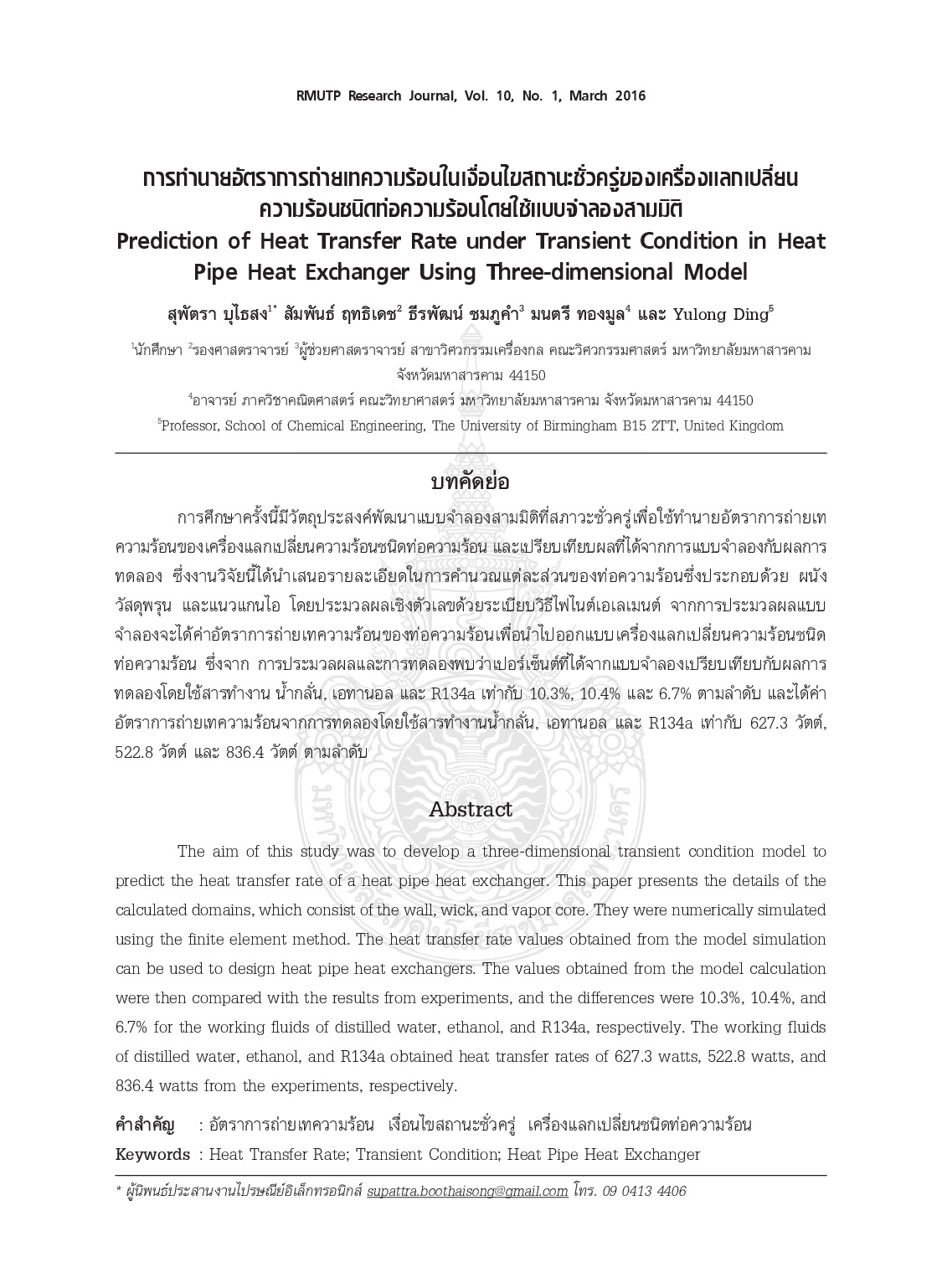
การทำนายอัตราการถ่ายเทความร้อนในเงื่อนไขสถานะชั่วครู่ของเครื่องแลกเปลี่ยนความร้อนชนิดท่อความร้อนโดยใช้แบบจำลองสามมิติ
The aim of this study was to develop a three-dimensional transient condition model to predict the heat transfer rate of a heat pipe heat exchanger. This paper presents the details of the calculated domains which consist of the wall wick and vapor core. They were numerically simulated using the finite element method. The heat transfer rate values obtained from the model simulation can be used to design heat pipe heat exchangers. The values obtained from the model calculation were then compared with the results from experiments and the differences were 10.3% 10.4% and 6.7% for the working fluids of distilled water ethanol and R134a respectively. The working fluids of distilled water ethanol and R134a obtained heat transfer rates of 627.3 watts 522.8 watts and 836.4 watts from the experiments respectively.