จำนวน Repository ( 10 )
การปรับปรุงคุณภาพไฟฟ้าในระบบจำหน่ายไฟฟ้าโดยการเชื่อมต่อแหล่งผลิตไฟฟ้าแบบกระจายตัวพลังงานแสงอาทิตย์
This thesis presents improving power quality in power distribution system with integration of photovoltaic energy distributed generation having objectives to improve power quality in distribution system model of voltage sag and voltage swell in distribution system model of power loss in distribution system application of mathematical model model of power generation by using solar energy and distributed generation connection technique simulation. In this thesis the power flow was tested with Newton-Raphson algorithm joining with mathematical model. The case study was done by reduction of power loss in distribution system by using techniques of connection of distributed generation joining with model of distribution system 33 bus. The case study about improvement of voltage sag and voltage swell in distribution system used connection techniques of distributed generation joining with model of distribution system 69 bus. The study found that technique of connection of distributed generation that was presented could reduce power loss and showed the percentage of improvement of voltage sag and voltage swell in distribution system especially voltage sag case according to IEEE 1159-1995 standard. This thesis showed that severity level of voltage sag depended on the size and duration of each distribution system model situation by photovoltaic energy distributed generation can reduce voltage sag.

การปรับปรุงคุณภาพมะขามหวานด้วยความร้อนระดับครัวเรือนเพื่อวิสาหกิจชุมชน
Sweet tamarind is a unique and economic plant of Phetchaboon province and it has already been geographical indication (GI) registered. One of its main problems is fungal degeneration which cannot be physically visible. This causes the consumer’s uncertainty on its quality especially sweet tamarind from small communities. This led to the study on the use of household heat to reduce fungal degeneration by steaming at 100oC for 50 60 70 and 80 minutes and drying in the hot air oven at 70oC for 3 hours. It was found that increasing the heat resulted in darkening the sweet tamarind color and heightening up its content moisture (p<0.05) statistical significance. Drying temperature at 60 70 and 80oC revealed the higher the heat the shorter the drying time and the sweet tamarind content was darker. In addition drying significantly decreased the moisture and preference score of sweet tamarind (p<0.05). The storage of sweet tamarind in mesh bag at ambient temperature revealed that the increase of the storage time resulted in a significant increase in the moisture of the sweet tamarind shell (p<0.05) and could preserve the tamarind for at least 12 weeks without the deterioration from the fungus.
การปรับปรุงคุณภาพขนมปังโดยใช้แป้งสุก
Bread is a bakery product with low moisture content. It have a hard and sticky texture that cause difficult to eat. Therefore in the present study the effect of gelatinized starch (wheat corn rice tapioca and glutinous starch) to improve of bread quality was determined. Starch were gelatinized and added as bread ingredients. Gelatinized starch influenced the quality of bread. The bread obtained gelatinized starch with high specific volume and moisture content but low density (p≤0.05). Sensory evaluation showed that the bread which contained from gelatinized tapioca starch obtained highest score especially texture and overall acceptance from the panelists. Tapioca gel has been used as texture improving agent in bead. The effect of tapioca gel on the quality of bread were determined. The tapioca gel (0 20 30 40 and 50% of wheat starch) was used in the formulation of the bread. Increasing tapioca gel improved specific volume moisture content density and sensory quality (p≤0.05); however these quality were deteriorated as add tapioca gel up to 50% (p≤0.05).
การศึกษาอุณหภูมิในการเผาเปลือกหอยลายเพื่อการปรับปรุงคุณภาพดิน
The purpose of this research was to study the temperature of burning surf clam shell for soil quality improvement. The experiment was divided two parts 1) the study of the optimum temperature for calcium oxide production by burning 800 900 1000 and 1100 °C 2) the study of using calcium oxide to improve soil qualities of acidic soil and saline soil. The parameters used in the analysis included elements of soil particles soil moisture pH conductivity total content nitrogen phosphorus and potassium. The results showed that the optimum temperature for the production of calcium oxide was 1100 °C since it provided the highest calcium oxide content of 90 % by weight. After applying calcium oxide into acidic soil the composition of soil particles was changed from sandy clay to sandy clay loam. In contrast the soil particle was not changed but the proportion was changed in saline soil. It was also found that calcium oxide reduced soil moisture and influenced the acidity of soil by increasing the pH from 3.39 to 6.92 in acidic soil and 6.49 to 9.11 in saline soil. In addition it was found that the electrical conductivity of the soil was related to salinity. In acidic soil the conductivity of before and after inputting calcium oxide were 0.87 and 1.24 dS/m respectively. In the case of saline soil the conductivity of before and after improvement were 14.37 and 18.80 dS/m respectively. Besides it was found that the total content of nitrogen phosphorus and potassium were reduced after the experiment.
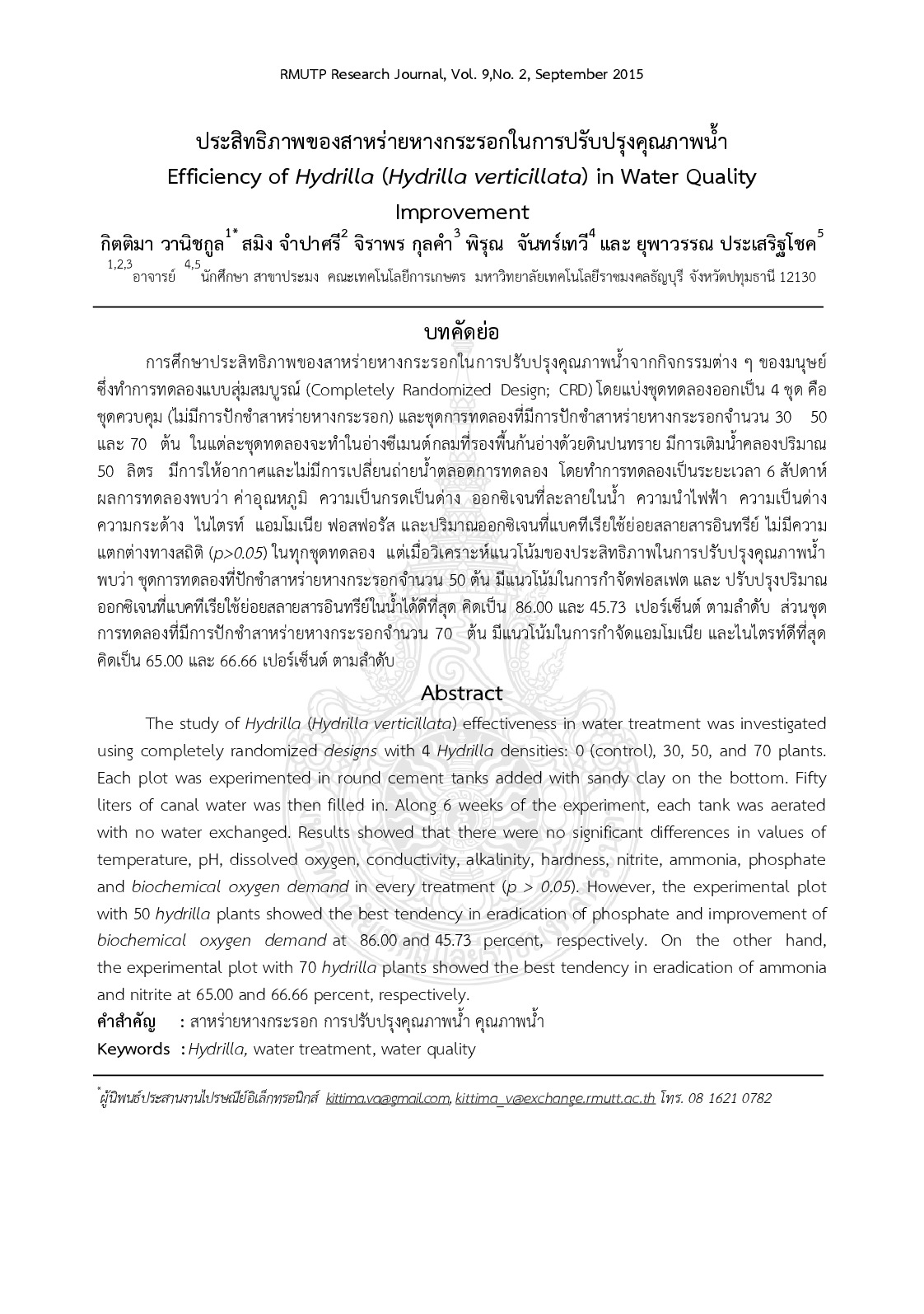
ประสิทธิภาพของสาหร่ายหางกระรอกในการปรับปรุงคุณภาพน้ำ
The study of Hydrilla (Hydrilla verticillata) effectiveness in water treatment was investigated using completely randomized designs with 4 Hydrilla densities: 0 (control) 30 50 and 70 plants. Each plot was experimented in round cement tanks added with sandy clay on the bottom. Fifty liters of canal water was then filled in. Along 6 weeks of the experiment each tank was aerated with no water exchanged. Results showed that there were no significant differences in values of temperature pH dissolved oxygen conductivity alkalinity hardness nitrite ammonia phosphate and biochemical oxygen demand in every treatment (p > 0.05). However the experimental plot with 50 hydrilla plants showed the best tendency in eradication of phosphate and improvement of biochemical oxygen demand at 86.00 and 45.73 percent respectively. On the other hand the experimental plot with 70 hydrilla plants showed the best tendency in eradication of ammonia and nitrite at 65.00 and 66.66 percent respectively.