จำนวน Repository ( 3 )
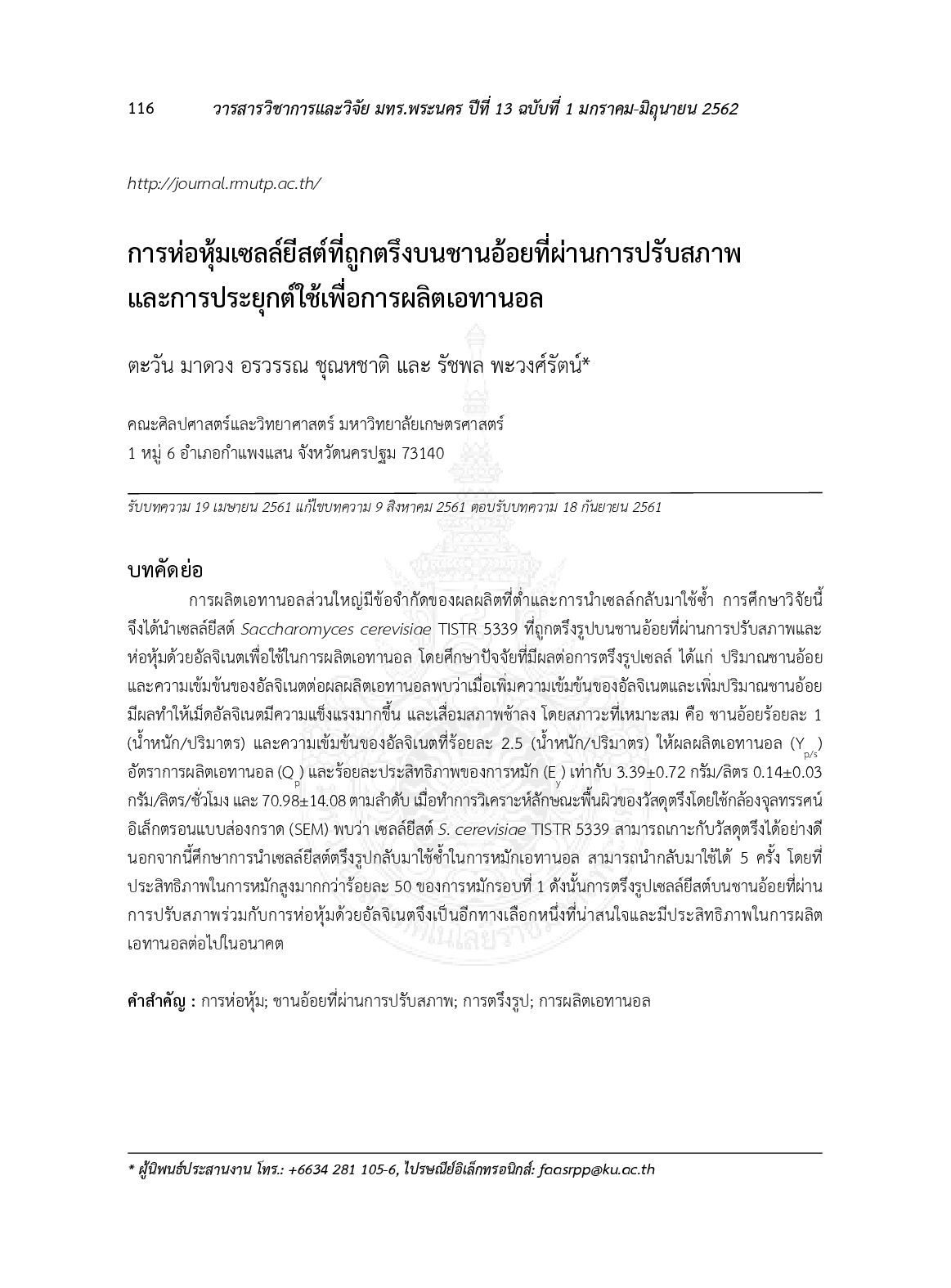
การห่อหุ้มเซลล์ยีสต์ที่ถูกตรึงบนชานอ้อยที่ผ่านการปรับสภาพและการประยุกต์ใช้เพื่อการผลิตเอทานอล
Most of ethanol production processes are limited by low ethanol production rate and recyclable problem of ethanologenic organisms. In the present study Saccharomyces cerevisiae TISTR 5339 entrapped in an aqueous mixture of alginate and pretreated-bagasse was used for ethanol production of immobilization parameter of yeast cells consisting of amount of bagasse and alginate concentration on ethanol production were investigated. The results showed that increase in alginate concentration and the amount of bagasse can increase structural strength and reduce deterioration of bead. The optimal condition of immobilization was 1.0% (w/v) bagasse and 2.5% alginate. Ethanol yield (Yp/s) ethanol production rate (Qp) and efficiency of fermentation (Ey) obtained from the bagasse-alginate immobilized yeast cell was 3.39±0.72 g/l0.14±0.03 g/l/h and 70.98±14.08% respectively. The ultrastructure obtained from SEM illustrated that S. cerevisiae TISTR 5339 was well incorporated within the bagasse-alginate matrix. Moreover the bagasse-alginate immobilized yeast cells were reusable at least 5 times with Ey higher than 50% of 1st round of fermentation. Therefore the pretreated bagasse-alginate immobilized yeast cells is an alternatively interesting techniques with effiiciency for ethanol production in the future.
การปรับสภาพผิวและการย้อมสีครามธรรมชาติบนเส้นใยป่าศรนารายณ์
This study aims to investigate on the adjustment of texture and indigo dye using natural substance on Sisal fibre. Temperature time period conditions of texture adjustment process and ombre dying techniques on braided Sisal fibre are used as focal factors of the study. To elaborate further the proper condition to alter braided Sisal fibre is by using softening agent and Surfactant each for 5 grams per litre at the temperature of 50 degree Celsius for 30 minutes as a result the tensile strength of the processed fibre has been reduced compared to the pre-processed ones. After the adjustment process the fabric will be dyed in natural indigo dye with 5 distinctive pigment concentrations of 20 30 40 100 and 200 grams per litre respectively. The colour fastness to washing is at good to high level while artificial light fastness is at an excellent level (level 8). The colour fastness to rubbing under dry condition of the deepest pigment (of 200 grams per litre) indigo-dyed braided Sisal fibre simmered with Sodium Hydroxide and boiled with softening agent and Surfactant is at low level and the colour fastness to rubbing under wet condition of the deepest pigment (of 200 grams per litre) indigo-dyed braided Sisal fibre simmered in Sodium Hydroxide and boiled with softening agent and Surfactant is relatively low to average. Thus it indicates that the softening agent could adjust Sisal fibre and its texture to be smoother and natural indigo dye could be adapted to dying Sisal textile as well.
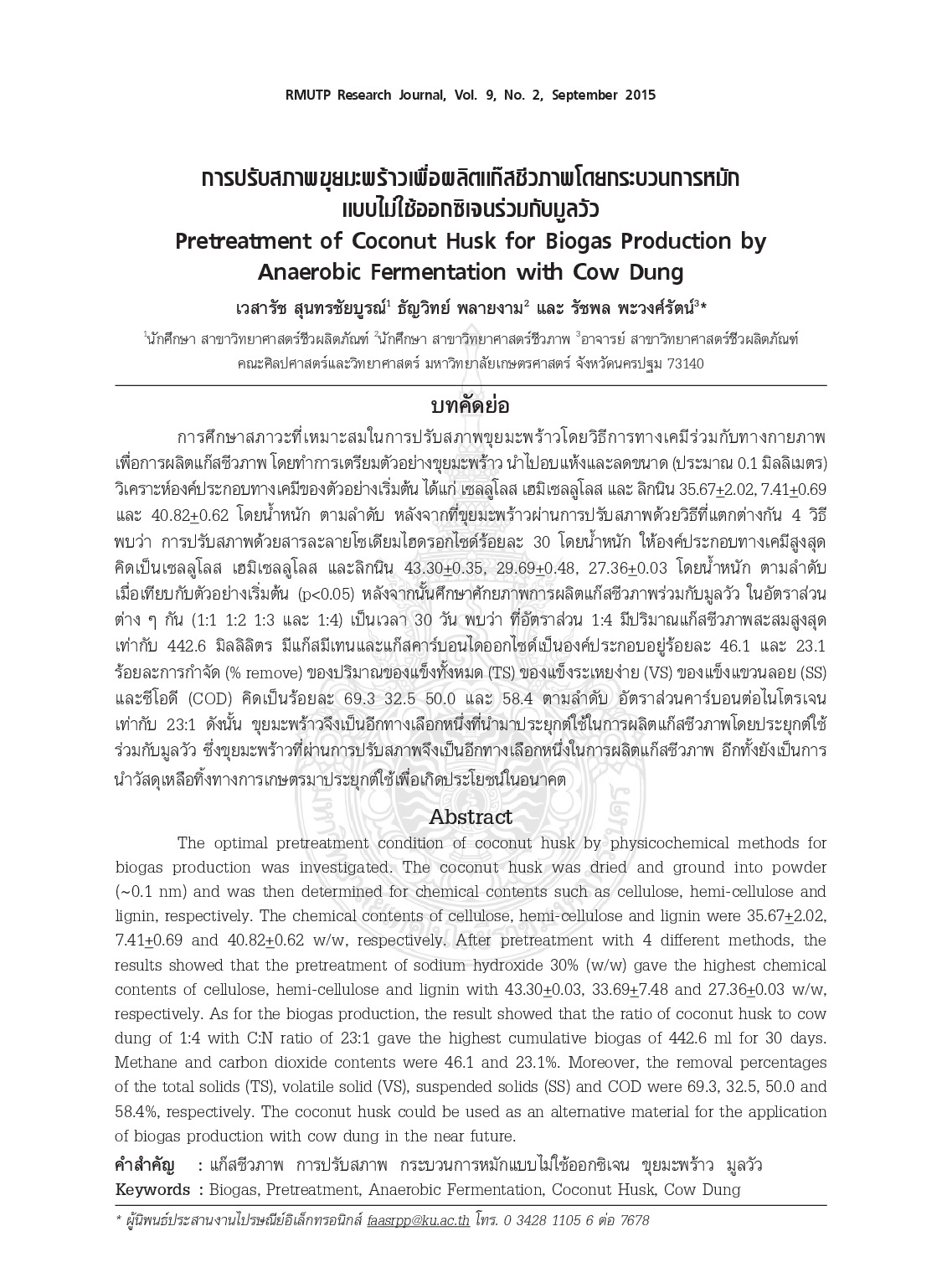
การปรับสภาพขุยมะพร้าวเพื่อผลิตแก๊สชีวภาพโดยกระบวนการหมักแบบไม่ใช้ออกซิเจนร่วมกับมูลวัว
The optimal pretreatment condition of coconut husk by physicochemical methods for biogas production was investigated. The coconut husk was dried and ground into powder (~0.1 nm) and was then determined for chemical contents such as cellulose hemi-cellulose and lignin respectively. The chemical contents of cellulose hemi-cellulose and lignin were 35.67±2.02 7.41±0.69 and 40.82±0.62 w/w respectively. After pretreatment with 4 different methods the results showed that the pretreatment of sodium hydroxide 30 % (w/w) gave the highest chemical contents of cellulose hemi-cellulose and lignin with 43.30±0.03 33.69±7.48 and 27.36±0.03 w/w respectively. As for the biogas production the result showed that the ratio of coconut husk to cow dung of 1:4 with C:N ratio of 23:1 gave the highest cumulative biogas of 442.6 ml for 30 days. Methane and carbon dioxide contents were 46.1 and 23.1 %. Moreover the removal percentages of the total solids (TS) volatile solid (VS) suspended solids (SS) and COD were 69.3 32.5 50.0 and 58.4 % respectively. The coconut husk could be used as an alternative material for the application of biogas production with cow dung in the near future.