จำนวน Repository ( 5 )
การวิเคราะห์ระบบสินค้าคงคลังโดยใช้ตัวแบบสินค้าคงคลังเชิงสโตคาสติก: กรณีศึกษาอุตสาหกรรมเหล็กและเหล็กกล้าของไทย
The objectives of this research were to select the most appropriate forecasting model for uncertain demand of hot-rolled steel and to find the purchase amount and the reorder point of some raw materials in order to minimize the total cost of production in an iron and steel production planning. The three forecasting models which were exponential model ARIMS model and the proposed Bayesian model were studied. An iron and steel factory in Samutprakarn province was a prototype for this study. Because of their uncertain high demand the Steel H-Beam Steel plate steel round bar and black steel round bar with various sizes were selected and their parameters including demand rate inventory cost back order cost and setup cost were collected. The study found that the proposed Bayesian forecasting model is the most appropriate. The predicted demand and all parameter values were used to find the purchase amounts and the reorder points of the raw materials under the (rQ) policy of the stochastic inventory model.
การสร้างและหาประสิทธิภาพบทเรียนคอมพิวเตอร์ช่วยสอนวิชาการวิเคราะห์ระบบไฟฟ้ากำลัง บทที่ 1-2
The purposes of the research were to create computer assisted instruction for Electric Power System Analysis Chapter 1-2 to find out the efficiency validation of computer assisted instruction based on the standard of 90/90 and to analyse the students learning achievement after using the computer assisted instruction. The subjects in the study were 17 third-year diploma engineering students enrolling at Rajamangala University of Technology Phra Nakhon. The researcher made the experiment by having the students pretest. Then they studied by using the computer assisted instruction focused on practicing basic turning. After the students had studied and had posttest the efficiency of the computer assisted instruction was calculated as well as the learning achievement was analysed. The research result revealed that the efficiency of the computer assisted instruction was at the standard of 90 / 90. Moreover the learning achievement after using the computer assisted instruction was different at the significant level of 0.05.
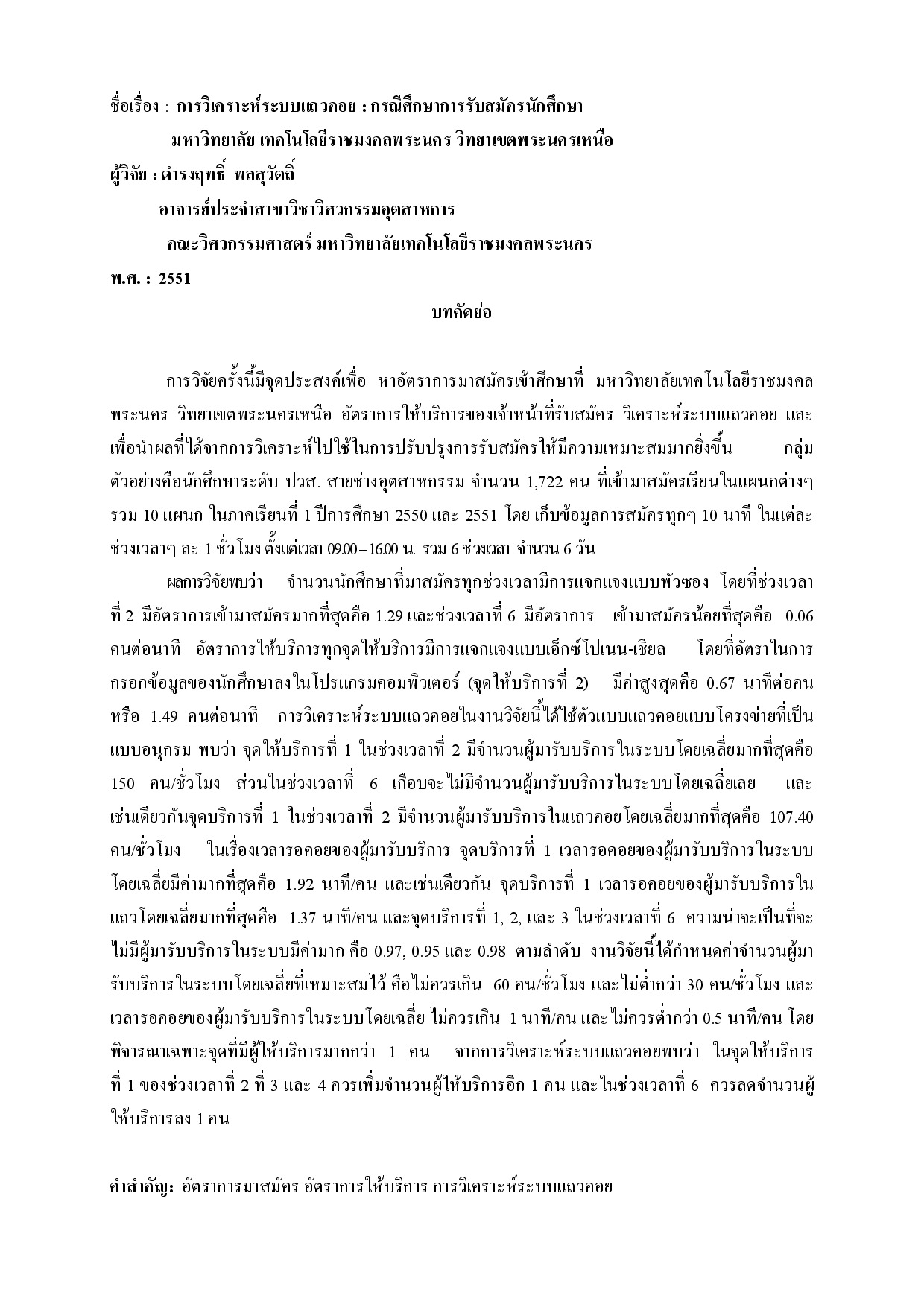
การวิเคราะห์ระบบแถวคอย, กรณีศึกษาการรับสมัครนักศึกษามหาวิทยาลัยเทคโนโลยีราชมงคลพระนคร วิทยาเขตพระนครเหนือ
The objectives of the study were to find the arrival rate of applicants who applied to study at Rajamangala university of Technology Pra Nakhon North Bangkok Campus the service rate of admission officers and to analyze queuing system in order to improve the admission system. The sample was 1722 technical students who applied to study in 10 divisions in 2007 and 2008. The application data was collected every 10 minutes in each one-hour period from 09.00 am. to 16.00 pm. for 6 days. The study found that the distribution of the number of applicants was Poisson distribution. The highest arrival rate 1.29 students/min was at the second period and the lowest arrival rate 0.06 students/min was at the sixth period. The distribution of service time at each station was exponential distribution. The highest service rate 0.67 min/student or 1.49 students/min was at the second station entering data into a computer. Queuing analysis in this study was series network. The analysis found that the highest expected number of applicants in the system 150 students/hour was at the first station in the second period and in the sixth period there was almost none. The highest expected number of applicants in the queuing system 107.40 students/hour was at the first station in the second period. The highest expected waiting time in the system 1.92 min/student and in the queuing system 1.37 min/student were at the first station. The probabilities of none of applicants in the system at the first the second and the third station in the sixth period were high 0.970.95 and 0.98 respectively. The proper value of the expected number of applicants in the system set in this study was not more than 60 students/hour and not less than 30 students/hour. The proper value of the waiting time in the system was not more than 1 min/student and not less than 0.5 min/students for stations with more than one servers. The analysis found that at the first station one more server should be added in the second the third and the forth period and one less server should be reduced in the sixth period.

Queuing Analysis The Study of Student’s Admission System at Rajamangala University of Technology Phra Nakhon, North Bangkok Campus
The objectives of the study were to find the arrival rate of applicants who applied to study at Rajamangala of Technology Pra Nakhon North Bangkok Campus the service rate of admission officers and to analyze queuing system in order to improve the admission system. The sample was 1722 technical students who applied to study in 10 divisions in 2007 and 2008. The plication date was collected every 10 minutes in each one-hour period from 09.00 am. to 16.00 pm. For 6 days. The study found that the distribution of the number of applicants was Poisson distribution. The highest arrival rate 1.29 student/min was at the second period and the lowest arrival rate 0.06 students/min was at the sixth period. The Distribution of service time at each station was exponential distribution. The highest service rate 0.67 min/student or 1.49 students/min was at the second station entering data into a computer. Queuing analysis in this study was series network. The analysis found that the highest expected number of applicants in the system 150 student/hour was at the first station in the second period and in the sixth period there was almost none. The highest expected number of applicants in the queuing system107.40 student/hour was at the first station in the second period The highest expected waiting time in the system.1.92 min/student and in the queuing system 1.37 min/student were at the first station. The probabilities of none of applicants in the system at the first the second and the third station in the sixth period were high 0.97 0.95 and 0.98 respectively. The proper value of the expected number of applicants in the system set in this study was not more than 60 student/hour and not less than 30 student/hour. The proper value of the waiting time in the system was not more than 1 min/student and not less than 0.5 min/student for stations for stations with more than one servers. The analysis found that at the first station one more server should be added in the second the third and the forth period and one less server should be reduced in the sixth period.