จำนวน Repository ( 5 )
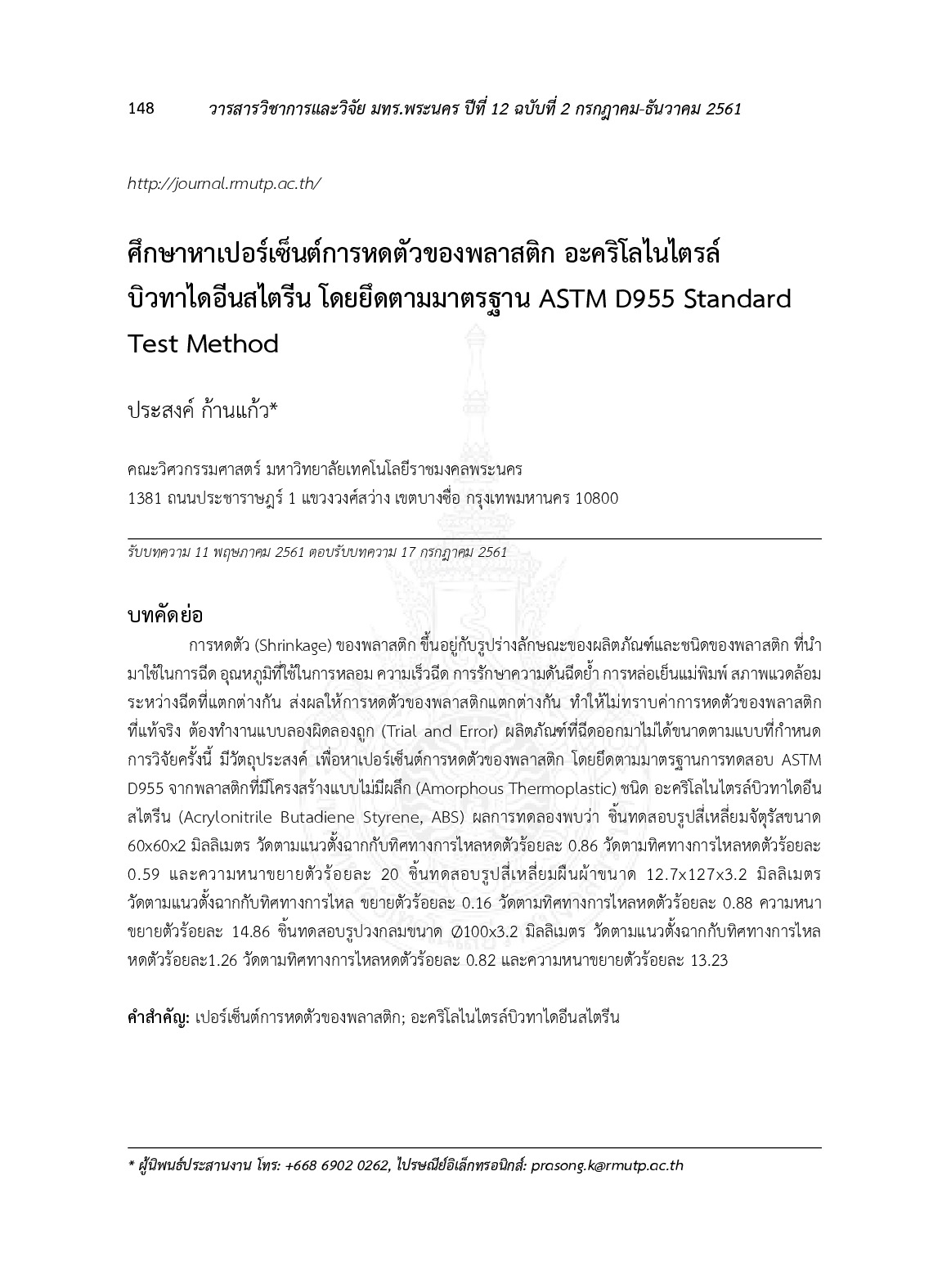
การศึกษาหาเปอร์เซ็นต์การหดตัวของพลาสติก อะคริโลไตรล์บิวทาไออีนสไตรีน โดยยึดตามาตรฐาน ASTM D955 standard test method
The shrinkage of plastic was caused by the shape of the product and the type of plastic used in the injection. The plastic shrinkage difference was resulted from the temperature used in melting the injection speed mold cooling and different injection surroundings. These led to unknown exact value of plastic shrinkage and the trial and error work has been done. As a result of trial and error work the injection products were not in the determined size. This research aims to find the percentage of plastic shrinkage according to standard test ASTM D955 from (Amorphous Thermoplastic) (Acrylonitrile Butadiene Styrene ABS). The findings showed that square specimen size 60x60x2 mm measured from vertical perpendicular to flowing direction the shrinkage was at 0.86% the shrinkage was at 0.59% when measured from flowing direction and the thickness expanded at 20%. For the rectangular specimen size 12.7x127x3.2 mm measured from vertical perpendicular to flowing direction the expanding was at 0.16% the shrinkage was at 0.88% when measured from flowing direction and the thickness expanded at 14.86%. The circular specimen size 100x3.2 mm the shrinkage was at 1.26 when measured from vertical perpendicular to flowing direction the shrinkage measured from flowing direction was at 0.82% and the thickness expanded at 13.23%
ศึกษาการหดตัวของพลาสติกโพลิเอทิลีนเทเรฟทาเลต ที่ใช้กับแม่พิมพ์เป่า
This research aims to study the shrinkage of plastic polyethylene Terephthalate used with the make blow mold in 2 stages. The shrinkage of work piece was determined in order to design the mold ; Z axis = 1% XY axis = 2.5% . The testing results were as follow. 1. Horizontal shrinkage(Z axis) was 0.85% which differed from the determined shrinkage(1%) at 0.15% 2. Vertical shrinkage(XY axis) was 1.83% that is 0.67% which differed from the determined shrinkage(2.5%) at 0.67%

Effect of binders on shrinkage cracking behavior of concrete
This research was aimed to study the effect of binders on cracking behavior of high strength concrete under restrained shrinkage condition. The cracking behaviors of concrete that study were cracking age in uniaxially restrained shrinkage test shrinkage rate free shrinkage crack propagation and strength of concrete. The binders used in this study were fly ash and limestone powder. The weight percentage of replacement of cement by fly ash and limestone powder were 30 and 10% respectively. The water to binder ratios was 0.35. The results indicated that the influence parameters of shrinkage cracking were type of binder amount of free shrinkage shrinkage rate and tensile creep of concrete. The use of fly ash and limestone powder could reduce free shrinkage and shrinkage rate of concrete and result in the longer cracking age than cement-only concrete. The tensile creep of cement-only concrete was higher than that of limestone powder concrete and fly ash concrete respectively
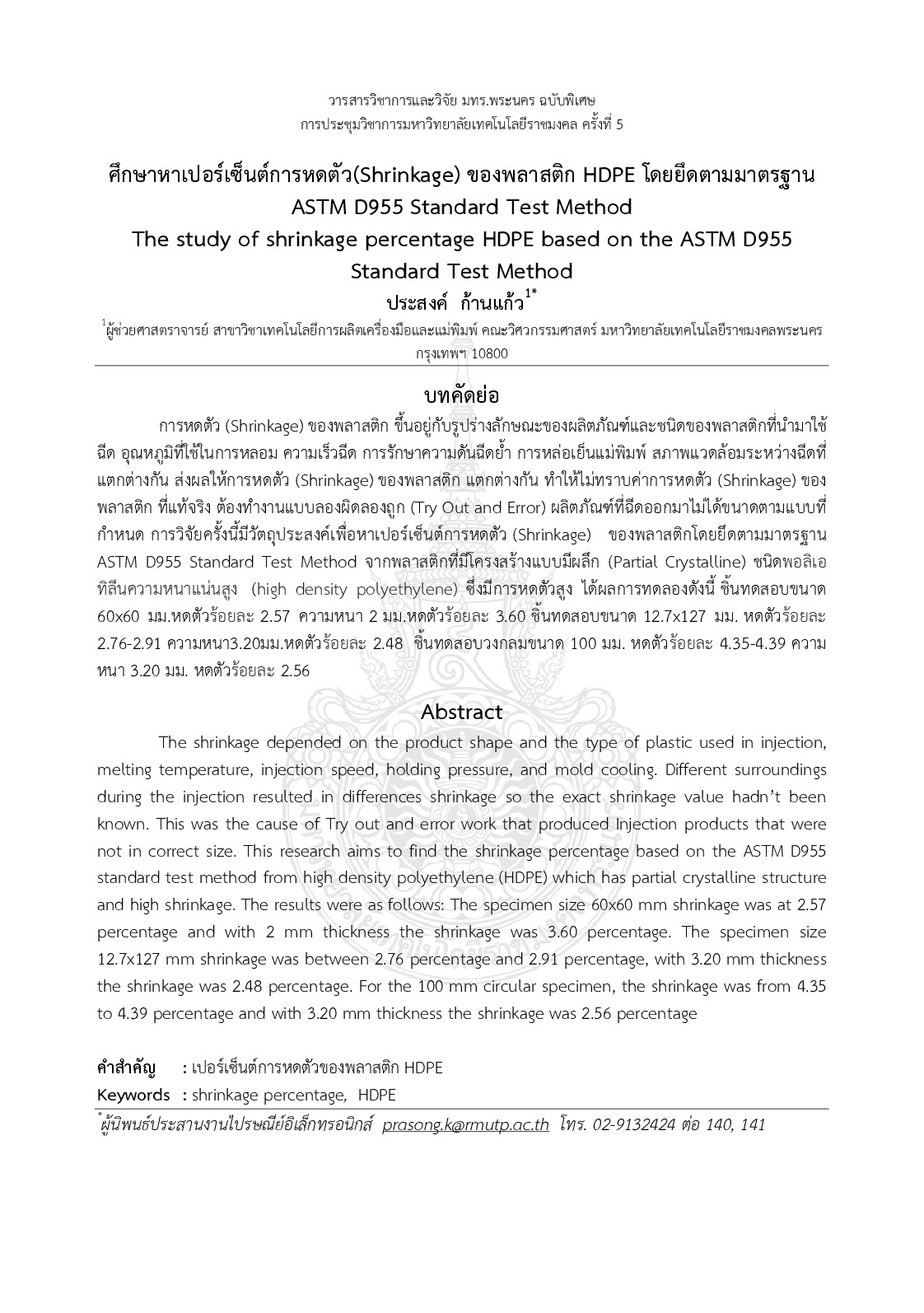
The study of shrinkage percentage HDPE based on the ASTM D955 Standard test method
The shrinkage depended on the product shape and the type of plastic used in injection melting temperature injection speed holding pressure and mold cooling. Different surroundings during the injection resulted in differences shrinkage so the exact shrinkage value hadn’t been known. This was the cause of Try out and error work that produced Injection products that were not in correct size. This research aims to find the shrinkage percentage based on the ASTM D955 standard test method from high density polyethylene (HDPE) which has partial crystalline structure and high shrinkage. The results were as follows: The specimen size 60x60 mm shrinkage was at 2.57 percentage and with 2 mm thickness the shrinkage was 3.60 percentage. The specimen size 12.7x127 mm shrinkage was between 2.76 percentage and 2.91 percentage with 3.20 mm thickness the shrinkage was 2.48 percentage. For the 100 mm circular specimen the shrinkage was from 4.35 to 4.39 percentage and with 3.20 mm thickness the shrinkage was 2.56 percentage
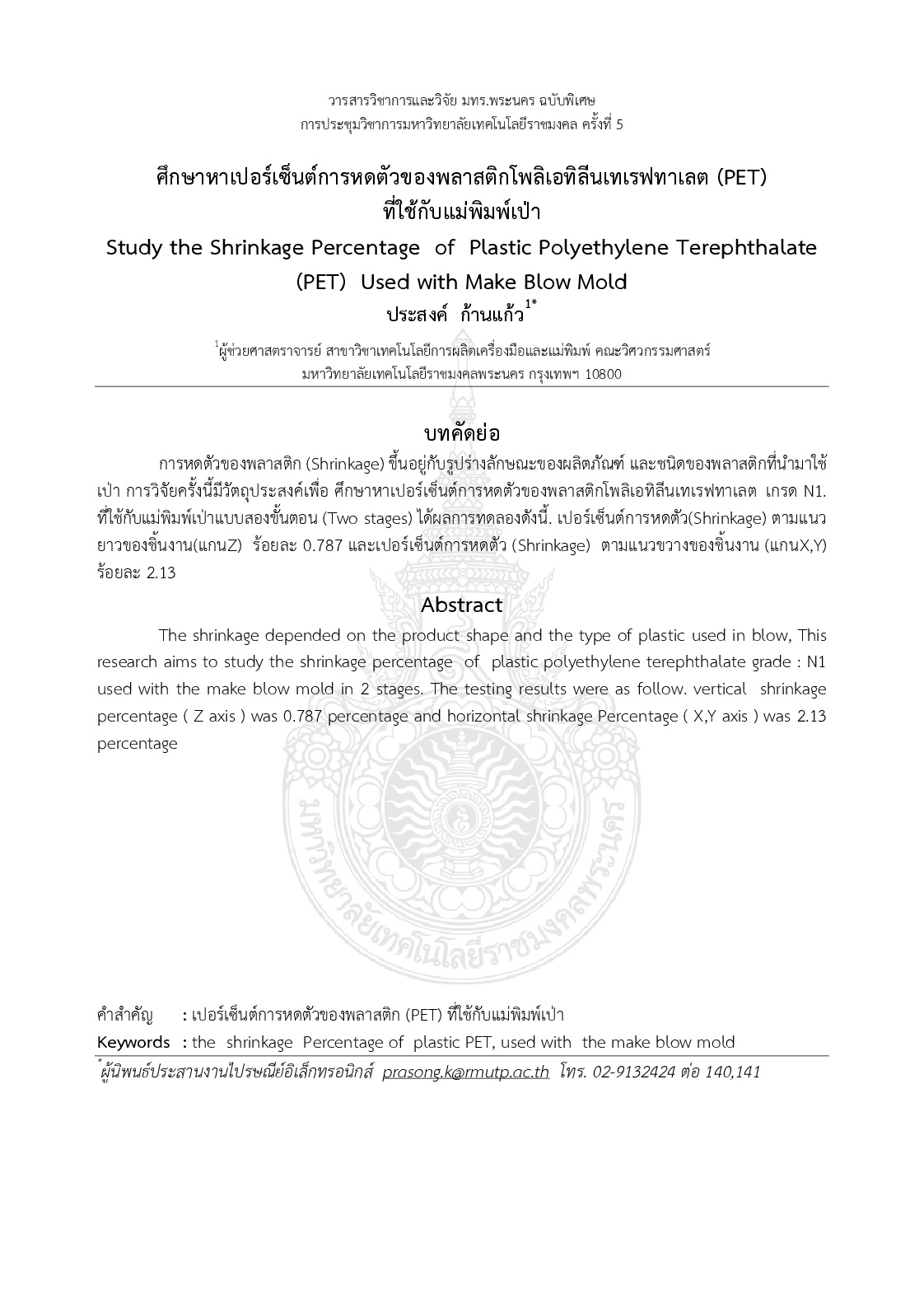
Study the shrinkage percentage of plastic polyethylene terephthalate (PET) used with make blow mold
The shrinkage depended on the product shape and the type of plastic used in blow This research aims to study the shrinkage percentage of plastic polyethylene terephthalate grade : N1 used with the make blow mold in 2 stages. The testing results were as follow. vertical shrinkage percentage ( Z axis ) was 0.787 percentage and horizontal shrinkage Percentage ( XY axis ) was 2.13 percentage