จำนวน Repository ( 8 )
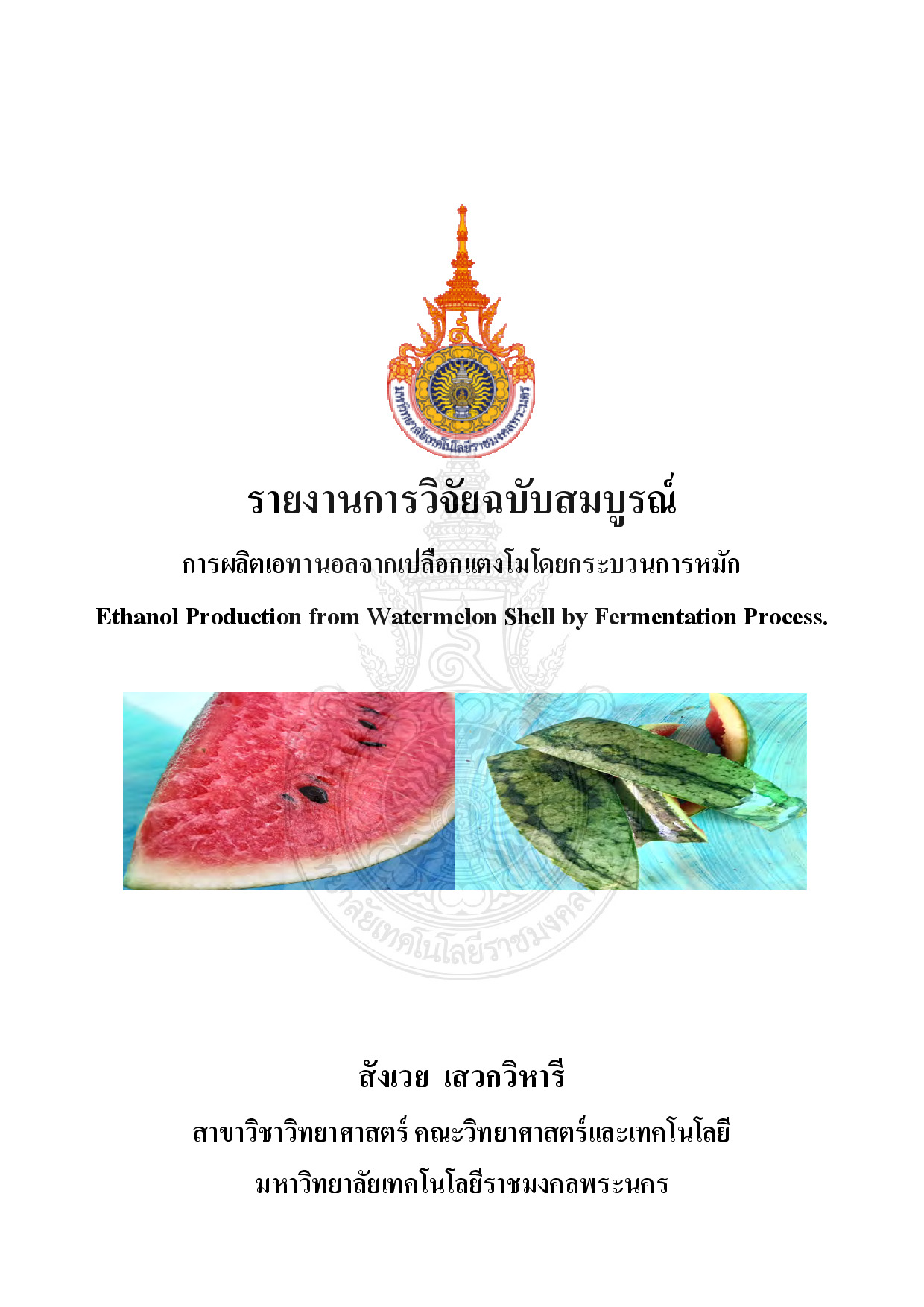
การผลิตเอทานอลจากเปลือกแตงโมโดยกระบวนการหมัก
Ethanol is a form of renewable energy. That can be used as fuel. Can replace gasoline or diesel. Fuel is an important factor driving the countrys economy. Ethanol can be produced from agricultural products garbage and various waste. his research uses watermelon rind. Which is waste from the community as a raw material for the production of ethanol by the fermentation process the microorganisms used in the fermentation process are ball flour. After fermentation for 6 hours it was found that the watermelon rind weighing 10 grams measured the concentration of alcohol. The concentration was 9.3 % VOL 18 Brix %. 20 grams of watermelon rind measuring the concentration of alcohol The concentration of 8.1 % VOL 16 Brix % of watermelon rind at 30 grams measured the concentration of alcohol. Get the concentration 8 % VOL 16 Brix % watermelon rind at 40 grams measure the concentration of alcohol get the concentration of 7.9 % VOL 15.1 Brix % and watermelon rind at 50 grams measure the concentration of alcohol the concentration of 7 % VOL 15 Brix %. Therefore it can be said that the watermelon rind which is waste from the community. Is a raw material with high potential for ethanol production to be used as a renewable energy source Instead of using raw materials from food plants and other energy crops.

การคัดแยกเชื้อจุลินทรีย์ที่มศักยภาพในการผลิตเอนไซม์เซลลูเลสจากผักเหลือทิ้งและเปลือกผลไม้ เพื่อใช้ในการหมักแอลกอฮอล
The research team has isolated the cellulase producing microorganisms which have capability in producing extracellular cellulase enzyme for cellulosic degradation from leftover agricultural waste materials such as fruits and vegetables. After cellulosic material degradation the products mainly were sugar moiety being the starting materials for further alcohol fermentation and/or possibly being used in cultivation of common microorganisms. In the study when different 49 bacterial isolates were tested for their cellulase activity on Carboxymethyl cellulose (CMC) two bacteria Bacillus spp. CE08 and 49 were selected due to high cellulase activity and thus tested for the physical and chemical properties. Their 16S rDNA sequence comparisons were close to Bacillus sp. isolate obtained from the soil. Both isolates are common aerobic/facultative aerobic bacteria with the length of 1-3 μm Gram positive and preferring the fermentation of maltose and xylose to glucose while minimal degradation on sucrose and lactose contents. Their optimum digestibility was at 40°C pH 4.5 for the broth having unpurified extracellular cellulase activity at 3-4 μg /mg. The enzyme could use the substrateCMC the best but rice straw more slowly but better than grass. However the enzyme displayed the least digestion effectiveness on cotton. Both of these isolates are expectedly applied in the biological degradation process substituting chemicals that cause pollution problems to the environment. Additionally this is one promise way to bring value of agricultural waste to the community.
การศึกษาการผลิตก๊าซชีวภาพโดยการหมักร่วมระหว่างมูลไก่กับสาหร่ายหางกระรอก
This work presented the production of biogas using anaerobic co-digestion between hydrilla verticillata (HV) from Songkhla Lake Basin and chicken manure (CM). From the study of compositions of both wastes it was found that the COD of CM and HV were 11200 and 14400 mg/l and pH were 6.5 and 5.5 respectively. The biogas production using anaerobic single-digestion of untreated hydrilla verticillata (UHV) gave accumulative methane of 1251 ml-CH4/g-VS and methane production of 78.28 L-CH4/kg-substrate was obtained. For hydrilla treated with 2% w/v NaOH (THV) the accumulative methane was 1786 ml-CH4/g-VS and the obtained methane production was 91.87 L- CH4/kg-substrate which was 17.5 % increase when compared to the UHV. For the biogas production using anaerobic single-digestion of CM it was found that the accumulative methane and methane production were 978 ml-CH4/g-VS and 78.28 L- CH4/kgsubstrate respectively. These were lower than the studies using HV. The study of anaerobic co-digestion of HV and CM at three different ratios; 1:1 2:1 and 3:1 was studied. It was found that the anaerobic co-digestion using THV and CM at ratio 3:1 and 2:1 gave the highest potential for biogas production. The accumulate methane of 3202.20 and 2079.19 ml- CH4/g-VS were obtained respectively. The methane productions were 2.53 and 82.26 L-CH4/ton-substrate for ratio 3:1 and 2:1 respectively which is no significant different at 95 % confidence interval.
การปรับสภาพขุยมะพร้าวเพื่อผลิตแก๊สชีวภาพโดยกระบวนการหมักแบบไม่ใช้ออกซิเจนร่วมกับมูลวัว
The optimal pretreatment condition of coconut husk by physicochemical methods for biogas production was investigated. The coconut husk was dried and ground into powder (~0.1 nm) and was then determined for chemical contents such as cellulose hemi-cellulose and lignin respectively. The chemical contents of cellulose hemi-cellulose and lignin were 35.67±2.02 7.41±0.69 and 40.82±0.62 w/w respectively. After pretreatment with 4 different methods the results showed that the pretreatment of sodium hydroxide 30 % (w/w) gave the highest chemical contents of cellulose hemi-cellulose and lignin with 43.30±0.03 33.69±7.48 and 27.36±0.03 w/w respectively. As for the biogas production the result showed that the ratio of coconut husk to cow dung of 1:4 with C:N ratio of 23:1 gave the highest cumulative biogas of 442.6 ml for 30 days. Methane and carbon dioxide contents were 46.1 and 23.1 %. Moreover the removal percentages of the total solids (TS) volatile solid (VS) suspended solids (SS) and COD were 69.3 32.5 50.0 and 58.4 % respectively. The coconut husk could be used as an alternative material for the application of biogas production with cow dung in the near future.
การผลิตก๊าซชีวภาพจากวัสดุเศษเหลือทางการเกษตร โดยระบบหมักไร้อากาศแบบแห้ง สำหรับครัวเรือนในชุมชนตำบลเกาะขันธ์ จังหวัดนครศรีธรรมราช
This research was studied and transferred the biogas production technology with the community participation using anaerobic dry fermentation system from agricultural residues. The production of renewable energy for replacing LPG in household cooking of Koh Khan Sub-district community Cha-Uat District Nakhon Si Thammarat Province was carried out. The efficiency of the biogas production from different co-digestion material with fresh cow manure was studied for 45 days. The experiment 1 bananas and papaya and the experiment 2 rice straw and coconut meal were used for fermented materials. It was found that the system using rice straw and coconut meal as a fermented material had a higher potential than using bananas and papaya. The system produced averaged biogas of 150 L/d and an average methane content of 67.68% respectively within just 15 days after start-up. While bananas and papaya as fermented materials took more time with more than 30 days after start-up the system. The system produced averaged biogas of 120 L/d and an average methane content of 64.64%. For usability test It was found that 150 L of biogas could continuously cook for 45-60 minutes. The 85% of the technology transfer recipients regarded that the knowledge gained as practical and reduced household expenditures. Additionally the system can produce biogas for a long time without adding new fermented materials. Therefore this biogas system could be applied to local agricultural waste for biogas production which can be expanded to other areas.