จำนวน Repository ( 7 )
การศึกษาความเหมาะสมของการใช้ระบบปรับอากาศในสำนักงานเพื่อการอนุรักษ์พลังงานและสภาวะความสบาย
Presently Rental office is famous in downtown that near food center and have good transportation. In Thailand office buildings usually have operating time 8-10 hours per day. So need to improve the building for energy conservation and employee’s comfort. Glasses are one way that heat transfers occur highly. Overall Thermal Transfer Value (OTTV) is a tool for measure heat transfers through building envelope. From OTTV calculation for existing building OTTV is 92.94 W/m2 that over ministerial regulations indicate 50 W/m2. Improving building envelope by add more thickness of glasses can reduce OTTV 1.3% and improving building envelope by film installation can reduce OTTV 47.2% and improving building envelope by add shading can reduce OTTV 48.5%. However each improving policy have each investment cost. Conjoint analysis is consider of many factor to find willingness to pay for each choice. So set policies for energy conservation water and waste management and increase comfort are employees to improve energy conservation water and waste management and increase comfort are 19935.90 17590.50 and 1563.60 baht respectively so can improve building envelope by add shading result in OTTV to 47.8 W/m2 Budget 18000 Baht can be improve organization that payback about 5400 Baht per year. Increase thermal comfort by install table fan. From the result of research expect to apply to improve rental office in the future.
การอนุรักษ์พลังงานด้วยอุปกรณ์ปรับความเร็วรอบของมอเตอร์ในระบบมอเตอร์สูบถ่ายน้ำมัน
This thesis aims to study the optimization of the supply fuel system of pipeline by improving the pumps system from use pump size 1850 kW (2 pupms) and use only control valve. We design new system by use pump size 1850 kW (2 pumps) with variable speed motors (VSD). In this way we can control stability of opening and closing of the valve at 100% and use adjusting of the frequency of VSD as follow typing of fuel. To analysing of efficiency system we will use fuel 4 type that have different coefficient of density are JET A1 Disel B91 and B95. And then we compared the relationship between the quantity of each fuel per time and usage of power for the old system and new design that we found the new design as analyze the result and as follow the theory of Affinity Law have the value of efficacy more than. And it also can save energy cost to 52.13%
การอนุรักษ์พลังงานและการลดการปล่อยก๊าซเรือนกระจกในอุตสาหกรรมการอนุรักษ์พลังงานและการลดการปล่อยก๊าซเรือนกระจกในอุตสาหกรรม
Currently the toy manufacture is beginning to be interested in greenhouse gas or carbon dioxide equivalent release reduction. Because this is one to way to encourage production cost environment trouble and organization image valve efficiently. The receivable standard for evaluation is carbon footprint for Organization CFO. So this research has objective to study opportunity for initiate CFO in Toy Manufacturing plant case study this CFO is able to evaluate energy consumption and GHG release systematically. This can be used to prepare plan of energy consumption reduction management and reduce GHG release of efficiently. This research was study energy consumption and GHG release by using database of 2010 we found that plant case study was released carbon dioxide 8500 tons CO2 carbon dioxide equivalent by calculated into Scope 1 = 1249 tons CO2 Scope 2 = 6948 tons CO2 equivalent and Scope 3 = 304 tons CO2 equivalent. So the result from this research is being uses important information for planning energy consumption reduction and GHG release of sustainable case study.
การพัฒนาแผ่นซีเมนต์บอร์ดจากเถ้ากะลามะพร้าว สำหรับการอนุรักษ์พลังงานและสิ่งแวดล้อม
This research aims to develop the cement board from coconut shell ash. The Portland cement type1: fine sand: tap water ratio is equal to 1: 0.4: 0.33 by weight. The 5 ratios of Portland cement type1: coconut shell ash include 1: 0.12 1: 0.13 1: 0.14 1: 0.15 and 1: 0.16 by weight. The cement board production uses the pressure casting in normal temperature (30 – 35 degree of Celsius) and controls the 0.75 g/cm3 of density then test the properties of cement-bonded fiberboard follow TIS 878-2537 standard (cement bonded particle board: high density). From the results 1: 0.12 is the most suitable ratio of cement board from coconut shell ash. This developed cement boards can reduce the quantity of coconut shell ash waste and have the good thermal insulation.
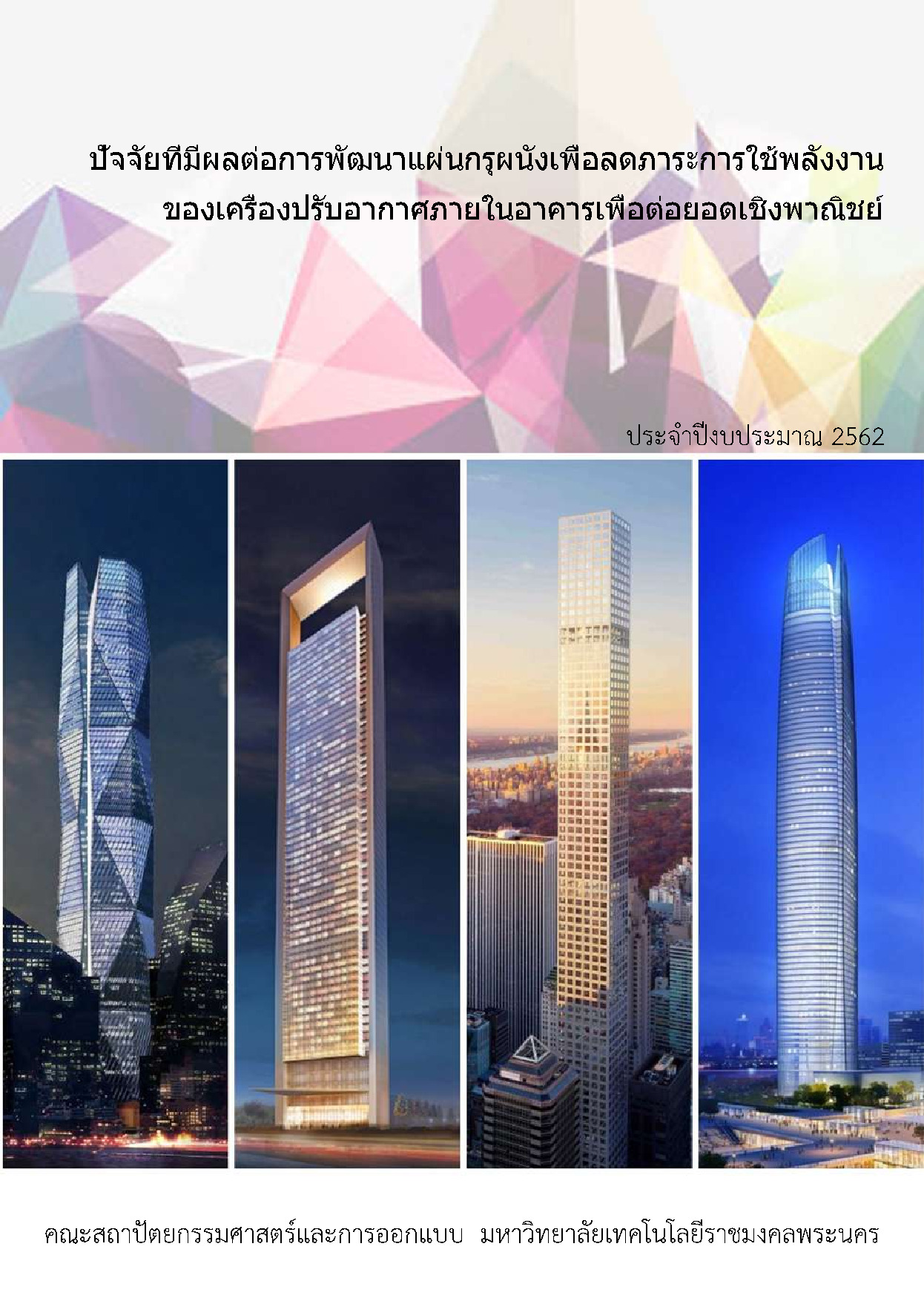
ปัจจัยที่มีผลต่อการพัฒนาแผ่นกรุผนังเพื่อลดภาระการใช้พลังงานของเครื่องปรับอากาศภายในอาคารเพื่อต่อยอดเชิงพาณิชย์
This research approach to study the development of interior wall for reduce energy consumption by air conditioning in the building. In order to be a prototype in the development of an industrial system for the export of green architecture in order to generate income for the community or entrepreneurs to bring money into the country to upgrade the industrial economy to be sustainable It is an architectural material that is compatible with the weather in Thailand. It can be used as a guideline for people interested in applying it to their own home building or disseminating through various media to reduce energy costs for a comfortable living. The objective is to study the factors that affect the development of wall paneling in order to reduce the energy burden of the air conditioner in the building in order to further the commercial production. The researcher collected data for the past 6 months not including other thermal energy. Used to calculate the energy consumption index for 2 building groups it was found that the electricity consumption of green buildings were 531100 kilowatt hours. And an average of 5.31 kilowatt hours per square meter While the non-green building has an average of 653360 kilowatt hours. And an average of 6.53 kilowatt hours per square meter As for the results of the data analysis the damage level is mostly at level 1 which is the wall surface and no obvious damage. Especially the 4th and 5th height is 1.55 meters and 1.85 meters from the floor level in the building. Damage level 3 is found at the height level 3 at a height of 1.00 meters from the floor level in the building. Assessment of damage caused to the interior wall of the building that occurred in 3 levels. The results of the data analysis showed that most damage levels were at level 1 namely the wall surface without obvious damage. Especially the 4th and 5th height is 1.55 meters and 1.85 meters from the floor level in the building. Damage level 3 is found at the height level 3 at a height of 1.00 meters and from the results of collecting moisture content in the exterior wall materials And analyzed to find the average for each of the 5 levels of height which are 0.55 meters 0.75 meters 0.95 meters 1.55 meters and 1.85 meters found that the buildings have different moisture content in each wall level (p <0.05). In conclusion this green building index equation can be applied to other buildings to reduce energy consumption and meet the standards of the green building. From the equation the electricity consumption can be predicted using the electricity usage index and systematically designed energy management in buildings. The area with the most damage will find the humidity in the range of 47% -98% the highest damage level 3 at an elevation of 0.80 meters from the floor level in the building