จำนวน Repository ( 7 )
การออกแบบรูปแบบล้อรันแฟลทที่เหมาะสมสำหรับรถยนต์บรรทุกปกติขนาดเล็กติดเกราะด้วยระเบียบวิธีไฟไนต์เอลิเมนต์
Run flat wheels for small armored regular trucks have been re-developed by transformation from the original metallic material to compound materials polymer group materials as important raw materials then added with aluminum oxide powder to achieve higher strength and wear resistance. The research was performed by using reverse engineering processes including designing and analysis with finite element methodology with the SolidWorks Simulation program and comparing the analyzed results with outcome experiments. Several variables used for the design and analysis were 1) the optimal width of the run flat wheel at the parts both attached to the wheel pan and contacted with the inner rubber surface 2) internal and external radiuses. The internal radius is depending on the size of the wheel pan and the external radius is a variable that determines the height of the Run flat wheel. 3) the shape designed to prevent wearing of the inner tire surface of the run flat wheel and the shape of the run flat reel in the part contacted with the wheel pan. This wheel pan part is such uneven inclined area which is difficult to hold. 4) a design locking kit for tightly fastening the run flat reels to the wheel pan 5) the material used to create the run flat wheel and 6) tire pressure. The run-flat wheels were then designed and constructed in a modular form of 3 parts for ease of the wheel pan assembly. In designing pattern the assembling run flat reels had to be fit into the characteristics of a small armored regular truck wheel pan convenient to assemble with a wheel pan and tightly attached without looseness or deformation when impacted. The run flat reel gripping device has been redesigned to lock all three run flat parts together. It brought up the impact resistance from body weight was at 50 km/hr.
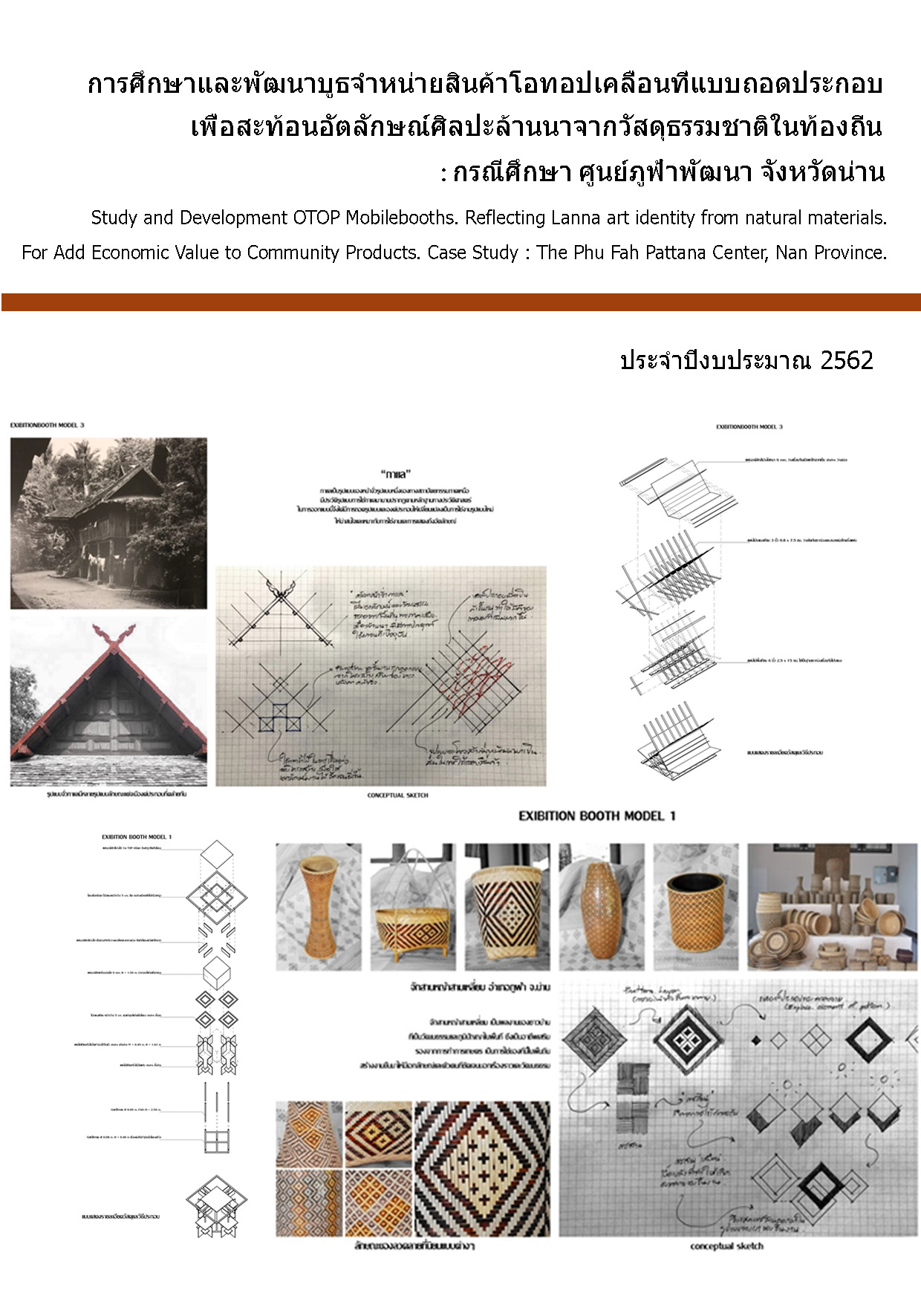
การศึกษาและพัฒนาบูธจำหน่ายสินค้าโอทอปเคลื่อนที่แบบถอดประกอบ สะท้อนอัตลักษณ์ศิลปะล้านนาจากวัสดุธรรมชาติในท้องถิ่นเพื่อเพิ่มมูลค่าทางเศรษฐกิจให้กับผลิตภัณฑ์ในชุมชน : กรณีศึกษา ศูนย์ภูฟ้าพัฒนา จังหวัดน่าน
This research aims to improve the booth model of OTOP products from Phu Fah Pattana Center Nan Province. To increase marketing channels by distributing products to various locations in order to increase sales to community products. The design must take into account the convenience of rapid assembly and dismantling for a limited time. The characteristics of the booth must be disassembled interesting in looks that reflect the identity of Lanna art. There is a beautiful strong structure to support the weight of the product. The size and proportion are suitable for the usage habits of consumers. Which will help promote products in the community that have higher sales stronger communities. Able to divide the product market in the country and can create marketing channels to other countries. It is a good result for the villagers in the community that will have the guarantee of self-sufficiency and sustainably sufficient lives. From the analysis of the Lanna Wisdom Identity Model there are 4 types of concepts which are The concept of the components of the house GalaeThe concept from the barn Concept of the components of the house Kwan Concept of triangular pattern woven grass. After that it was developed to the stage to interpret the meaning of space in form of booth. And then lead to the design of 4 booths. And conducted a questionnaire to find satisfaction with each type of booths that responded to various usability benefits including satisfaction with the appearance and usage characteristics that responded to the behavior of Most users. Conclusion Booths from the concept of Lanna house components called galae have the highest percentage of satisfaction in 3 aspects which are Percentage of satisfaction with the layout of the booth Percentage satisfaction with workpiece assembly and disassembling storage and transportation Percentage of satisfaction with the perception of Lanna identity. For the satisfaction with the size the proportion of use and the convenience of use the booth from the concept of the components of the house Kwan with the highest rate of percentage satisfaction.
การพัฒนาคุณภาพของภาพนูนต่ำที่ทำจากวัสดุธรรมชาติชนิดต่างๆ
Based on the research on creation of bas-relief molds for production of bas-reliefs made from boiled pineapple leafs conducted by Rachadasak Pengcum of which purpose was to help generate income for members of Pineapple Leaf Paper Community Enterprise Ban Pasang Wiwat Mueang District Chiang Rai Province it was found that the bas-reliefs need further improvements in terms of appearance and durability as well as the use of other natural raw materials to produce them. The researcher therefore has considered developing the previous research by applying other 3 valueless natural materials which include rice straw water hyacinth and banana stem skin to make bas-reliefs for different beautiful surfaces of the products. Also the quality of bas-reliefs has been comparatively investigated by surveying satisfactions of members of the Community Enterprise and visitors to the project towards the bas-reliefs made from rice straw water hyacinth and banana stem skin. The total period of questionnaire distribution was 3 months. There are 59 respondents administering the questionnaires most of whom (43 persons) are female which accounts for 72.88 per cent. The majority of the respondents (25 persons) obtained junior/senior secondary school diplomas or equivalent accounting for 42.37 per cent. 16 respondents or 27.12 percent are 60 years of age. As for satisfactions towards the bas-reliefs made from rice straw 89 times of “strongly agree” was selected whereas 126 times of “pretty much agree” 75 times of “fairly agree” and 5 times of “disagree” were marked by the respondents. Concerning the bas-reliefs made from water hyacinth 87 times of “strongly agree” was selected while 97 times of “pretty much agree” 110 times of “fairly agree” and 1 time of “disagree” were chosen. When asked about the bas-reliefs made from banana stem skin the respondents selected 77 times of “strongly agree” 99 times of “pretty much agree” 110 times of “fairly agree” and 8 times of “disagree”.

การศึกษาโครงสร้างกันแรงกระแทกของรถยนต์ที่ส่งผลต่อการดูดซับพลังงาน
Nowadays an automotive industry steadily has been growing and playing a major role on economy development for many years. The crash box is one of the most important parts for safety but it was found that the crash boxes manufactured domestically are not met international standard requirements. This is due to process and material limitation. This process for automotive safety test requires high budget and there is unclear approach for specific test. Therefore a study of crash boxes referred to energy absorption project was conducted as an alternative choice of testing. Regarding to the problems as addressed above this project was aimed to design and test crash boxes which come in various structures; simple type corrugated type and honeycomb type of crash box. In addition it was also emphasized in studying energy absorption behavior and physical deformation of crash boxes after dynamic and static energy being applied. Numeric simulation and static test methodology of front collision were applied for these tests in reference to USA NCAP standard for automobile collision test. Testing all types of crash boxes indicated that the corrugated type was able to absorb energy at 2.8% and 5.9% higher than honeycomb type and rectangular type respectively. This is capable to pickup stress and strain continually and effecting to more energy absorb than another type. Additionally this corrugated structure is feasible and suitable for crash box design in automotive manufacturing.
การออกแบบและพัฒนาอุปกรณ์ลดระยะทางการยกเบาะนั่ง ในโรงงานผลิตรถยนต์
This research aimed to study the design and development to assist in bringing the car seat into the production process and the risk assessment approach to ergonomics to suit operator. Emphasizing the importance of work and trying to create design tools. Organize work appropriately in accordance with the competency and performance of each individual. Using the principles of biomechanics analysis applied in the analysis along with an assessment of the risks by taking into consideration upon 3 factors. 1. The level of severity. 2. The level of frequency.3. Safety measures at the different parts of the body due to which the body must be borne from the outside and in the work. By bringing knowledge of mechanics the proportion of the body anatomy and physiology is able to create the relationship in a model way of Ergonomics which occurs according to the gesture. The use of tools lifting heavy parts and labor pull push and press researchers found in the process of lifting car seat weighs 14.5 kg dimensions width 45 cm length 55 cm and 100 cm in height is the distance of the car seat to shelve. Assembly point distance of 200 cm research has fixed this issue by adjusting the distance of the car seat and shelves by only 50 cm distance can be reduced down to 150 cm and adjust the position of the lifting cushion to reduce twisting torso while assess the biomechanics model of the behavior of all employee in improvement on quality both before and after work station.