จำนวน Repository ( 4 )
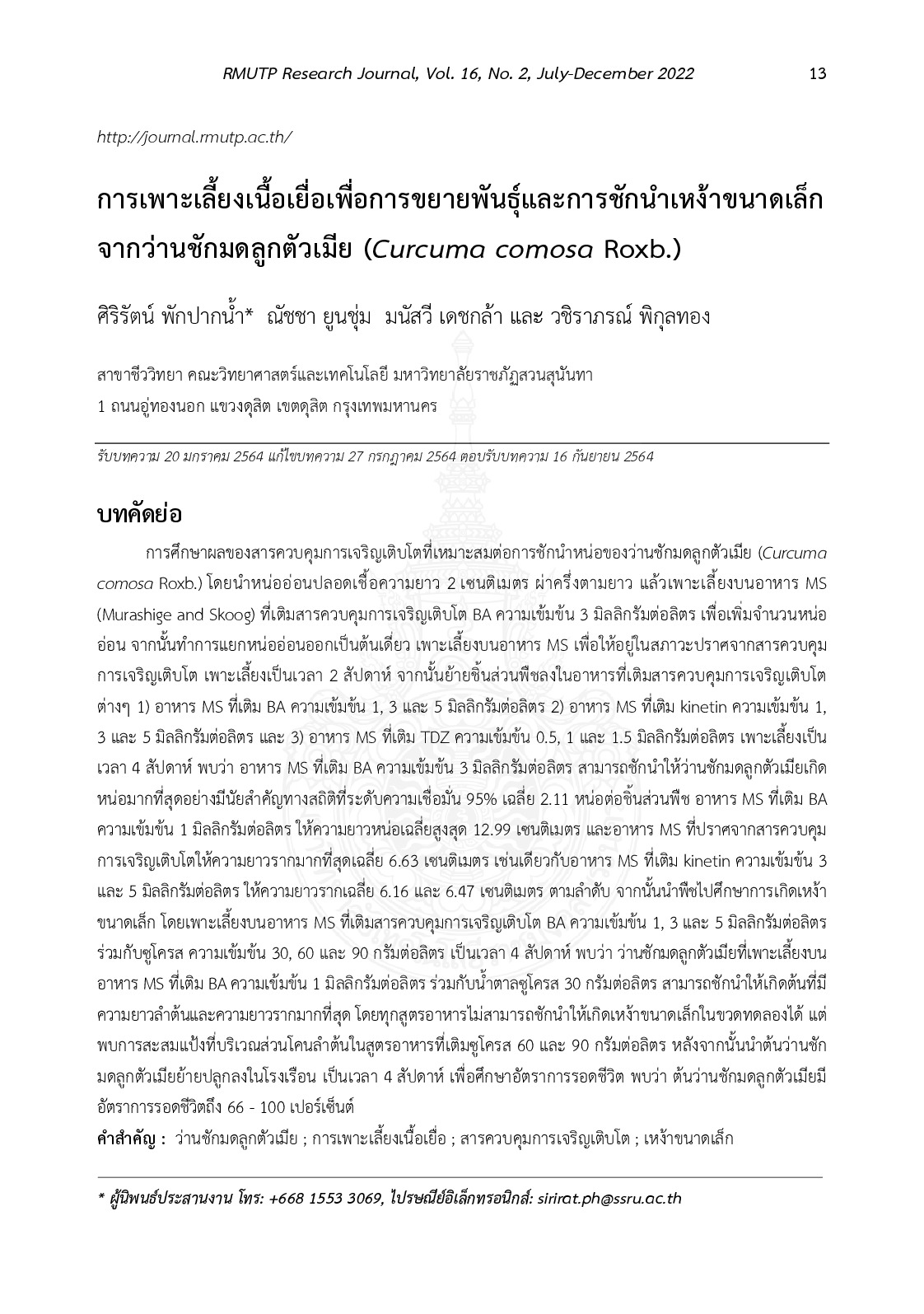
การเพาะเลี้ยงเยื่อเพื่อการขยายพันธุ์และการชักนำเหง้าขนาดเล็กจากว่านชักมดลูกตัวเมีย Curcuma comosa roxb
This study was conducted to determine the effects of plant growth regulators on in vitro propagated plantlets and microrhizome inductions of Curcuma comosa Roxb. for an efficient development of plant regeneration. In vitro sprouted shoots (2 cm length) of C. comosa were incised in longitudinal section and subcultured on MS media supplemented with 3 mg/L BA for shoot multiplication and plant regeneration. Subsequently the regenerated plants were transferred to MS medium with various concentrations of plant growth regulators; BA (1 3 5 mg/L) kinetin (1 3 5 mg/L) and TDZ (0.5 1 1.5 mg/L). The result showed that MS medium supplemented with 3 mg/L BA was the most effective in shoot induction with the significantly maximum average number of 2.11 shoot buds per responding explant. Moreover MS medium supplemented with 1 mg/L BA produced the longest average of shoot bud explants (12.99 cm) while the basal MS medium induced the longest average of root multiplication (6.63 cm). Furthermore microrhizome induction was produced under in vitro conditions derived young shoot buds upon transfer to MS medium containing various combinations of 1 3 and 5 mg/L BA and 30 60 and 90 g/L sucrose concentrations. The optimum combination in the induction of significantly highest average length of both stem (18.32 cm) and root (7.52 cm) multiplication was obtained on MS basal medium supplemented with 1 mg/L BA and 30 g/L sucrose for 4 weeks. Although microrhizome formation was not produced by the different amount of BA and sucrose in induction medium starch accumulation was found at the base of the stem explants cultured on MS medium containing 60 and 90 g/L sucrose concentrations. Additionally in vitro propagated C. comosa plantlets through microrhizome induction were grown under greenhouse conditions for 4 weeks and further developed into normal plants resulting in successfully high survival rates of 66 – 100% in the cultivated C. comosa.
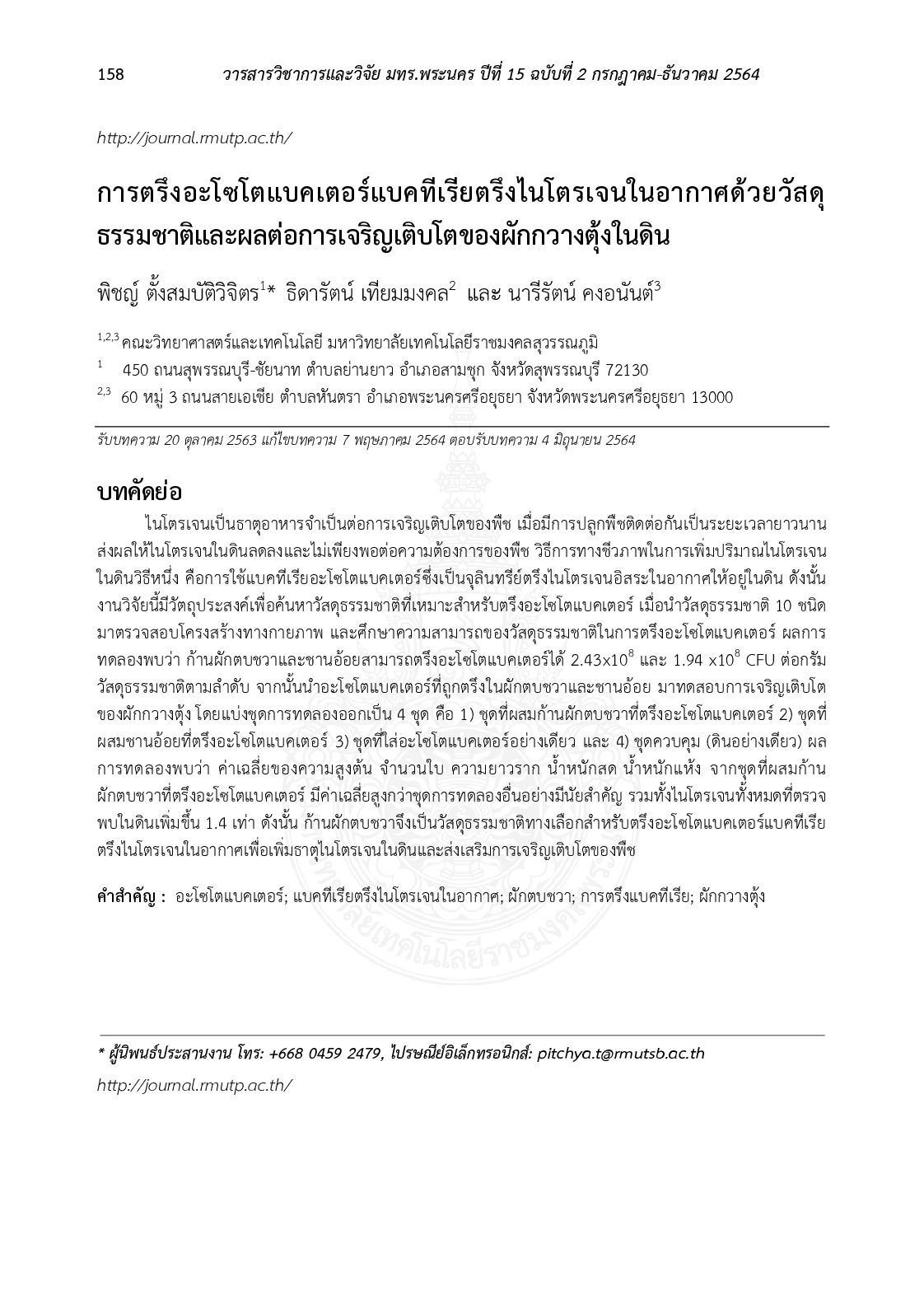
การตรึงอะโซโตแบคเตอร์แบคทีเรียตรึงไนโตรเจนในอากาศด้วยวัสดุธรรมชาติและผลต่อการเจริญเติบโตของผักกวางตุ้งในดิน
Nitrogen is an essential nutrient for plant growth. When the plants have been grown for a long-term effect to decreased nitrogen in soil and insufficiency of the plant growth. One biological method for increasing the nitrogen content in soil is utilize of free nitrogen-fixing bacteria Azotobacter. Therefore the objective of this research was to search natural material suitable for Azotobacter fixation. The 10 natural materials were observed physical structure and investigated the ability of natural materials for Azotobacter fixation. The results showed that water hyacinth and bagasse stalks were fixed the Azotobacter of 2.43x10⁸ and 1.94 x10⁸ CFU per gram of each natural material respectively. After that the selected fixed Azotobacter of water hyacinth and bagasse stalks were studied the growth of Brassica Chinensis. This experiment was designed to 4 treatments. The first treatment was mixed of water hyacinth stalks and the Azotobacter. Second treatment was mixed of bagasse stalks and the Azotobacter. The third treatment was the Azotobacter only. The last treatment was soil only. The results indicated that the average of plant growth include height leaf number root length fresh weight and dry weight of the mixed of water hyacinth stalks and the Azotobacter had significantly higher growth rates than other treatments. The total nitrogen was also increased 1.4 fold in the soil. All results suggest that the water hyacinth stalk is alternative for the fixation of the free nitrogen-fixing bacteria Azotobacter as induce nitrogen in the soil and plant growth promotion.
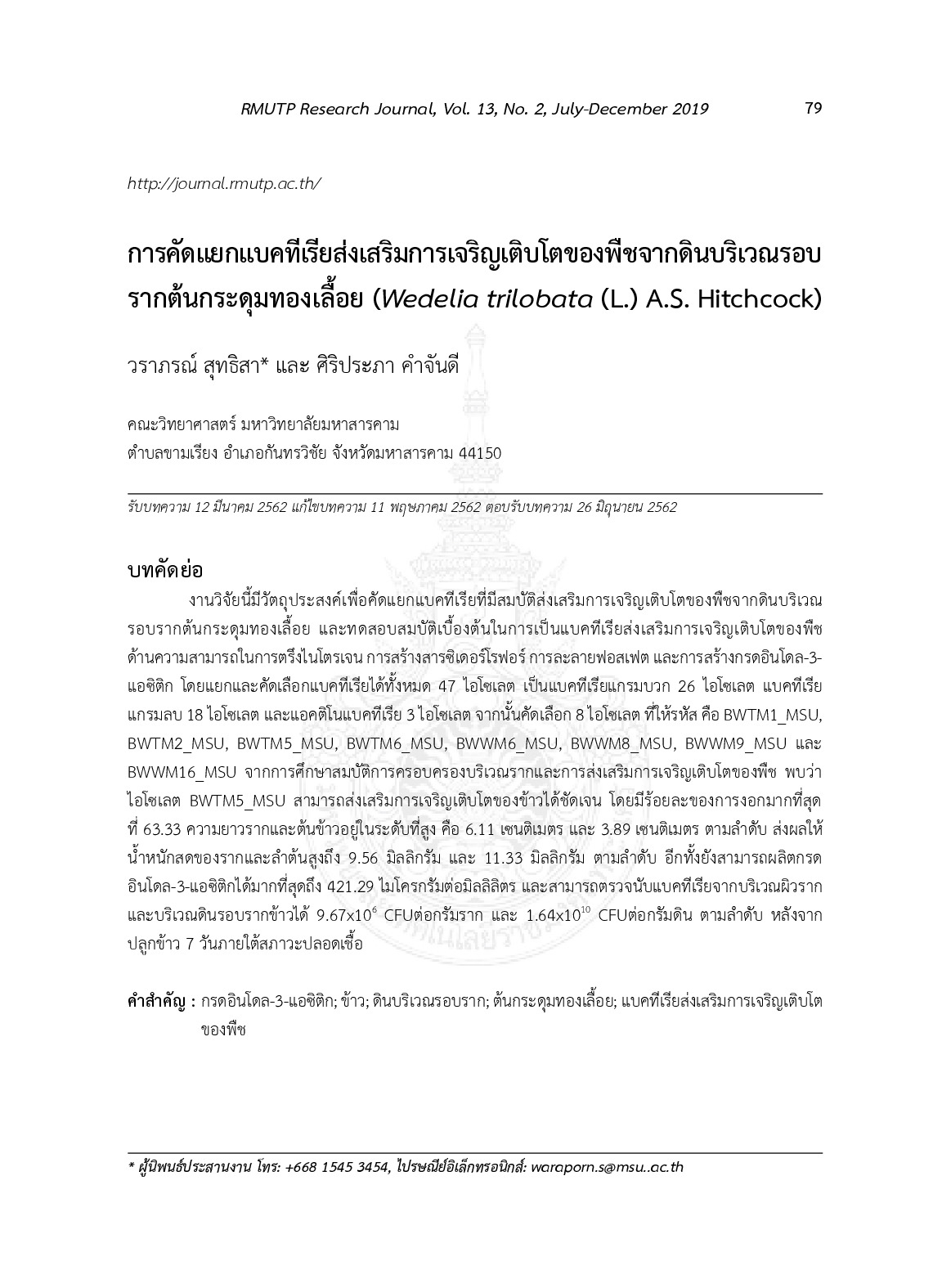
การคัดแยกแบคทีเรียส่งเสริมการเจริญเติมโตของพืชจากดินบริเวณรอบรากต้นกระดุมทองเลื้อย (Wedelia trilobata (L.) A.S. hitchcock)
The objective of this research was to isolate plant growth promoting rhizobacteria from Wedelia trilobata (L.) A.S. Hitchcock rhizosphere and preliminarily test their plant growth promoting properties such as nitrogen fixation siderophore production phosphate solubilization and indole-3-acetic acid production. Forty-seven bacterial isolates were obtained including 26 isolates of gram positive 18 isolates of gram negative and 3 isolates of actinobacteria. After that 8 isolates (including BWTM1_MSU BWTM2_MSU BWTM5_MSU BWTM6_MSU BWWM6_MSU BWWM8_MSU BWWM9_MSU and BWWM16_MSU) were selected for studying on root colonization and plant growth promoting properties under aseptic condition. The results showed that BWTM5_MSU had the evident on the promotion of plant growth with the most percentage of rice seed germination (63.33%) high level of root and shoot length with 6.11 cm and 3.89 cm respectively. As a result the root and shoot fresh weight was as high as 9.56 mg and 11.33 mg respectively. It also correlated with the highest production of indole-3-acetic acid up to 421.29 ug/ml. The root colonization was studied by counting rhizobacteria isolate BWTM5_MSU from rice rhizoplane and rhizosphere with presented bacterial number at 9.67x10⁶ CFU/g root and 1.64x10 10 CFU/g soil respectively.
การศึกษาประสิทธิภาพของน้ำหมักและทำนองเพลงที่มีผลต่อการเจริญเติบโตของต้นกุหลาบหนู
The objectives of this research were to study the growth rate of microbial sludge in the fermented juice and to study the efficiencies of fermented juice and melodies on Fairy Rose growth. In the experiments the growth rate of microbial sludge was analyzed with 10 parameters for 4 weeks. Moreover the Fairy Rose was divided into 2 groups used and non-used the fermented juice. Each experimental group was tested with 3 types of melodies including jazz classical and Mozart. All experiments were set 3 replications by the total number of 24 Fairy Roses. The growth of the Fairy rose was analyzed by considering the number of leaf Height length of root and mass. The experimental results showed that the growth of microbial sludge in fermented juice was good and produced microbial sludge in fermented juice approximately 1063 ±158 mg/L on average. The Fairy Rose more growing with water and fermented juice. The number of leaves was 144±11 leaves in average Height was 30±1 cm in average Length of root was 38±8 cm in average and weight of Fairy Rose at the end of experimentation was found 400 g in average. In the case of melody affected Fairy Roses growth was classical. The growth of fairy roses found that the number of leaves was 143±6 leaves in average height was 29±1 cm in average Length of root was 34±1 cm in average and weight of Fairy Roses at the end of experimentation was 93 g in average