จำนวน Repository ( 8 )
การประยุกต์การใช้พลังงานแบบผสมผสานเพื่อบูรณาการกับภาคการเกษตรกรรม
The application of integrated energy use in the agriculture sector It is presented in the form of using renewable energy from solar energy to produce electricity to use in conjunction with other sources of electricity such as generators or electric power systems. Using solar panels or solar cells the size and number of panels does not exceed 300 watts 4 panels and the electrical system of the electrical system. Supply electric power to the water pump size does not exceed the rating of 1500 watts 220 volts. Solar power supply systems alone may be affected by weather conditions or electrical power supplies. Including the quality of electricity obtained from solar energy and will result in the water pump not working efficiently. Therefore the application of solar energy by using a power supply system from 2 sources by using a hybrid inverter device to select the power supply from the solar cell is the main power and the power supply from the memory system is the backup power. Therefore a research project on the application of solar water pumps in a mixed system for agriculture is proposed to increase the efficiency of electric power distribution. This application of solar water pump hybrid system for agriculture when used with water pumps can normally help to save electricity and can also use solar energy instead of using electricity to pump water. Let the water pump and can work efficiently.
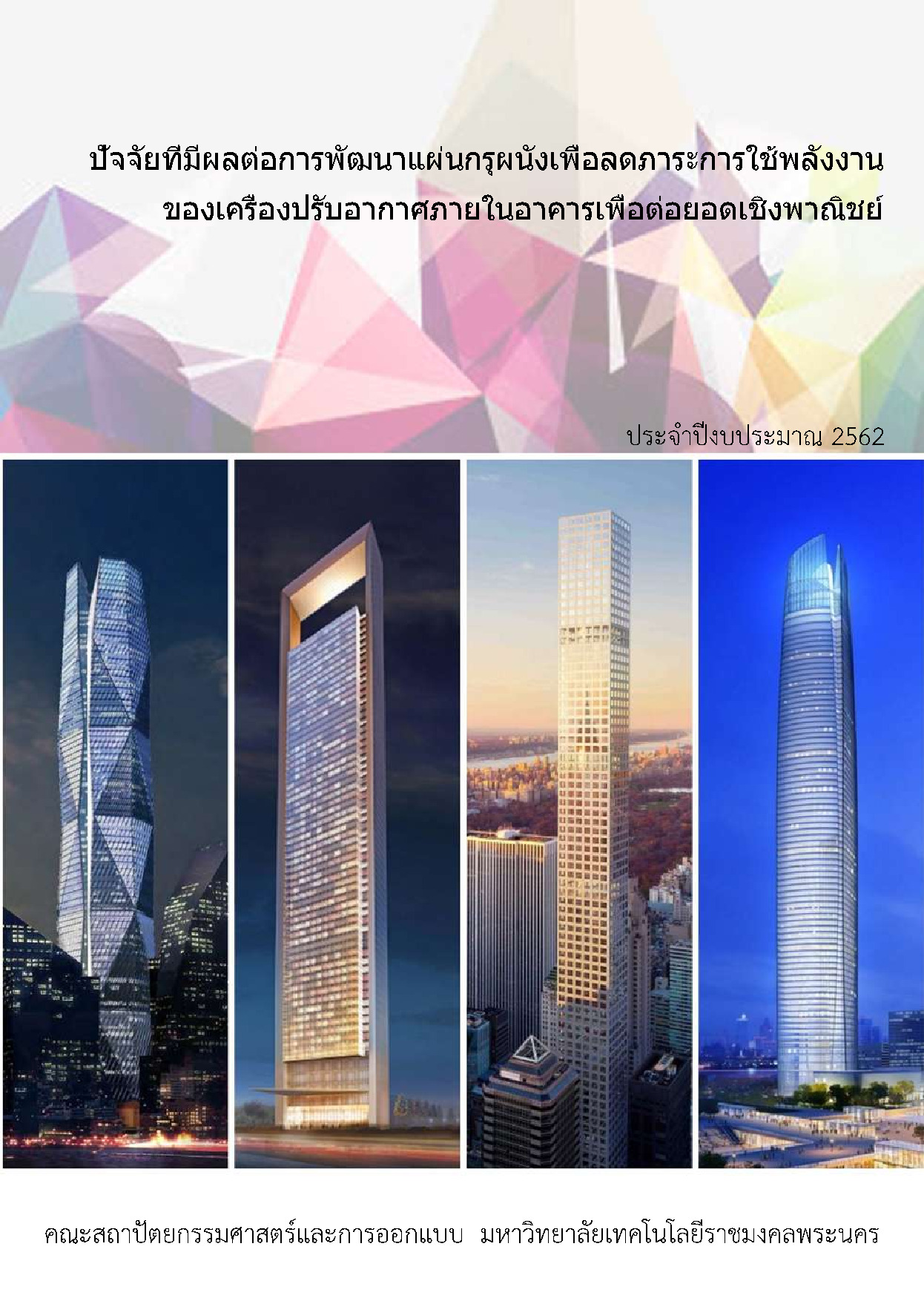
ปัจจัยที่มีผลต่อการพัฒนาแผ่นกรุผนังเพื่อลดภาระการใช้พลังงานของเครื่องปรับอากาศภายในอาคารเพื่อต่อยอดเชิงพาณิชย์
This research approach to study the development of interior wall for reduce energy consumption by air conditioning in the building. In order to be a prototype in the development of an industrial system for the export of green architecture in order to generate income for the community or entrepreneurs to bring money into the country to upgrade the industrial economy to be sustainable It is an architectural material that is compatible with the weather in Thailand. It can be used as a guideline for people interested in applying it to their own home building or disseminating through various media to reduce energy costs for a comfortable living. The objective is to study the factors that affect the development of wall paneling in order to reduce the energy burden of the air conditioner in the building in order to further the commercial production. The researcher collected data for the past 6 months not including other thermal energy. Used to calculate the energy consumption index for 2 building groups it was found that the electricity consumption of green buildings were 531100 kilowatt hours. And an average of 5.31 kilowatt hours per square meter While the non-green building has an average of 653360 kilowatt hours. And an average of 6.53 kilowatt hours per square meter As for the results of the data analysis the damage level is mostly at level 1 which is the wall surface and no obvious damage. Especially the 4th and 5th height is 1.55 meters and 1.85 meters from the floor level in the building. Damage level 3 is found at the height level 3 at a height of 1.00 meters from the floor level in the building. Assessment of damage caused to the interior wall of the building that occurred in 3 levels. The results of the data analysis showed that most damage levels were at level 1 namely the wall surface without obvious damage. Especially the 4th and 5th height is 1.55 meters and 1.85 meters from the floor level in the building. Damage level 3 is found at the height level 3 at a height of 1.00 meters and from the results of collecting moisture content in the exterior wall materials And analyzed to find the average for each of the 5 levels of height which are 0.55 meters 0.75 meters 0.95 meters 1.55 meters and 1.85 meters found that the buildings have different moisture content in each wall level (p <0.05). In conclusion this green building index equation can be applied to other buildings to reduce energy consumption and meet the standards of the green building. From the equation the electricity consumption can be predicted using the electricity usage index and systematically designed energy management in buildings. The area with the most damage will find the humidity in the range of 47% -98% the highest damage level 3 at an elevation of 0.80 meters from the floor level in the building
การวิเคราะห์แรงดัน ไฟฟ้าที่ผลกระทบต่อการใช้พลังงาน ของโรงงานอุตสาหกรรมต้นทางที่ระดับแรงดัน 22 กิโลโวลต์
This thesis presents a method of compare the reducing high voltage source more than necessary to the pilot study two plants in case of load near power station the same distance but different. There are 2 methods first method reducing the voltage by adjusting tap transformer. Other method installed by voltage equipment. Regulator in a factory used 2 methods for measured the value of voltage before&after and continued to reduce the voltage until minimum loading that this factory can normal operate. From two trials we found that reducing the voltage by installation voltage regulator/voltage equipment can save more energy cost 10.23% than adjusting tap transformer that can save only 4.66%. And analysis of Specific Energy Consumption (SEC) by reducing the voltage level of the industry. Energy consumption kWh per 1 output (plastic bottles) Then lower from 0.119 kWh per 1 bottle remaining 0.089 kWh per 1 bottle This is in line with the energy analysis that main control electric power.
โครงการออกแบบและพัฒนาผลิตภัณฑ์เซรามิกส์ที่ใช้ในการก่อผนักเพื่อการอนุรักษ์การใช้พลังงานภายในอาคาร
This research aims to study and test a ceramic product in using to constructs a wall. This research is based on a previous studying to develop a ceramic product that saves the energy in the building. The early test shows the product has out door heat resisting capability and it is very user-friendly. However the test was only an early stage. The research still lack of a real life situation test and has very little feedback from the consumers. All of which are very importance to farther develop this product into a production stage. The research has 2 steps. First step to testing the heat and humidity resisting quality of the product the researcher is building four testing blocks (dimension 1x1x1 meter). Each block has different material on one of its side block 1 has brick block 2 has concrete masonry unit block 3 has autoclaved aerated concrete and block 4 has ceramic block. The other three side of each block have a heated and humidity resisting form. The researches test the following; heat energy the temperature inside the blocks and humidity inside the block. After comparing the difference between the airs inside and out-side of the blocks the block 2 with concrete masonry unit has the best humidity resisting quality and is the most user-friendly product. In the term of heat resisting block 3 with autoclaved aerated concrete perform the best. Second step to test the user-friendliness of the product the researcher found 2 groups of consumers. First group are the wall constructing expert. This group has a hard time using this product and can’t get use d to the product so they find this product to be too thin and too weak. Second group the home owner feel the product has a thinner wall and believe it’s weaker than a typical construction brick. There for they still don’t know how to use this product.
การศึกษาการใช้พลังงานในเครื่องอัดไฮดรอลิก
Recently Hydraulic Press has been generally used as a labor-saving device in several functions through industrial section. Previously most of the factory merely concern about using this powerful device and that caused so much electric energy wasted during the pending process on equipment transformation. Therefore our team initiated a conceptual study of energy consumption on using hydraulic press. The invention of hydraulic press for the study of electric energy requires hydraulic devices installation. This includes 3.7 kW 3 phases system induction motor and VSD hydraulic pump single shaft 2 sets set 1 low flow high pressure at flow rate 3.65 liters per minute and set 2 high flow low pressure at flow rate 6.79 liters per minute and total flow rate 10.44 liters per minute pressure relief valve and 2 ports 2 positions Bypass control valve and 4 ports 3 positions directional control valve double acting cylinder 100 mm diameter and 250 mm stroke and pressure gauge. The experiment on energy consumption using hydraulic press has been considered in 5 cases. Each case operated by different hydraulic devices in order to observe the differences of energy consumption. The result of experiment showed that case 1 had electric energy lost the most the rate of loss will increase as a percentage of the increase in pending. Case 2 to 4 with the lost of electric energy are similar. Case 5 is bringing the case 4 added VSD to adjust the speed of the electric motor is reduced to 435 rpm during the waiting period so this case had the lost of energy is minimal. After comparative experiment between case 1 and the other 4 cases during the pending process on equipment transformation at 20% - 200% it revealed that case 2 reduced electric energy wasted more than case 1 accounted for 17.07% - 30.46% while case 3 to 5 reduced electric energy wasted more than case 1 accounted for 16.06% - 29.52% 17.37% - 30.80% and 23.90% - 50.55% respectively