จำนวน Repository ( 9 )
กาวหลอมร้อนจากยางธรรมชาติ
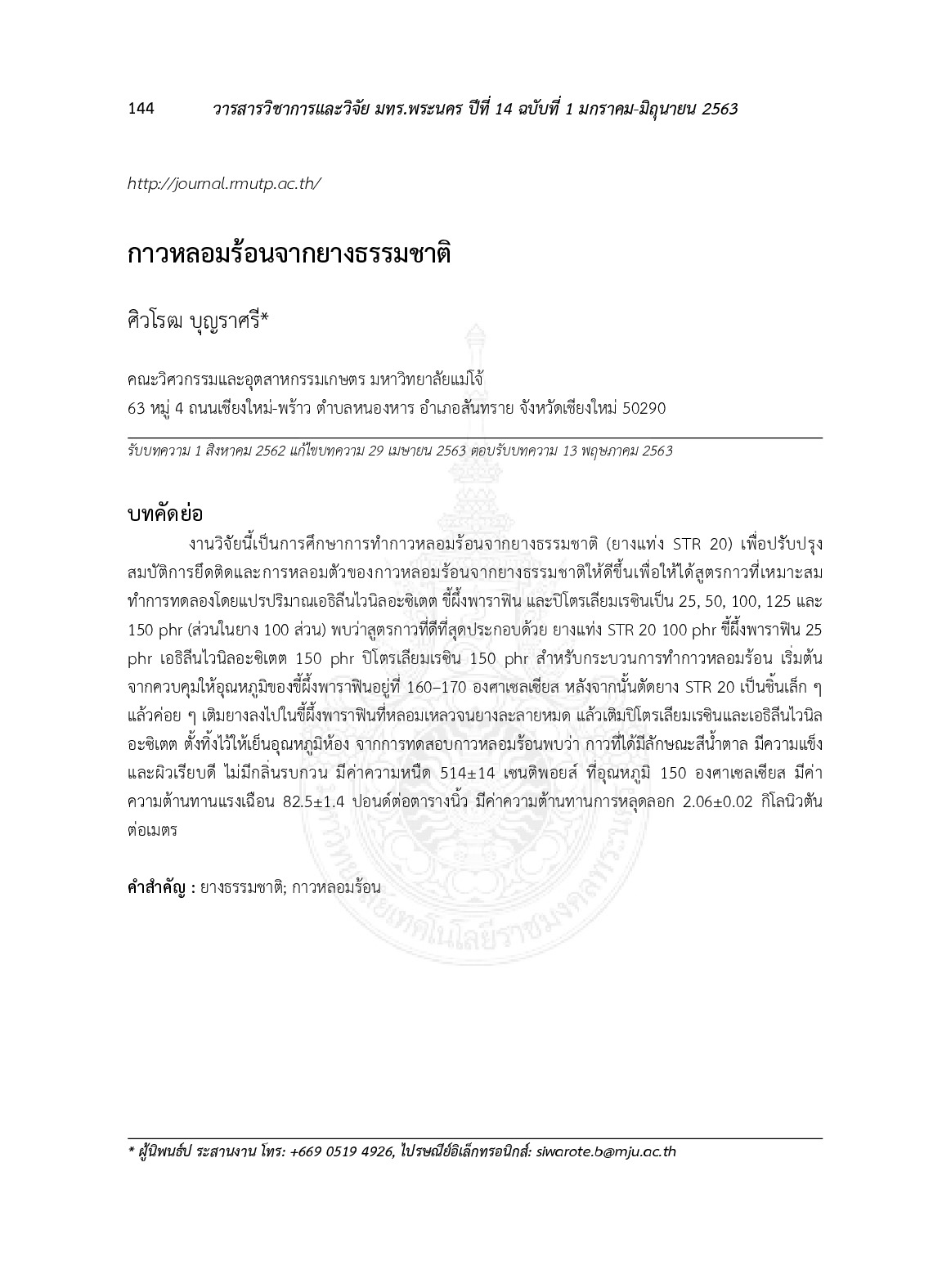
The purpose of this research was to study hot-melt adhesives from natural rubber (Standard Thai Rubber 20 STR 20). In order to improve the adhesion and melting properties of hot-melt adhesive to get the best glue formula from STR 20 the ethylene vinyl acetate content (EVA) paraffin wax (Wax) and petroleum resin (Resin) were varied from 25 50 100 125 and 150 phr (Part Per Hundred Rubber). It was found that the best adhesive formulas consisted of 100 phr of STR 20 25 phr of wax 150 phr of EVA and 150 phr of resin. For preparing hot-melt adhesive first the wax was heated and maintained at 160-170 ºC then cut the STR 20 into small pieces and slowly added the rubber into the melted wax until the rubber was completely melted. And then added resin and EVA and cooled to room temperature finally the results show that hot-melt adhesive was dark brown hard and odorless smooth texture and easy to melt with 514±14 centipoises of Viscosity at 150 ºC 82.49±1.4 lbf/in2 of shear strength and 2.06±0.02 kN/m of cleavage peel strength.

การใช้กาวฟีนอลผลิตแผ่นฟ้าเพดาน T-Bar จากต้นสบู่ดำ
This research aims to produce the T-BAR particleboard from Physic nuts for interior building which are brought agricultural wastes to used for beneficial materials. Under the Thailand industrial standard (TIS-876-2547) specified the evaluated values such as desnsity water content water absorption thickness swelling bending strength elastic modulus and internal bonded. The experiment and evaluation processes between Physic nuts per Urea Formaldehyde ratio and Physic nuts per Phenol-cyanate based on 90:10 92:8 95:5 and 97:3 in consequence that we found the thickness of particleboard not more than 2 cm. The suitable ratio for Phenol-cyanate 92:8 percentage (Physic nuts 92% with Phenol-cyanate 8%) and suitable ratio for Urea Formaldehyde 90:10 percentage (Physic nuts 90% with Urea Formaldehyde 10%) at 120 Celsius temperature on pressing process. The Phenol-cyanate glue ratio of 0.80 gram per cubic centimeter suited to produce the particleboards averaged water content before pressing 8.89% suitable pressure in process 150 pound per square inch water content 7.65% density 0.818 gram per cubic centimeter water absorption 14.23% during 2 hours thickness swelling 8.02% during 2 hours internal bond 0.56 MPa bending strength 21.45 MPa modulus 2116 MPa. The Urea Formaldehyde glue ratio of 0.82 gram per cubic centimeter suited to produce the particleboards averaged water content before pressing 9.84% suitable pressure in process 152 pound per square inch water content 8.63% density 0.833 gram per cubic centimeter water absorption 14.36% during 2 hours thickness swelling 8.95% during 2 hours internal bond 1.39 MPa bending strength 22.37 MPa modulus 2117 MPa. As the results shown that both of Urea Formaldehyde and Phenol-cyanate with Physic nuts passed the TIS 876-2547 standard. The Physic nuts can produce the particleboards for using inside building.
การลอกกาวไหมด้วยยางมะละกอ
Degumming process is a fundamental process for silk yam and silk fabric finishing. The main objective is scouring the substrate such as silk gum (sericin) wax and fatty acid from silk fiber. The principle of degumming process is destroying the peptide linkage of amino acid in sericin structure into a small molecule which is soluble in water. The hydrolysis reaction performed by acid alkaline enzyme surfactant as soap and high pressure steam process. The conventional methods favor degumming with soap and sodium carbonate. This process has a problem on the surface area of silk. Proteolytic enzymes can answer this problem but it seldom use because of a specific condition and high cost. For this reason the insteading of papain enzyme from dry latex of Carica payapa Linn. was decided to use for silk degumming at any condition study. This research was concerned with the silk degumming using papain enzyme form dry latex of Carica payapa Linn. The degumming process was performed at the temperature vary from 55 -85 degree Celsius time fromlO to 40 minutes and the amount of dry latex ranging from 0 to 4% owf in order to study the suitable condition for degumming and surface morphology. The efficiency of degumming process was evaluated by determination of tensile strength and stainiqgJest with dire~~ dyes (C.1. Direct Red 80~StaIDing result.will be opposed to degumming efficiency. The result was revealed; the appropriate conditions for silk degumming with dry Carica payapa Linn. s latex were recommended as follows : the amount of dry latex solution of 4 % owf at 75 degree Celsius for 30 minutes. The degummed fibers leaves lustrous soft and surface smooth. This condition does not have effect to tensile strength and fiber surface.
The product of ceiling plate-Bar from base bark of physic-nut by phenol-cyanate
The objective of this research is to produce the T-Bar. The mixed Gule Phenol-cyanate to made ceiling Plate-Bar plate from the agriculture process’s waste. The researcher brought physic nut plant to produce T- BAR plate for interior building. It was tested based on Thailand industrial standard (TIS 876-2547) for determination of moisture content density absorption and expansion when soak in water as well a cohesion and perpendicular surface tension flexural resistance and modulus of elasticity . at The results show that suitable size material should not thicker than 2 centimeters. The experiment of ratio between physic nut plant and phenol cyanide resin at 90:10 and 92:8. It was found that suitable proportion of physic nut pant and phenol cyanide resin was 92:8. The temperature used for compression was 120o C. The appropriate density prior to the compression plate was 0.80 g/cm.3 The average moisture content of materials before compression was 8.88%. The suitable compression was 151 lb/in?. The moisture content of the product was 7.64% The density was 0.818 g/cm.3 The expansion value after soaking in water for 2 hours was 8.02% and water absorption was 14.22%. Inner bond was 0.55 MPa. Flexibility was 22.44 MPa. and mordulus was 2112MPa.The result of testing complied with the Thailand Industrial Standard (TIS 876-2547).It was concluded that physic nut plant can be used as raw material to make T- Bar plate for interior building
Inorganic filler-filled epoxy adhesive for electronic packaging application
As the high performance electronic devices are required the better heat dissipation in electronic packaging is necessary. In this work the thermal diffusivity of epoxy-based adhesive used as an underfill material in electronic packaging can be improved by adding nano-sized inorganic fillers. These fillers including aluminum oxide (Al2O3) silicon nitride (Si3N4) and silicon carbide (SiC) were used alone for preparing particulate filled-epoxy adhesive. Furthermore In order to achieve good dispersion of filler in matrix the adhesive’s preparation process was adjusted. The maximum loading of fillers in adhesive were determined by the homogeneity of filler and matrix. In addition to avoid the agglomeration of filler silane coupling agent was treated onto surface of aluminum oxide filler to improve interfacial interaction between filler and epoxy resin. The effects of the filler type and filler’s loading on the thermal diffusivity of adhesive were investigated using Laserflash.