จำนวน Repository ( 8 )
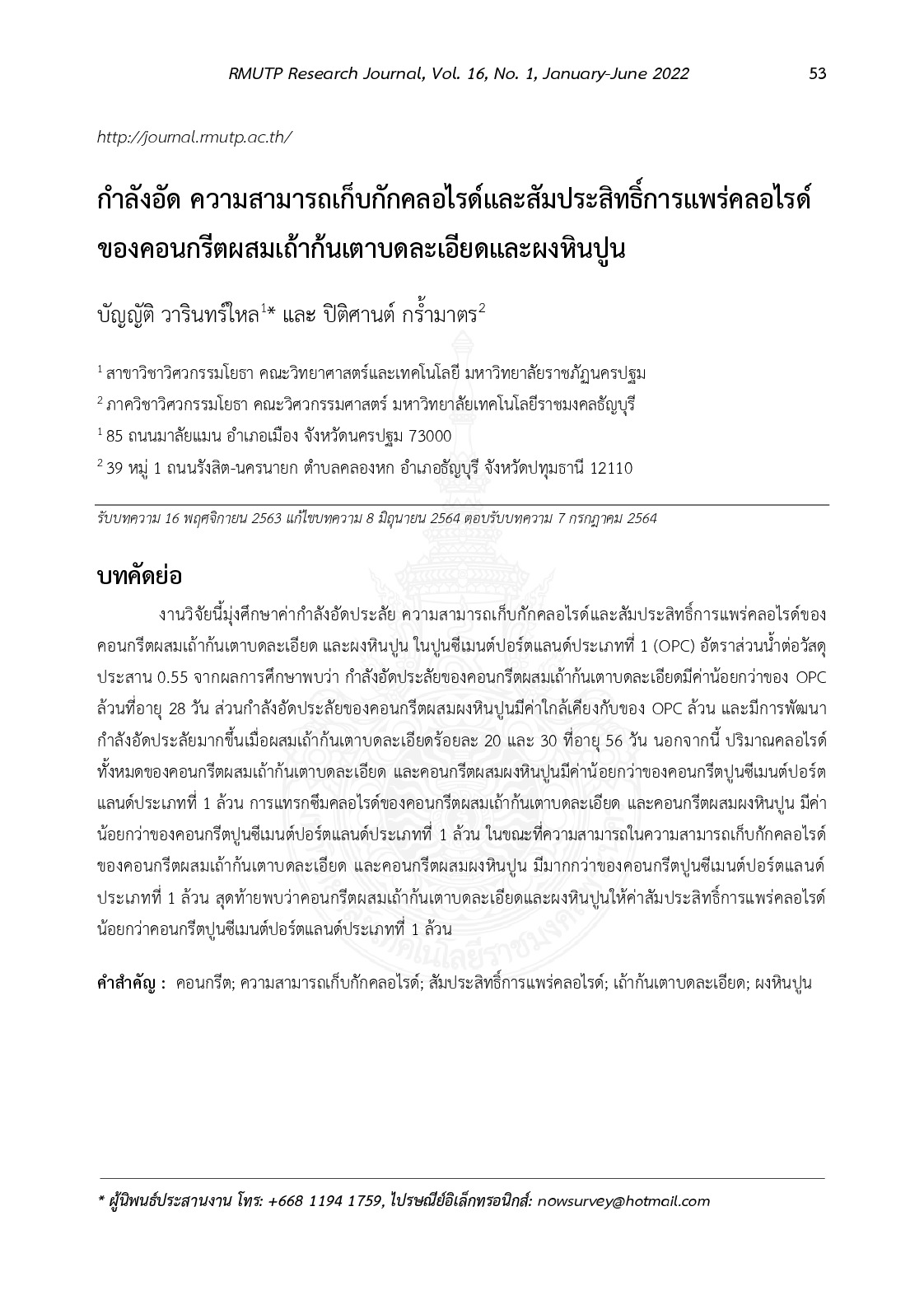
กำลังอัดความสามารถเก็บกักคลอไรด์และสัมประสิทธ์การแพร่คลอไรด์ของคอนกรีตผสมเถ้าก้นเตาบดละเอียดและผงหินปูน
This research was aimed to study the compressive strength chloride binding capacity and chloride diffusion coefficient of concrete replaced by ground bottom ash (GBA) and limestone powder in ordinary Portland cement (OPC). The water to binder ratios were 0.55. The results showed that the compressive strength of concrete with GBA was lesser than that of OPC concrete at 28 days. Also the compressive strength of concrete with limestone powder was close to that of OPC concrete and compressive strength could develop of concrete with GBA 20% and 30% higher than that of OPC concrete at 56 days. Moreover the total chloride of the concrete containing GBA and limestone powder was less than that of OPC concrete. The chloride penetration of the concrete containing GBA and limestone powder was less than that of OPC concrete. The chloride binding capacity of the concrete made with ground bottom ash and limestone powder were higher than that of OPC concrete. Finally the chloride diffusion coefficient of the concrete containing GBA and limestone powder was less than that of OPC concrete.
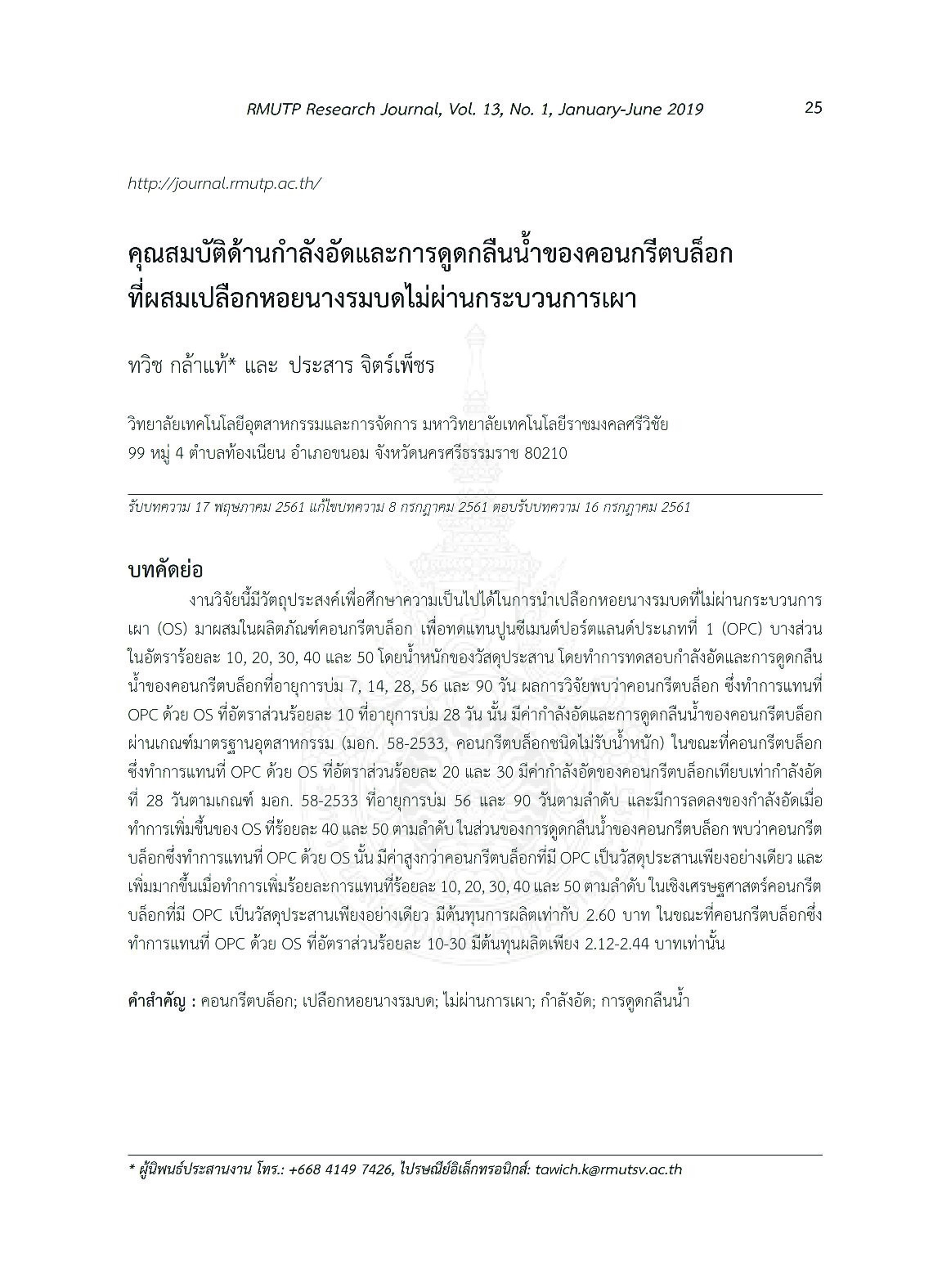
คุณสมบัติด้านกำลังอัดและการดูดกลืนน้ำของคอนกรีตบล็อกที่ผสมเปลือกหอยนางรมบดไม่ผ่านกระบวนการเผา
The research aims to investigate the possibilities of crushed oyster shell (OS) not have to go through the process of burning as a substitution cement for concrete blocks. The cement was replaced with crushed oyster shell not process burning (OS) at 0% 10203040 and 50% by the weight of the binder. After that the concrete blocks were tested to determine the compressive strength and moisture absorbed of the concrete blocks cured for 7 142856 and 90 days The result showed that the compressive strength of the concrete blocks which replaced cement with OS (at the proportion of 10% by the weight of the binder) at 28 days had the compressive strength and water absorbed accordance with the TIS 58-2533 on non-load bearing concrete blocks.Moreover the concrete blocks which replaced cement with OS at the proportion of 20 % and 30 % had the compressive strength equivalent to 28 days compressive strength of TIS 58-2533 standard at 56 and 90 days respectively and decreased when the percentage in addition to OS in concrete blocks of 40 and 50 %. Tested results also showed that the water absorbed of concrete blocks increased when the percentage of replacement of OS in binder increased at 10 20 30 40 and 50%. The economical of concrete blocks it has manufactured unit cost is 2.60 baht. Whereas the concrete block containing crushed oyster shell at 10-30% it has manufactured unit cost at 2.12-2.44 baht respectively.
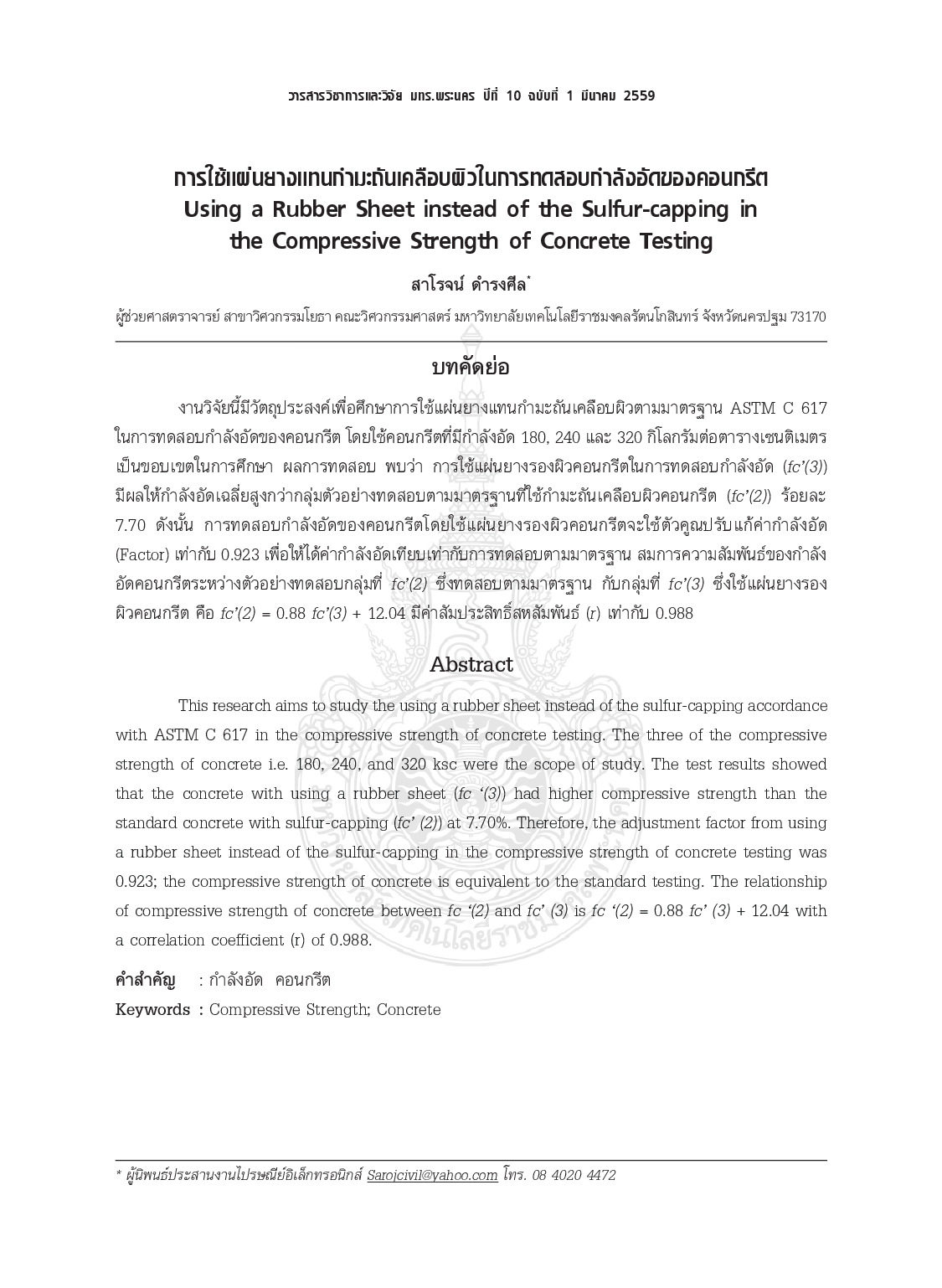
การใช้แผ่นยางแทนกำมะถันเคลือบผิวในการทดสอบกำลังอัดของคอนกรีต
This research aims to study the using a rubber sheet instead of the sulfur-capping accordance with ASTM C 617 in the compressive strength of concrete testing. The three of the compressive strength of concrete i.e. 180 240 and 320 ksc were the scope of study. The test results showed that the concrete with using a rubber sheet (fc (3)) had higher compressive strength than the standard concrete with sulfur-capping (fc (2)) at 7.7%. Therefore the adjustment factor from using a rubber sheet instead of the sulfur-capping in the compressive strength of concrete testing was 0.923; the compressive strength of concrete is equivalent to the standard testing. The relationship of compressive strength of concrete between fc (2) and fc (3) is fc (2) = 0.88 fc (3) + 12.04 with a correlation coefficient (r) of 0.988.
การวิจัยด้านคอนกรีตพรุนที่เป็นมิตรกับสิ่งแวดล้อม
This research presents a study of the compressive strength flexural strength coefficient of permeability and superplasticizer requriment of Porous Concrete containing fine fly. Portland cement (CT) is partially replaced with pozzolans 0 20 30 and 40% by weight of the cementitious materials. The results show that the high compressive strength flexural strength and low total void ratio of Porous Concrete improves substantially with partial replacement of Portland cement with fly ash. Porous Concrete mix cement containing 20 and 30% of fly ash can be used to make cementitious materials. In addition the use of fly ash produces Porous Concrete mix with good compressive strength flexural strength total void ratio and coefficient of permeability.
การพัฒนาเถ้าแกลบและเถ้าถ่านหินเพื่อใช้แทนที่ปูนซีเมนต์ปอร์ตแลนด์ในงานคอนกรีตกำลังสูง
This research presents a study of the use of classified fly ash and ground rice husk ash as a pozzolanic material in producing high-strength concrete. Portland cement (CT) is partially replaced with classified fly ash and ground rice husk ash by weight of the cementitious materials. Compressive strength porosity and chloride penetration were investigated. The results show that the compressive strength resistance to chloride and low porosity of high-strength concrete improves substantially with partial replacement of Portland cement with fly ash and rice husk ash.