จำนวน Repository ( 4 )
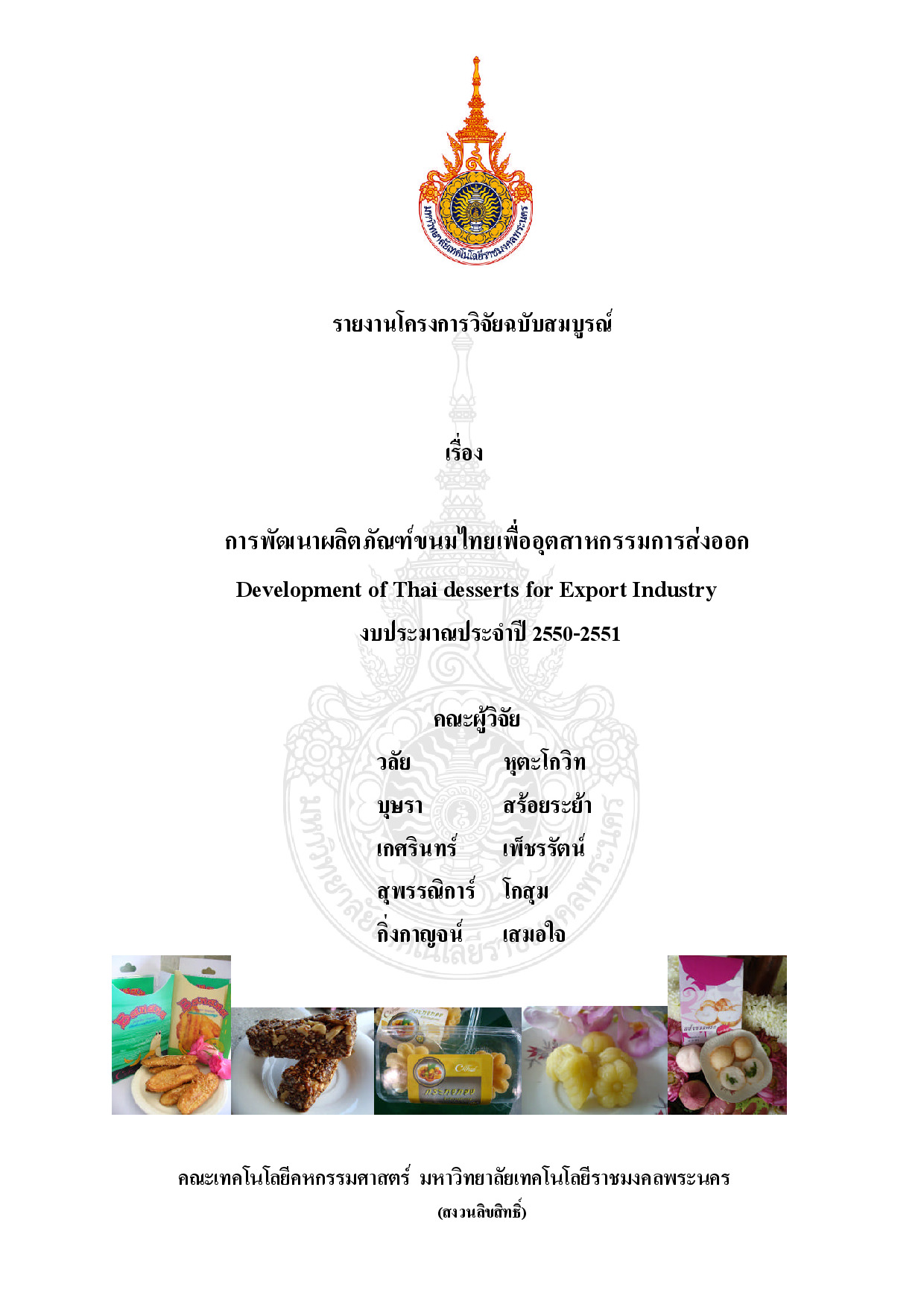
การพัฒนาผลิตภัณฑ์ขนมไทยเพื่ออุตสาหกรรมการส่งออก
Development Project of Thai dessert products for export industry aimed to develop 5 kinds of Thai dessert recipes and process which consisted of cereal bar instant peanut paste powder instant fried banana flour Kratong Thong (Golden Thai Pastry Cups) adapted for keeping longer and instant Kanom Krok flour (Coconut Rice Cake). The result was found that cereal bar from black sticky rice was developed by using 2 % high-fructose syrup and 12% glucose syrup and total soluble solid of syrup was at 90 Brix. The product tested was accepted moderately. Instant peanut paste powder recipe development made by Miss Suphannika Kosum was tested for sensory evaluation to compare with other peanut paste produced in marketplace. It was found that the product was accepted and there was statistically significant difference at p< 0.05. The five sensory overall liking attributes (colour smell taste texture and total impression) were 7.83 7.76 7.73 7.63 and 8.03 respectively. The product had high preference score. Instant fried banana flour recipe development was done by using rice flour to wheat flour ratio at 120:20 12.5% baking soda and 0.5% calcium chloride. Water requirement was 200 milliliter. The product was accepted at medium to high level. The second recipe of Kratong Thong (Golden Thai Pastry Cups) was the most accepted because it was golden yellow and smooth and stir frying for 1.3 minutes. The product was accepted at medium to high level. For instant Kanom Krok flour (Coconut Rice Cake) it was found that 3 recipes of them were significantly different for texture liking at p< 0.05. 100 and 90 gram of rice flour were studied for producing Kanom Krok it was found that there was no statistically significant difference for overall liking attributes (p> 0.05). Because of indifferent quantity of flour Kanom Krok was slightly different. However Kanom Krok made by 90 gram rice flour was less firming when compared to 100 gram rice flour and the product quantity obtained was also less. There was no statistically significant difference for overall liking attributes. The researcher transferred this knowledge and technology to the target private organization. The first time held on “Thai Dessert Products Course” in Lopburi province between 12-13 May 2008. The result of the technology transfer was found that 80 % of the participants’ satisfaction was accepted and after the course was finished the target groups applied this knowledge and technology for their careers to increase community’s income. It is regarded that this project was accomplished according to its success in the goal and objectives. Remark: 1Assistant Professor 2Lecturer of the Faculty of Home Economics Technology 3Lecturer of the Faculty of Architecture and Design
โครงการการพัฒนากระดาษจากใบอ้อยด้วยมือแบบไทยเพื่องานหัตถกรรมและบรรจุภัณฑ์
The project Development of Thai hand made paper from sugar cane leaves for handicraft and package aims to study the technique of making paper from sugar cane leaves to make the prototype products made from the developed paper and then transfer the technology to the selected groups. The study included 5 steps: (1) select the target group of 60 people from sugar cane fanners community enterprise group and general public in Lopburi province (2) make the prototype products and present to public (3) prepare the tools for transferring the technology (4) transfer the developed technology and (5) evaluation and statistical analysis including frequency percentage mean and standard deviation. The general infonnation of the 60 trained people can be summarized as follows: 80.00 % is female 26.67 % is 31-40 years old and 40.00 % is sugar cane fanner. The objectives content activities and training method were evaluated to be the best suitable. The structure of the course was found to be the most suitable. More over the materials training documents and place were rated to be the most suitable to the best suitable.
การพัฒนาผลิตภัณฑ์กระดาษจากแกนสับปะรด
Technology transferring project on manufacturing pare from pineapple cores and designing packages and making souvenirs from pineapple core paper to community and interested persons was a continued part of the project pineapple core paper development. There were 7 steps of the project process. 1. Studying for basic information of paper manufacturing from pineapple cores designing and making products from the paper. 2. Surveying training needs of the target group of populations. 3. Designing training course. 4. Making model products used in training. 5. Preparing training materials and handouts. 6. Training 7. Course and training process evaluation. The researchers followed the designed processes of transferring the study to 90 populations which were the target population group consisted of pineapple farmers private company staff and interested persons by using random population sampling. The statistics used were percentage and mean.

โครงการวิจัยและพัฒนาผลิตภัณฑ์และบรรจุภัณฑ์กล้วยไม้เชิงอนุรักษ์และเรือโบราณจากกระดาษสา
The objective of this research project is to transfer the knowledge and skills of making extirpative orchids from mulberry -pulp paper for decorating home or souvenir to the housewives of Department of Veterinary and the third agricultural division Department of Veterinary Thai Army and the interested people at Amphoe Mae Rim in Changwat Chaing MaL This project processes these activities as follow: 1. Studying basic data of designing and making orchids for many kinds of ornaments 2. Surveying the need to train from target population 3. Making the training course 4. Making prototypes for the training course 5. Preparing media and documents for this course 6. To train the target group and 7. To evaluate the training course and methodology. The sampled population of this process transferring the knowledge and skills of making extirpative orchids from mulberry -pulp paper includes the housewives of Department of Veterinary and the third agricultural division Department of Veterinary Thai Army and the interested people at Amphoe Mae Rim in Changwat Chaing Mai (88 adult persons sampling by completely random sampling method). Research instruments are the training course the questionnaire for evaluating the training course and the training procedures. Descriptive analyses (percentage and mean) are conducted to this work.The results of this work show that all of trainees are women (100%) age between 40 49 years (31.82%) and most of trainees were housewives (73.87%). Evaluation of the training course and methodology finds that objectives structures contents and activities of this course are more suitable level. The opinions about materials and documents using for this course and the training room are more and the most suitable level. The training procedures are the most suitable level. The assessment of expert (preparing to lecture the knowledge about contents of the course the skillful making of products. and ability to transfer the knowledge to answer the questions and to give advice) are the most suitable level. The comment from trainees is they continuously want to train courses that could actually bring back the knowledge and skills to do the occupation.