จำนวน Repository ( 4 )

พฤติกรรมการบริโภคขนมขบเคี้ยวของนักเรียนมัธยมศึกษาตอนต้น โรงเรียนเทพมิตรศึกษา จังหวัดสุราษฎร์ธานี
The purposes of this study were: 1) to studied of knowledge about snack consumption 2) to studied the behavior of snack consumption 3) to studied the association between personal factors or behavior of snack consumption 4) to studied the relationship between family factors or behavior of snack consumption and 5) to studied the association between the knowledge or the snack consumption behavior of middle school students in Thepmitrsuksa School Surat Thani Province. Samples were the middle school students in Thepmitrsuksa School Surat Thani Province that were studying in 2sd semester of academic year 2016 of 301 students. The Research instrument was a questionnaire. The statistics used to data analysis such as; frequency value percentage value average standard deviation and the Chi-squared test that were performing the data analysis used to SPSS statistics. The results of research were found: 1) most of students had highly knowledge about snack consumption 2) the students behavior of snack consumption sometimes had the behavior of snack consumption that consumed candies more than anything else. 3) the association between personal factors such as sex age habitation characteristics amount was being received characteristics from guardian and amount was being received characteristics from the guardian with snack consumption behavior of middle school students in Thepmitrsuksa School Surat Thani Province there were associated statistically significant at 0.05 however the association between personal factors in grade level of study there were not statistically significant in association with snack consumption behavior at .05. 4) the relationship between family factors such as education of guardian and the size of family with snack consumption behavior of middle school student in Thepmitrsuksa School Surat Thani Province that will have found the relationship were statistically significant at .05. and 5) the knowledge about snack consumption behavior of middle school students in Thepmitrsuksa School Surat Thani Province that will has been finding the association was statistically significant at .05.
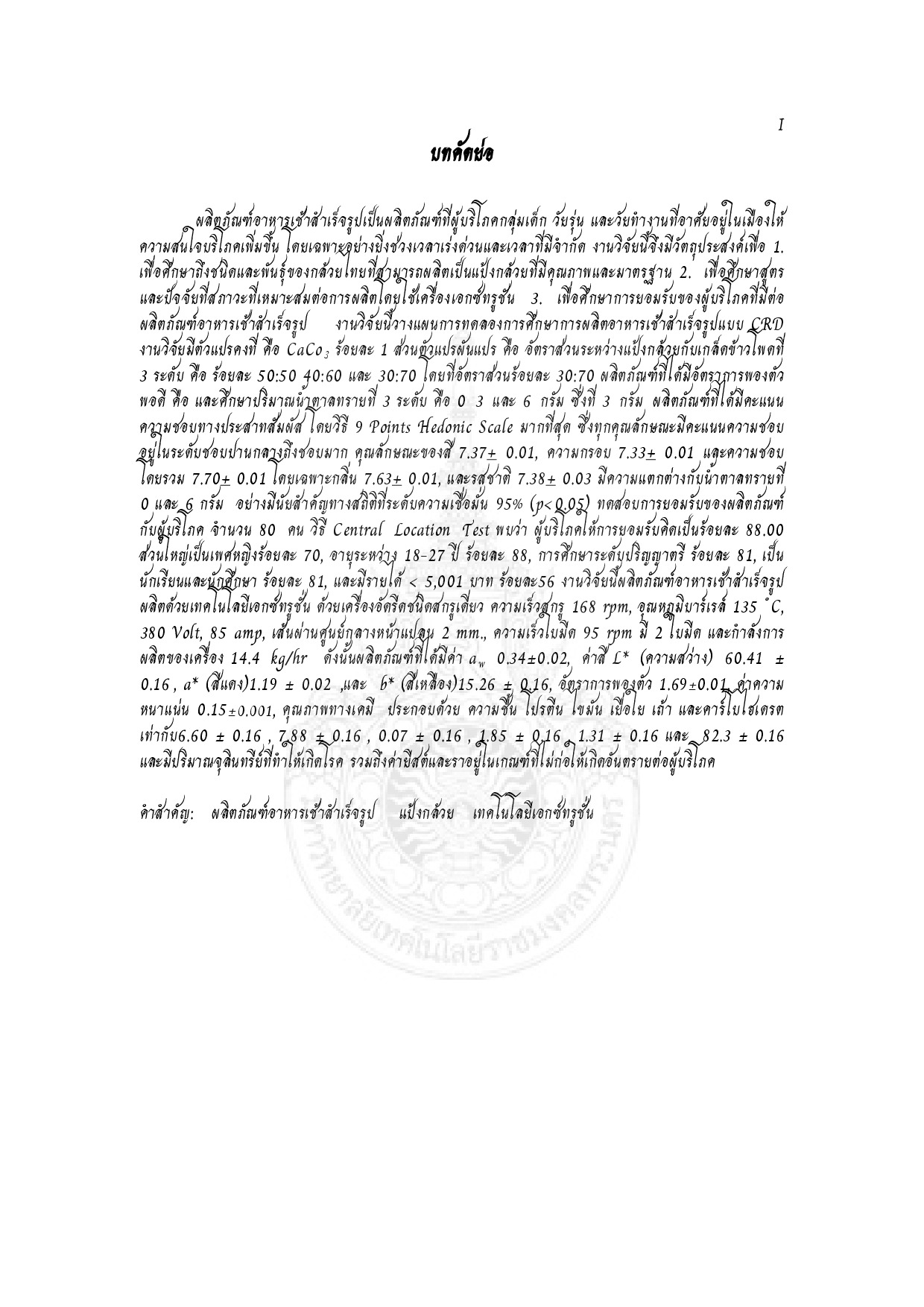
ผลิตขนมขบเคี้ยวจากพืชสมุนไพรไทยพื้นบ้านด้วยเทคโนโลยีเอ็กซ์ทรูชั่น
Thai Local Herbs Snack Product (TLHSP) is very popular and has increase tendency the target group in worldwide such as children teenager and adult which live in metropolis. The aim was 1.) to study the formular and condition to produce TLHSP by extruder machine 2.) to study the type and quantity of Thai Local Herbs which was added 3.) to study the shelf-life and type of package to keep TLHSP. The study used CRD to design the method and has a stable variable is 1% CaCo3and varies 2 variables are the ratio between a speed of single screw at 3 levels such as 250 300 and 350 rpm and moisture content of raw material at 3 levels such as 15 17.5 and 20. And this research study about the level of grinded sugar (GS) at 3 levels such as 0 3 and 6 g. which at 3 g. the TLHSP had well scores of 7 to 8 (like moderately to like very much; used 9 Points Hedonic Scale method for the sensory test) the characteristic for color was 7.37+ 0.01 texture in crisp was 7.33+ 0.01 and overall acceptance was 7.70+ 0.01. Especially odor was 7.63+ 0.01 and taste was 7.38+ 0.03 there were significant differences (p<0.05) with 0 and 6% grinded sugar. TLHSP was well accepted by consumers with 88.00% (By the Central Location Test for questionnaire paper survey). Almost 70% were female 88% had 18-27 years-old 81% were student and 56% hadincome cash < 5001 baht/ months. This study used the extrusion technology to produceTLHSP which the fixed specification fallow as; a speed of single screw was 300 rpm Barrel temperature was 134-165 ˚C 380 Volt 85 amp a diameter in front of machine was 2 mm. a speed of blade 95 rpm and had 2 pieces. And the capacity was 14.4 kg/hr. Therefore aw0.34±0.02 Lightness 60.41 ± 0.16 %extended ratio1.69±0.01 %bulk density 0.15± 0.001. Chemical Properties for %moisture6.60±0.16 %protein 7.88±0.16
กระบวนการผลิตกระเจี๊ยบเขียวแผ่นอบกรอบโดยการใช้เครื่องอบแห้งแบบลมร้อน
The study on baked crispy okra sheets (Hit 9701 species) by using a hot air dryer. The objective of this study was to investigate the okra sheets formula and manufacturing procees by hot air dryers with 3 methods; pouring finely blended okra onto the inside tray pouring finely blended okra onto the outside tray and pouring finely blended okra into an aluminum block. It was found that pouring finely blended okra into an aluminum block resulted in the least crack in the dried sheet with the rectangular shape remaining intact. After the forming method is decided on a study was conducted on the temperature to bake okra at 3 levels namely 70 80 and 90 C.It was found that baking okra at 80 C for 4.5 hours was suitable the baking and crispy okra sheets ended up with the lightness(L*) of 49.75 the green (a*) was-2.53 and yellowness (b*) of 23.71. The moisture content was at 5.07 % water activity content was 0.27 The hardness was 5.01 N and the crispness was 4.67. The results of chemical analysis showed that the carbohydrate content was 76.34% crude fibers was 10.72% ash content was 8.24% moisture content was 4.24% and fat content was 0.46%. From the study on the bacteriological quality it was found that the crispy okra sheet products can be stored at room temperature for 28 days.
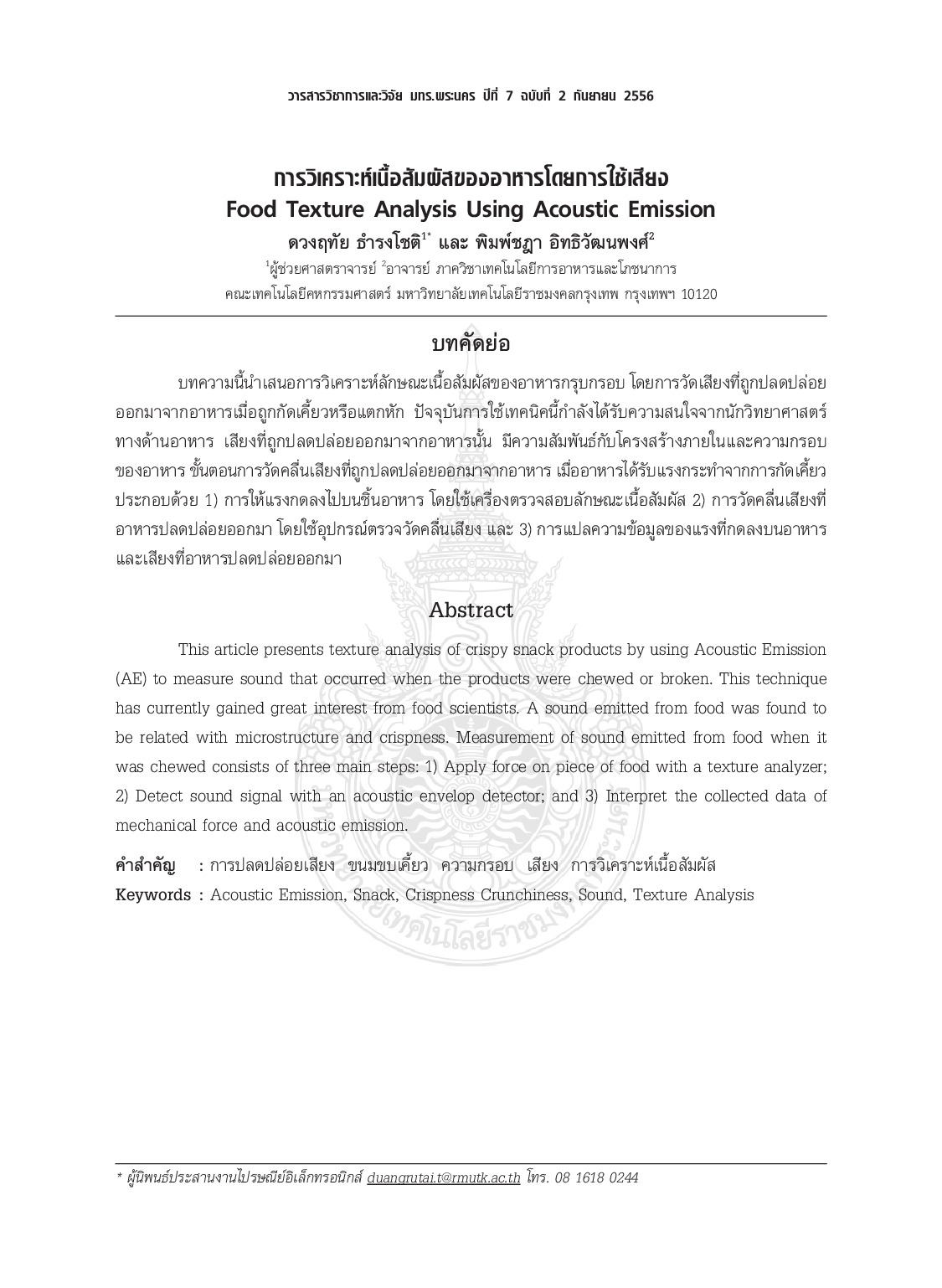
การวิเคราะห์เนื้อสัมผัสของอาหารโดยการใช้เสียง
This article presents texture analysis of crispy snack products by using Acoustic Emission (AE) to measure sound that occurred when the products were chewed or broken. This technique has currently gained great interest from food scientists. A sound emitted from food was found to be related with microstructure and crispness. Measurement of sound emitted from food when it was chewed consists of three main steps: 1) Apply force on piece of food with a texture analyzer; 2) Detect sound signal with an acoustic envelop detector; and 3) Interpret the collected data of mechanical force and acoustic emission.