จำนวน Repository ( 3 )

The social responsibility of students in the faculty of management technology Rajamangala University of Technology Isan surin campus
The purpose of this research is to study the social responsibility of students in the faculty of technology management Rajamangala University of Technology Isan Susin campus. The samples used are Faculty of Management students of Rajamangala University of Technology Isan Surin campus in 2011 315 students. Tools used such as questionnaire. Results showed that Most of the samples are studying in Information Systems Management Accounting and the others. The social responsibility family responsibilities about their care and concern for all members of the family and Responsibility to the nation about the performance of their duties as good citizens by carrying an ID card at the highest level. Responsibility friend about respect and honor all sincere friends Responsibility for the school about praise honor and university is very proud Responsibility to the community about participating and helping to organize the annual event in the community such as Songkran Buddhist etc. at a high level. Samples with different gender age and disciplines. With social responsibility Responsibility for the school difference is statistically significant at the 0.05 level. The other four areas. Such as Family Responsibilities Responsibility friend Responsibility to the community and responsibility to the nation. No difference. Samples at different levels of education and grade levels. With social responsibility the difference is statistically significant at the .05 level. The 5 areas.
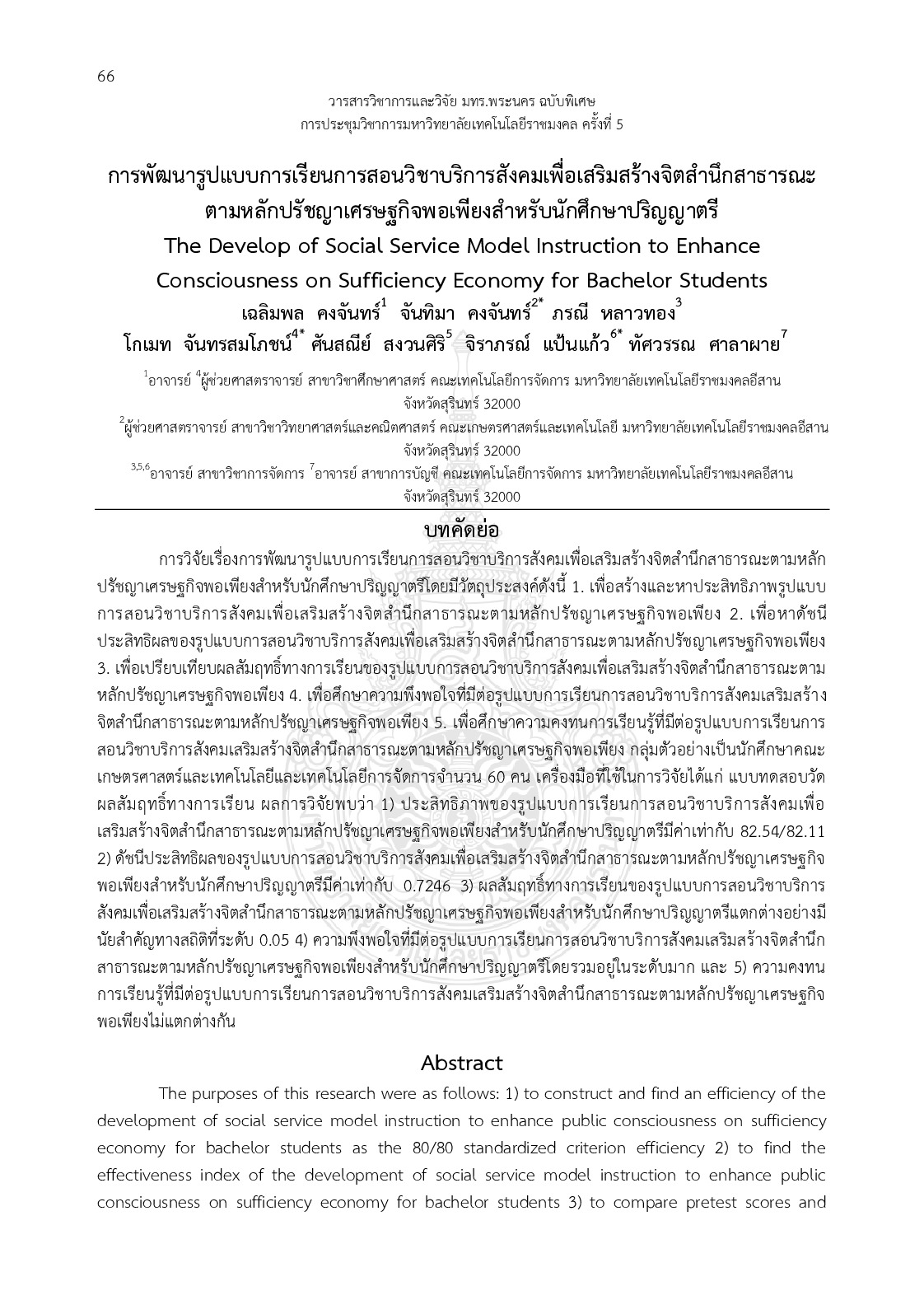
The develop of social service model instruction to enhance consciousness on sufficiency economy for bachelor students
The purposes of this research were as follows: 1) to construct and find an efficiency of the development of social service model instruction to enhance public consciousness on sufficiency economy for bachelor students as the 80/80 standardized criterion efficiency 2) to find the effectiveness index of the development of social service model instruction to enhance public consciousness on sufficiency economy for bachelor students 3) to compare pretest scores and post-test scores all lessons 4) to study the satisfaction of students after they join the class 5) to study the attitude of students after they join the class and 6) to find the retention of students after join the class in two weeks. The sixty students were area on simple random sampling selected from students in Rajamangala Technology University. The results the study was as follows: 1) An efficiency of the development of social service model instruction to enhance public consciousness on sufficiency economy for bachelor students was 82.54/82.11 which higher than the 80/80 standardized criterion efficiency. 2) The efficiency index of the development of social service model instruction to enhance public consciousness on sufficiency economy for bachelor students was 0.7246. 3) The results of the comparisons of pre-test scores and post-test scores all lesson significantly different at 0.05. 4) The results of the satisfaction of the development of social service model instruction to enhance public consciousness on sufficiency economy for bachelor students was found to be a high level. 5) The retention of the teachers after join the class in two was no significantly different.
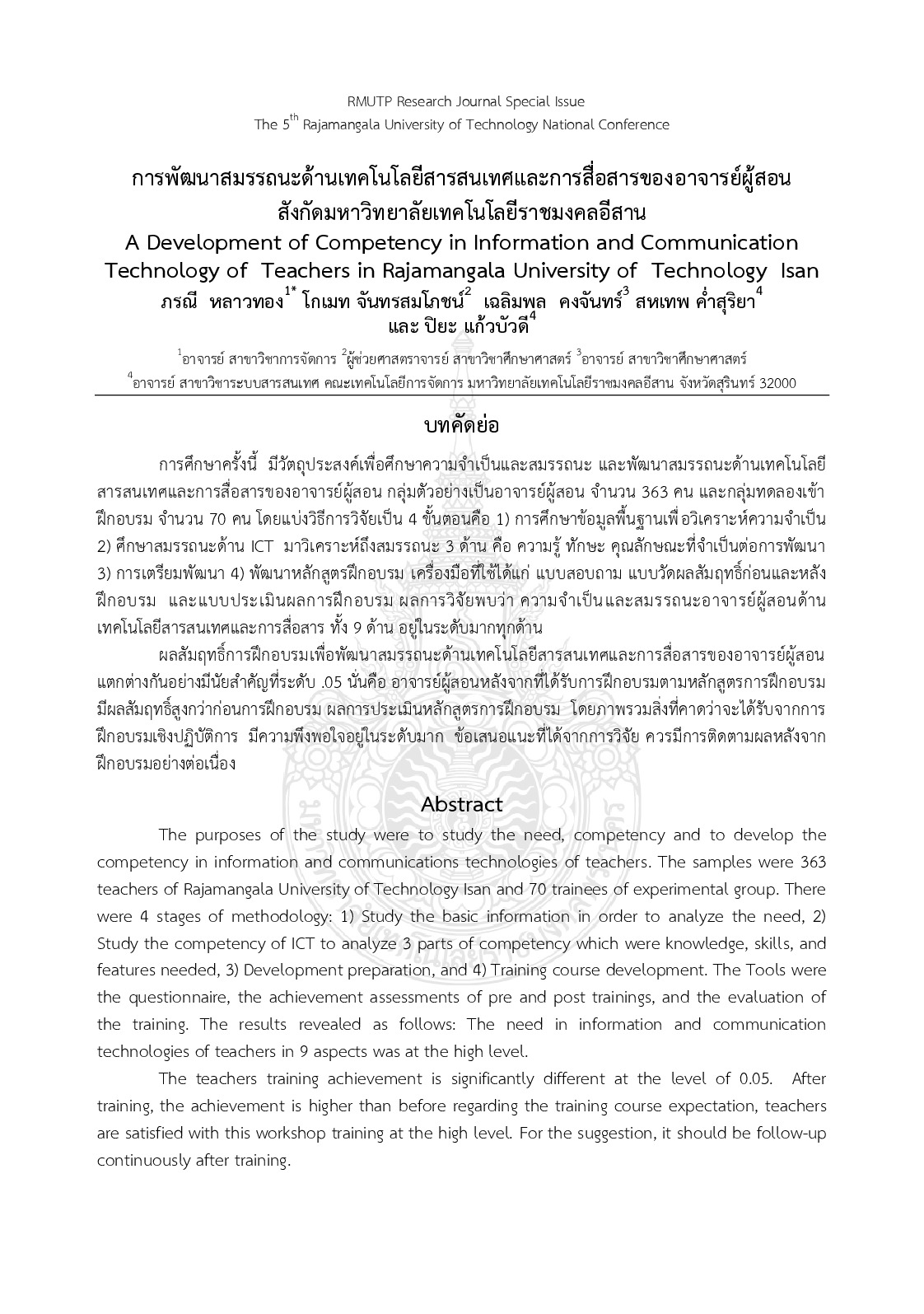
A development of competency in information and communication technology of teachers in Rajamangala University of Technology isan
The purposes of the study were to study the need competency and to develop the competency in information and communications technologies of teachers. The samples were 363 teachers of Rajamangala University of Technology Isan and 70 trainees of experimental group. There were 4 stages of methodology: 1) Study the basic information in order to analyze the need 2) Study the competency of ICT to analyze 3 parts of competency which were knowledge skills and features needed 3) Development preparation and 4) Training course development. The Tools were the questionnaire the achievement assessments of pre and post trainings and the evaluation of the training. The results revealed as follows: The need in information and communication technologies of teachers in 9 aspects was at the high level. The teachers training achievement is significantly different at the level of 0.05. After training the achievement is higher than before regarding the training course expectation teachers are satisfied with this workshop training at the high level. For the suggestion it should be follow-up continuously after training.