จำนวน Repository ( 3 )

The product of ceiling plate-Bar from base bark of physic-nut by phenol-cyanate
The objective of this research is to produce the T-Bar. The mixed Gule Phenol-cyanate to made ceiling Plate-Bar plate from the agriculture process’s waste. The researcher brought physic nut plant to produce T- BAR plate for interior building. It was tested based on Thailand industrial standard (TIS 876-2547) for determination of moisture content density absorption and expansion when soak in water as well a cohesion and perpendicular surface tension flexural resistance and modulus of elasticity . at The results show that suitable size material should not thicker than 2 centimeters. The experiment of ratio between physic nut plant and phenol cyanide resin at 90:10 and 92:8. It was found that suitable proportion of physic nut pant and phenol cyanide resin was 92:8. The temperature used for compression was 120o C. The appropriate density prior to the compression plate was 0.80 g/cm.3 The average moisture content of materials before compression was 8.88%. The suitable compression was 151 lb/in?. The moisture content of the product was 7.64% The density was 0.818 g/cm.3 The expansion value after soaking in water for 2 hours was 8.02% and water absorption was 14.22%. Inner bond was 0.55 MPa. Flexibility was 22.44 MPa. and mordulus was 2112MPa.The result of testing complied with the Thailand Industrial Standard (TIS 876-2547).It was concluded that physic nut plant can be used as raw material to make T- Bar plate for interior building
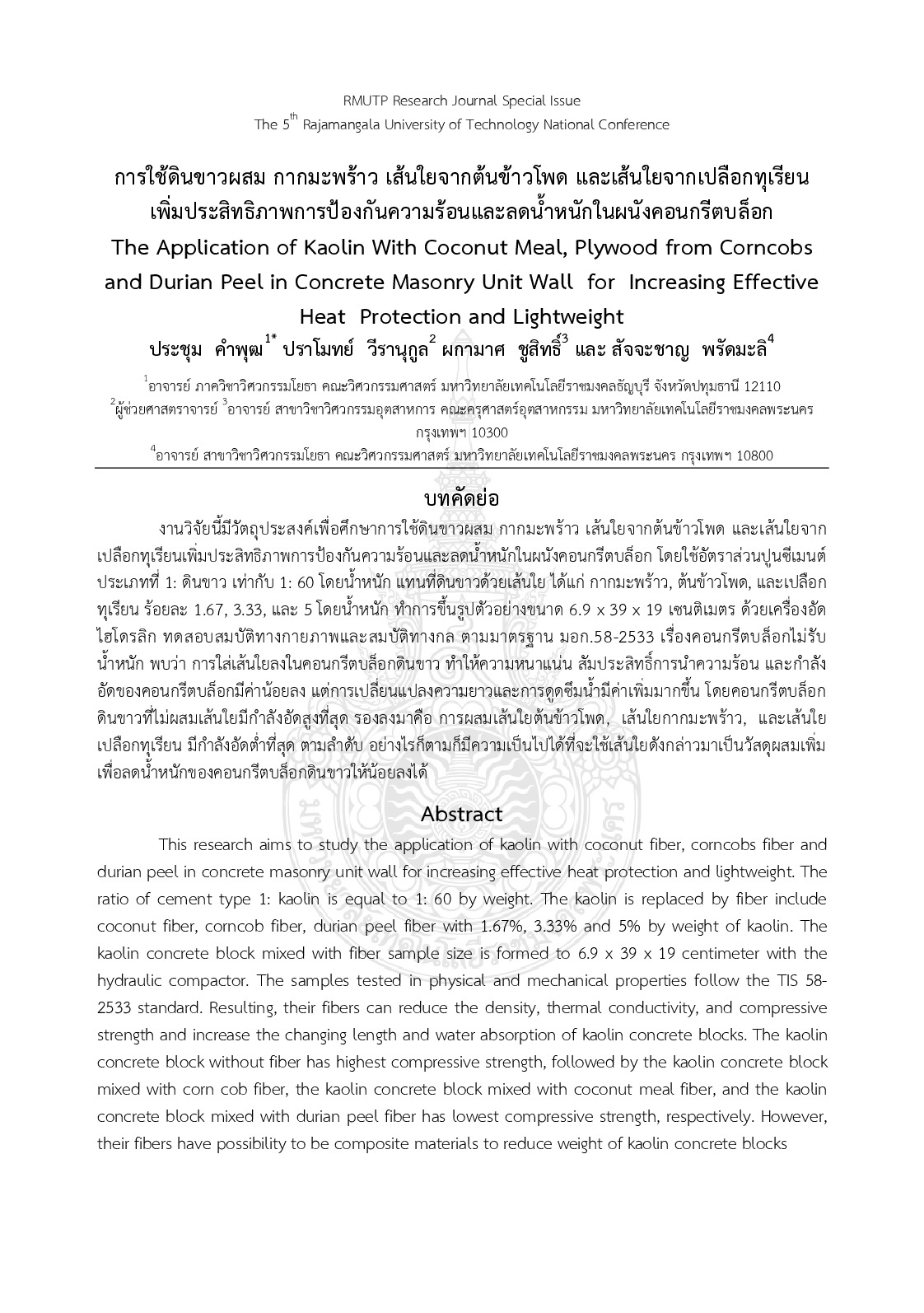
The application of kaolin with coconut meal, plywood from corncobs and durian peel in concrete masonry unit wall for increasing effective heat protection and lightweight
This research aims to study the application of kaolin with coconut fiber corncobs fiber and durian peel in concrete masonry unit wall for increasing effective heat protection and lightweight. The ratio of cement type 1: kaolin is equal to 1: 60 by weight. The kaolin is replaced by fiber include coconut fiber corncob fiber durian peel fiber with 1.67% 3.33% and 5% by weight of kaolin. The kaolin concrete block mixed with fiber sample size is formed to 6.9 x 39 x 19 centimeter with the hydraulic compactor. The samples tested in physical and mechanical properties follow the TIS 58-2533 standard. Resulting their fibers can reduce the density thermal conductivity and compressive strength and increase the changing length and water absorption of kaolin concrete blocks. The kaolin concrete block without fiber has highest compressive strength followed by the kaolin concrete block mixed with corn cob fiber the kaolin concrete block mixed with coconut meal fiber and the kaolin concrete block mixed with durian peel fiber has lowest compressive strength respectively. However their fibers have possibility to be composite materials to reduce weight of kaolin concrete blocks
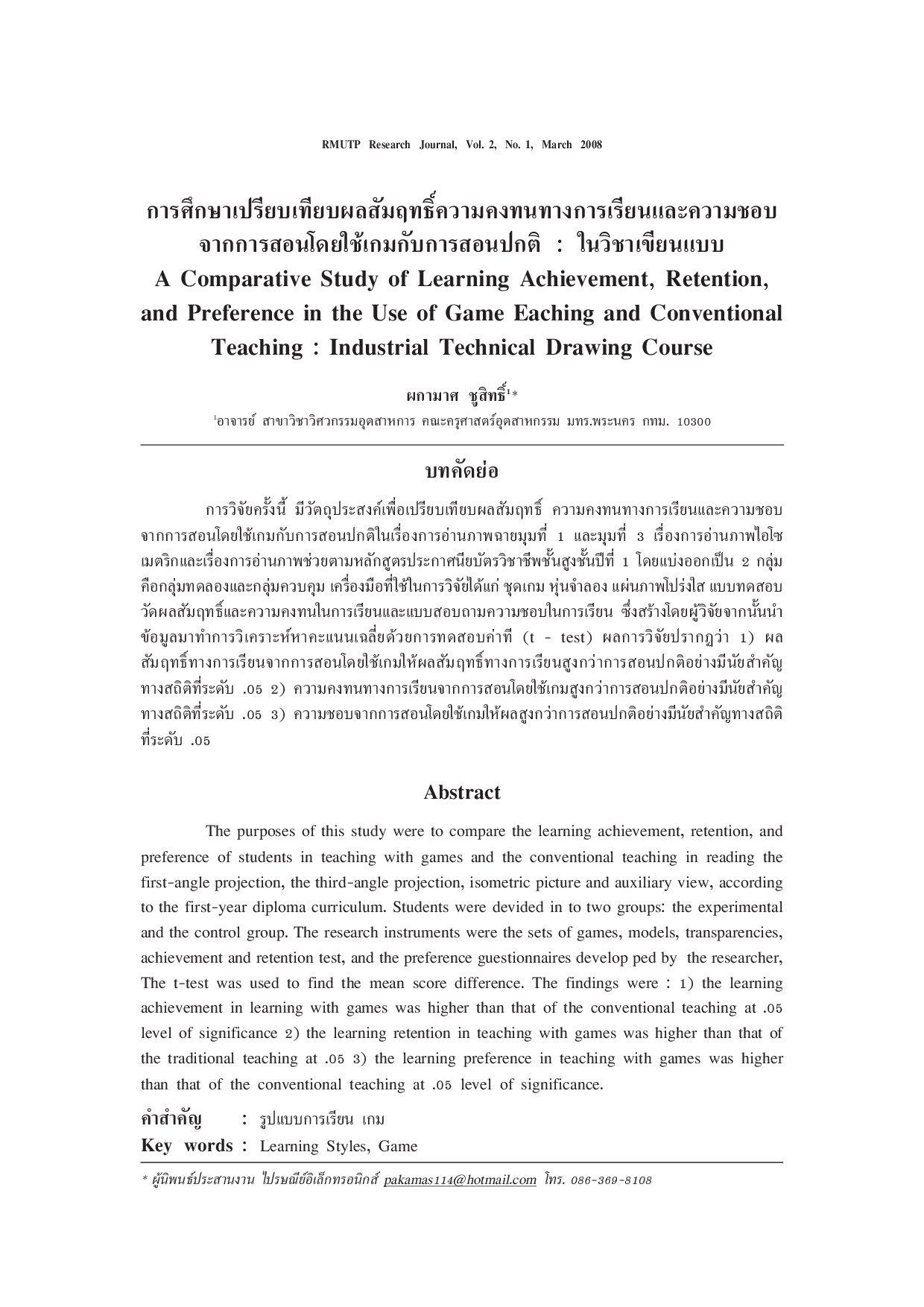
A Comparative Study of Learning Achievement, Retention, and Preference in the Use of Game Eaching and Conventional Teaching : Industrial Technical Drawing Course
The purposes of this study were to compare the learning achievement retention and preference of students in teaching with games and the conventional teaching in reading the first-angle projection the third-angle projection isometric picture and auxiliary view according to the first-year diploma curriculum. Students were devided in to two groups: the experimental and the control group. The research instruments were the sets of games models transparencies achievement and retention test and the preference guestionnaires develop ped by the researcher The t-test was used to find the mean score difference. The findings were : 1) the learning achievement in learning with games was higher than that of the conventional teaching at .05 level of significance 2) the learning retention in teaching with games was higher than that of the traditional teaching at .05 3) the learning preference in teaching with games was higher than that of the conventional teaching at .05 level of significance.