จำนวน Repository ( 6 )

การพัฒนาแบบจำลองความรู้ด้านเทคโนโลยีผนวกวิธีการสอนและเนื้อหา (TPCK) ในการประเมินศักยภาพความร้อนของนักศึกษาฝึกสอนสายช่างอุตสาหกรรม
This research conducted an investigation on vocational pre-service teachers’ performance based on Technological Pedagogical Content Knowledge Framework (TPCK) to support learning in 21st century. TPCK Framework integrated three kinds of knowledge needed by a teacher in providing learning process for students effectively. The results of this study found that vocational pre-service teachers had the knowledge of using technology understanding teaching pedagogies and mastering on content individually. However they were limited in blending such essential three domains together to form more effective learning process for their students.
การศึกษาการพัฒนาทักษะเกี่ยวกับการสอนวิชาชีพช่างอุตสาหกรรมด้านไฟฟ้า
การวิจัยครั้งนี้มีวัตถุประสงค์เพื่อศึกษาปัญหาที่เกิดขึ้นในการฝึกประสบการณ์วิชาชีพที่เกี่ยวกับทักษะการสอน และทักษะที่นักศึกษาฝึกสอนนำไปใช้ในขณะฝึกสอน นักศึกษาส่วนให่เป็นเพศชาย จำนวน 22 คิดเป็นร้อยละ 100.00 มีอายุ 20 ปี จำนวน 15 คน คิดเป็นร้อยละ 68.18 รองลงมาอายุ 21 ปี จำนวน 10 คน คิดเป็นร้อยละ 45.45 มีวุฒิการศึกษาระดับ ปวส. จำนวน 22 คน คิดเป็นร้อยละ 100.00 จบการศึกษาจากสถานศึกษาในสังกัดรัฐบาล จำนวน 20 คน คิดเป็นร้อยละ 90.91 และเอกชน จำนวน 2 คน คิดเป็นร้อยละ 09.09 มีผลสัมฤทธิ์ทางการเรียนระหว่าง 201-2.50 จำนวน 21 คน คิดเป็นร้อยละ 95.45 และผงสัมฤทธิ์ทางการเรียน จบการศึกษาสายช่างอุตสาหกรรม จำนวน 22 คน คิดเป็นร้อยละ 100.00 มีภูมิลำเนาในเขตปริมณฑล จำนวน 4 คน คิดเป็นร้อยละ 18.18 ผู้ที่มีส่วนสำคัญในการตัดสินใจเลือกสาขา คือ ตัดสอนใจด้วยตนเอง จำนวน 10 คน คิดเป็นร้อยละ 45.45 รองลงมา บิดา มารดา และตัวท่านร่วมกัน จำนวน 6 คน คิดเป็นร้อยละ 27.27 และบิดา มารดาหรือผู้ปกครองมีรายได้ต่อเดือน ตั้งแต่ 20001-30000 บาท จำนวน 6 คนคิดเป็นร้อยละ 40.91 รองลงมา มีรายได้ตั้งแต่ 10001-20000 บาท จำนวน 6 คน คิดเป็นร้อยละ 27.27 ผลการวิจัยนักศึกาามีความคิดเห็นต่อทักษะที่ใช้ในขณะฝึกสอนและทักษะที่นำมาใช้ในขณะฝึกสอน นั้น นักศึกษาใช้ทักษะต่างๆ สำหรบการสอนวิชาชีพช่างอุตสาหกรรมด้านไฟฟ้าในขณะฝึกสอน โดยรวมอยู่ในระดับมาก และนักศึกษามีความคิดเห็นในการนำทักษะต่างๆมาใช้ในขณะฝึกสอน ได้แก่ ทักษะการกระตุ้น ทักษะการเสริมแรง และทักษะการนำเข้าสู่บทเรียน สำหรับทักษะที่ควรนำมาใช้ในขณะฝึกสอน นักศึกษาส่วนใหญ่มีความคิดเห็น ว่าทักษะที่ควรนำมาใช้ในขณะฝึกสอน ได้แก่ ทักษะการอธิบายบทเรียน ทักษะการเสริมแรง ทักษะการกระตุ้น
การวิเคราะห์ความอยู่รอด : การศึกษาการออกกลางคันของนักศึกษา ปวส.สายช่างอุตสาหกรรม มหาวิทยาลัยเทคโนโลยีราชมงคลพระนคร วิทยาเขตพระนครเหนือ
The objectives of the study were to fine the survival probabilities the haazard rates of dropping out of the tecnical diploma level students at Rajamangala University of Technology phra Nakhon North Bangkok Campus and the factors influencing on the university in 2005. The study foud tht the frist semester the survival probabilities of students in all divisions were high ranging from 0.9210 to 1.00 For the second semester the survival probabilities of students in all divisions ranged from 0/7820 to 0.8815 except Industrial Technology which had a maximum value of 0.9295 aned Metal Technology which had aminimum value of 0.6271. For the third and the fourth semester there were 6 division which had survival probabilities ranging from 0.7142 to 0.7971. They were Tool and Die Making Computer technology Eletrical Technology Electronics Auromatic Machine and production design. They 4 were Mechanical Tool Technology Business Computer Mechanical Power and Industrial Technolog. the hazard rates of dropping of students in all divising were low ranging for 0.00 to 0.0822. For the second semester the hazard rates of dropping of students in all divisions ranged from 0.1260 to 0.2458 except Industrial technology which had a minimum value of 0.0730 and Metal Technology which had a miximum value of 0.5221. For the third and the fourth semester the hazard rates of students in all division ranged from 0.1355 to 0.2962 excepy metal Technology which had the maximum value of 0.5932 and Tool and Die Making which had the value of 0.3364. The factors influencing on hazard rates of students drpout were place of previous school region of previos school and grade point average of previons school. The hazard rate of dropping of students graduation from school in the central region (not including Bankok Metropolitan Area) was 43% (0.562 times) less than the hazard rate of dropping of students graduation from schools in Bangkok metropolitan area. The hazard rate of dropping of students having grade aveage of 3.10-3.50 and 3.51-4.00 from previous school was 43.1% (0.569 times) and 63.7% (0.377 times) less than the hazard rate of students having grade point average of 2.00-2.50 respectively.
สำรวจความต้องการครูช่างอุตสาหกรรมในประเทศไทย ช่วงปี พ.ศ. 2550-2554
This study aims to survey the trend of the demand of the industrial instructors of the wanted institutions and the producing organization especially for the Faculty of Industrial Education Rajamangala University of Technology Phra Nakhon so as to know exactly about the certain demand and to estimate the production of the industrial instructors sufficiently to their needs and upgrade their skill more efficiently including implementation plan and curriculum development. The population are administrators heads of the departments from the Office of Vocational Education Commission and the Administration Office of Private Education Enhancing Commission. 112 samples were drawn under sample procedure by using the purposive sampling. The tool used in this research is questionnaire concerning the demand situation of the industrial instructors in Thailand during 2007-2011 emphasis on the institutions using industrial instructors. Qualitative data were analyzed by using content analysis method whereas quantitative data were analyzed by statistics; frequency percentage and mean.The result is found that the demand of the industrial instructors in certificate level during 5 years (2007-2001) are the same. The department with highest demand is electronice and electricty (average;238 instructors/ year) next is auto-mechanics mechanics and maintenance metal and construction respectively. The overall demand of the industrial instructors in each department of certificate level is high (average; 3.51)and the department with highest average demand is metal (3.75) construction (3.69) respectively. The average demand of the industrial instructors in each field from the most to the least is plastic mold (4.03) mechanical drawing (3.08) respectively. The demand of the industrial instructors in higher diploma level during 3 years (2009-2011) are the same. The fields with highest demand are mechanics and electronics and electricity (average; 125 instructors/year next is electrical power (average; 116instructors/year) production technology (average; 63 instructors/year)and construction (average; 19 instructors/year) respectively. The overall demand of the industrial instructors in each department of higher diploma level is high (average; 3.51) and the department with highest average demand is electrical power (3.70) electronics (3.66) construction (3.33) respectively. The average demand of the industrial instructors in each field from the most to the least is air-conditioning (3.91) electrical appliance maintenance (3.85) electrical mechanics (3.84) mechanical technology (3.19) respectively.
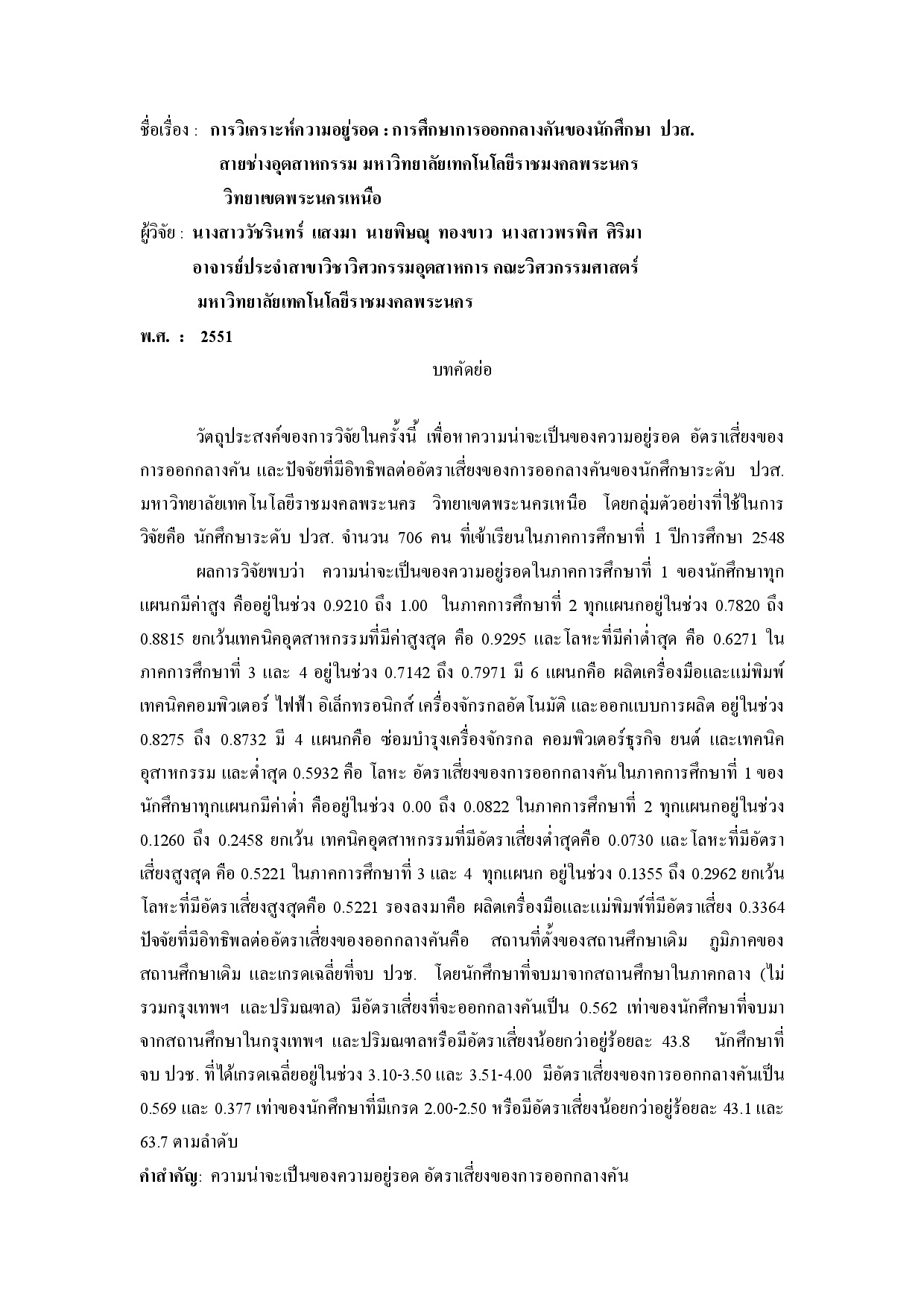
การวิเคราะห์ความอยู่รอด : การศึกษาการออกกลางคันของนักศึกษา ปวส. สายช่างอุตสาหกรรม มหาวิทยาลัยเทคโนโลยีราชมงคลพระนคร วิทยาเขตพระนครเหนือ
The objectives of the study were to find the survival probabilities the hazard rates of dropping out of the technical diploma level students at Rajamangala University of Technology Phra Nakhon North Bangkok Campus and the factors influencing on the hazard rates of students dropout. The sample was the students enrolling in the university in 2005. The study found that for the first semester the survival probabilities of students in all divisions were high ranging from 0.9210 to 1.00. For the second semester the survival probabilities of students in all divisions ranged from 0.7820 to 0.8815 except Industrial Technology which had a maximum value of 0.9295 and Metal Technology which had a minimum value of 0.6271. For the third and the fourth semester there were 6 divisions which had survival probabilities ranging from 0.7142 to 0.7971. They were Tool and Die Making Computer Technology Electrical Technology Electronics Automatic Machine and Production design. There were 4 divisions which had survival probabilities ranging from 0.8275 to 0.8732. They were Mechanical Tool Technology Business Computer Mechanical Power and Industrial Technology. The division of Metal Technology had the minimum value of 0.5932. For the first semester the hazard rates of dropping of students in all divisions were low ranging from 0.00 to 0.0822. For the second semester the hazard rates of dropping of students in all divisions ranged from 0.1260 to 0.2458 except Industrial Technology which had a minimum value of 0.0730 and Metal Technology which had a maximum value of 0.5221. For the third and the fourth semester the hazard rates of dropping of students in all divisions ranged from 0.1355 to 0.2962 except Metal Technology which had the maximum value of 0.5932 and Tool and Die Making which had the value of 0.3364. The factors influencing on hazard rates of students dropout were place of previous school region of previous school and grade point average of previous school. The hazard rate of dropping of students graduating from schools in the central region (not including Bangkok Metropolitan Area) was 43.8% (0.562 times) less than the hazard rate of dropping of students graduating from schools in Bangkok Metropolitan Area. The hazard rate of dropping of students having grade point average of 3.10-3.50 and 3.51-4.00 from previous school was 43.1% (0.569 times) and 63.7% (0.377 times) less than the hazard rate of dropping of students having grade point average of 2.00-2.50 respectively.