จำนวน Repository ( 5 )
ผลิตภัณฑ์ซองเส้นใยเปลือกข้าวโพดเคลือบสารสกัดน้ำมันผิวมะกรูด ทดแทนซองพลาสติกเพื่อบรรจุซิลิกาสำหรับดูดความชื้น
In order to maintain food and materials including drying products at the original dried condition silica gel can be one choice for absorbing moisture. Most silica gel is packed in an Parcel made from plastic which is difficult to naturally degrade thus causing environmental problems. This research therefore have developed packaging material from agricultural waste corn husks for absorbing moisture from food rice. From the study it was found that the corn husk paper had characteristic of smooth paper surface. When making it into a corn fiber Parcel its maximum moisture absorption from saturated humidity was 9.22±0.92% and it could absorb the moisture from the rice stored at room temperature when compared to the plastic sachet at 8.26±0.50% and 9.30±0.08% respectively. When coated with kaffir lime oil extract the corn husk Parcel had the capability in anti-fungus commonly habituated in corn husks up the concentration of 15000 ppm. It could naturally be degraded within 12 days. Therefore with these advantageous qualification the natural Parcel made of corn husk paper harboring silica is for moisture absorption as sustainable and environmental conservation material.
การสังเคราะห์ซิลิกาจากขี้เถาแกลบเพื่อมาประยุกต์ใช้ในการทำแก้วคริสตัลสี
The aim of this work was to synthesis the glass crystals by using silica from rice husk ash (RHA) as a raw material. First rice husk was synthesis by heated at various temperatures between 1000-1200 °C and then silica which was heated at the first step was used to be the raw materials for glass crystal. From the result shows that RHA with heated at 1000-1200 °C could be use for silica to synthesis crystals glass. X-ray Diffraction pattern demonstrated that all of condition to heat RHA showed the same results Cristoballite Tridamite are the phase formation appeared all of materials. The crystal glass show blue colour. The optimum condition with show the highest density and density value were obtain with the sample of heated RHA at 1000 °C
ผลิตภัณฑ์ลดความชื้นที่เป็นมิตรต่อสิ่งแวดล้อมด้วยการใช้สารสกัดซิลิกาใบไผ่
Silica is an amorphous and nanometer scale voids and porous form of silicon dioxide. As long known for its high specific surface area synthetic silica has been used to adsorb water readily and applied for keeping many biological products dry protecting equipment from moisture damage. In the study the researchers have interested in making the tentative eco-friendly dehumidifying products based on the silica extract from bamboo leaves. The extraction procedures were performed by boiling dry bamboo leaves with various concentrated hydrochloric acid (HCl) at 1 2 3 and 4 M then burning them at 650oC for 4 hr before analyzing the purity of the biosilica with the X-ray Fluorescence Method. The results showed that the highest purity of the biosilica sample at 96% could be obtained after treated with 4 M HCl comparing with the control commercial silica. By hygroscopic test the extracted biosilica with 2 M HCl showed the highest moisture absorption properties close to the commercial silica. While the highest adsorption capacity was found in the biosilica sample treated with 3 M HCl. The dehumidifying efficiencies of all HCl treated biosilica power were not much different comparing to the commercial silica gel. Instead of using synthetic silica therefore this high environmentally friendly and cheaper biosilica from bamboo leaves can preferably be decent and further applied in green industry.

การศึกษาแก้วเซรามิกชีวภาพที่ประกอบด้วยผลึกเฟอร์โรแมกเนติกระดับนาโนจากระบบที่มีและไม่มีซิลิกาเป็นองค์ประกอบด้วยวิธีอินคอเปอเรชัน
The aim of this work was to study the magnetic properties of magnetic glass-ceramics with composition system SiO2-CaO-Na2O-P2O5-BaO-Fe2O3. The magnetic glass–ceramics were prepared by conventional melting at 1300oC for 2 h of the coprecipitation derived starting products and heat treated at different temperatures. The structure and microstructure of the samples were characterized by X-ray diffraction energy dispersive X-ray analysis (EDXA) and scanning electron microscopy. The magnetic measurement showed that the samples which contained barium ferrite exhibited magnetic behavior which is similar to soft magnetic materials. Finally the samples were soaked in simulated body fluid (SBF) for 14 days. The apatite was found to form on the surface layer of glass-ceramics and it increases with the barium ferrite content was increased.
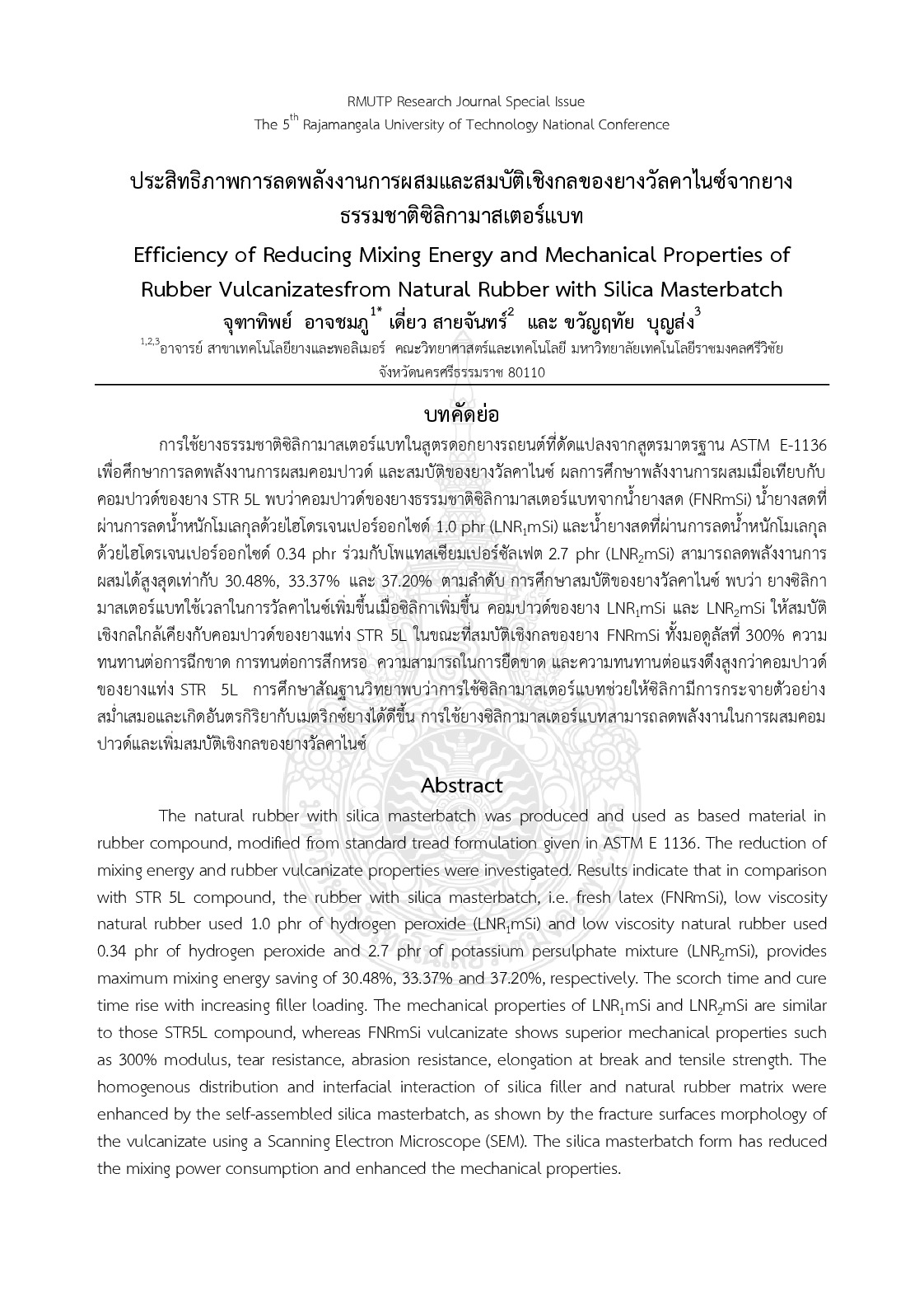
Efficiency of reducing mixing energy and mechanical properties of rubber vulcanizatesfrom natural rubber with silica masterbatch
The natural rubber with silica masterbatch was produced and used as based material in rubber compound modified from standard tread formulation given in ASTM E 1136. The reduction of mixing energy and rubber vulcanizate properties were investigated. Results indicate that in comparison with STR 5L compound the rubber with silica masterbatch i.e. fresh latex (FNRmSi) low viscosity natural rubber used 1.0 phr of hydrogen peroxide (LNR1mSi) and low viscosity natural rubber used 0.34 phr of hydrogen peroxide and 2.7 phr of potassium persulphate mixture (LNR2mSi) provides maximum mixing energy saving of 30.48% 33.37% and 37.20% respectively. The scorch time and cure time rise with increasing filler loading. The mechanical properties of LNR1mSi and LNR2mSi are similar to those STR5L compound whereas FNRmSi vulcanizate shows superior mechanical properties such as 300% modulus tear resistance abrasion resistance elongation at break and tensile strength. The homogenous distribution and interfacial interaction of silica filler and natural rubber matrix were enhanced by the self-assembled silica masterbatch as shown by the fracture surfaces morphology of the vulcanizate using a Scanning Electron Microscope (SEM). The silica masterbatch form has reduced the mixing power consumption and enhanced the mechanical properties.