จำนวน Repository ( 5 )
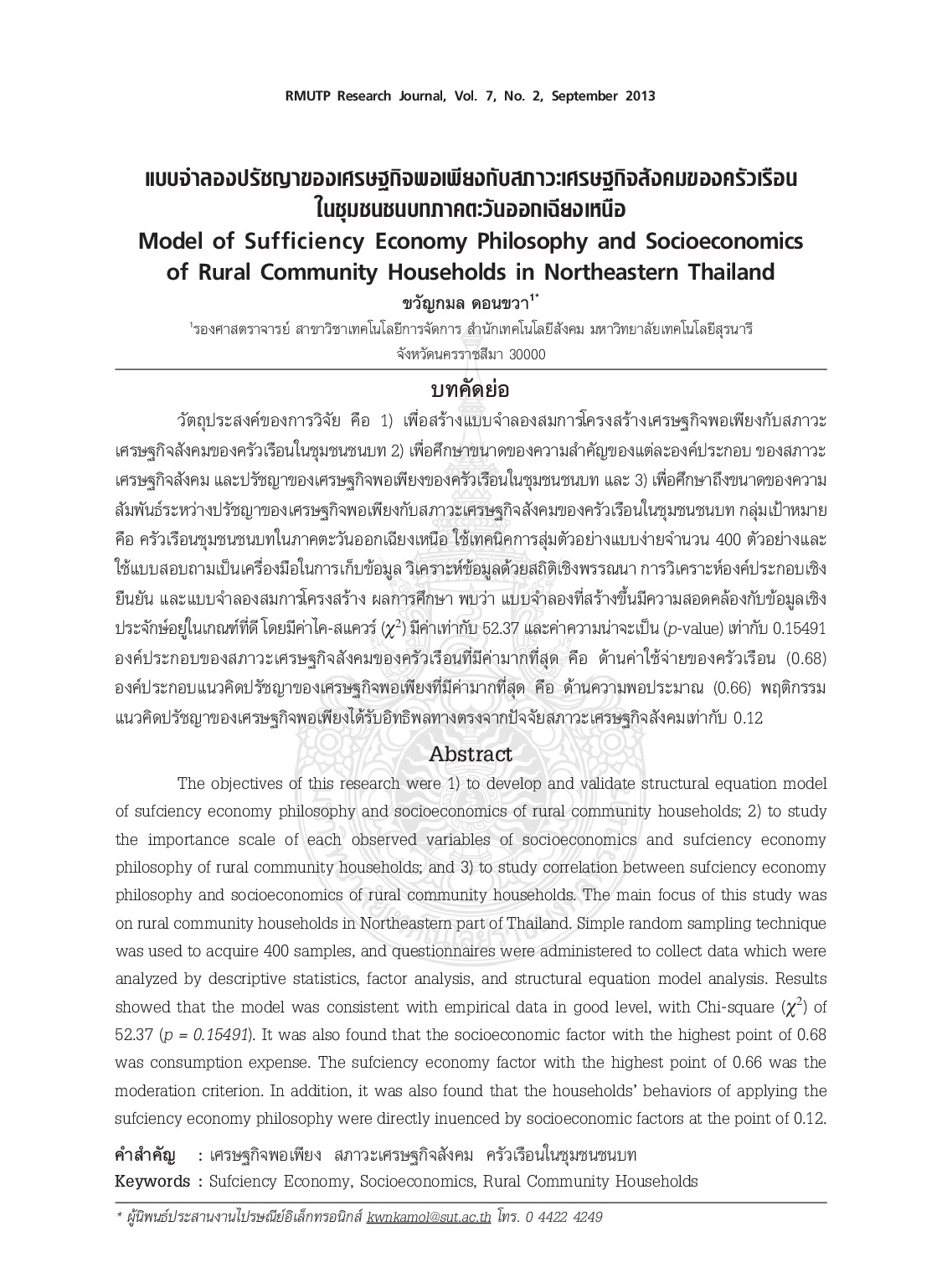
The model of a sufficiency economy philosophy with socioeconomics of rural community’s households, Northeastern Thailand
The objectives of this research were 1) to develop and validate the structural equation model of application of the sufficiency economy philosophy with socioeconomics of rural community households 2) to study the importance scale of each of the observed variables with socioeconomics and the sufficiency economy philosophy of rural community households and 3) to study the correlation level between the sufficiency economy philosophy and socioeconomics of rural community households. The main focus of this study was on rural community households. Simple random sampling technique was used to arrive at 400 samples and a questionnaire was administered to collect data and analyzed by descriptive statistics factor analysis and structural equation model analysis. The result showed that the model was consistent with the empirical data. Goodness of fit measures were found to be: Chi-square 52.37(p- value= 0.15491). It was also found that the factor loading of socioeconomics with the highest point was the consumption expenditure at 0.68 whereas the factor loading of the sufficiency economy philosophy with the highest point was the criterion of moderation at 0.66. Besides it was found that the rural community households’ behavior of applying the sufficiency economy philosophy received direct influence from the socioeconomic factors at the point of 0.12.
ห่วงโซ่อุปทานการท่องเที่ยวเชิงนิเวศ กรณีศึกษา อุทยานแห่งชาติเขาใหญ่ จังหวัดนครราชสีมา
Strong positive correlations exist among management of upstream factors services or midstream factors and the level of satisfaction of tourists of downstream factors. Upstream factors have the following conelated coefficient with each of the midstream factors respectively: 0.656 for accommodations 0.593 for transportation 0.610 for the handling of excursion and activities on the ground and 0.552 for foods and crafts. Midstream factors correlate with downstream factors with a correlation coefficient of 0.815 And upstream factors have a correlated coefficient of 0.811 with downstream factors. The upstream factors of values and culture have the most direct effect on midstream factors and downstream factors. Middtream factors have the most direct effect on downstream factors by accommodation.

ISQE-OTOP: An Interactive System for Quality Evaluation of OTOP Products
This research was aimed to develop criteria for quality evaluation of OTOP products of 5 types; namely food product beverage product cloth and costumes product utensils decoration and souvenirs product and herbal product. Which is not food Then the developed criteria were used as a quality evaluation form for OTOP products in interactive system on website. The usability of the system was tested by 72 persons in the group of OTOP product entrepreneurs and 96 persons in the group of customers. The results from the development of 5 types of criteria for product quality evaluation showed that: the criteria for food product consisted of 282 items; beverage product consisted of 41 items; cloth and costumes product consisted of 47 items; utensils decoration and souvenirs product consisted of 27 items and herbal product which is not food consisted of 77 items According to the usability tested by the entrepreneurs it was found that the effectiveness of usage was at the highest level. As for the usability tested by the customers it was found that the effectiveness of usage and the learnability were at the highest level.
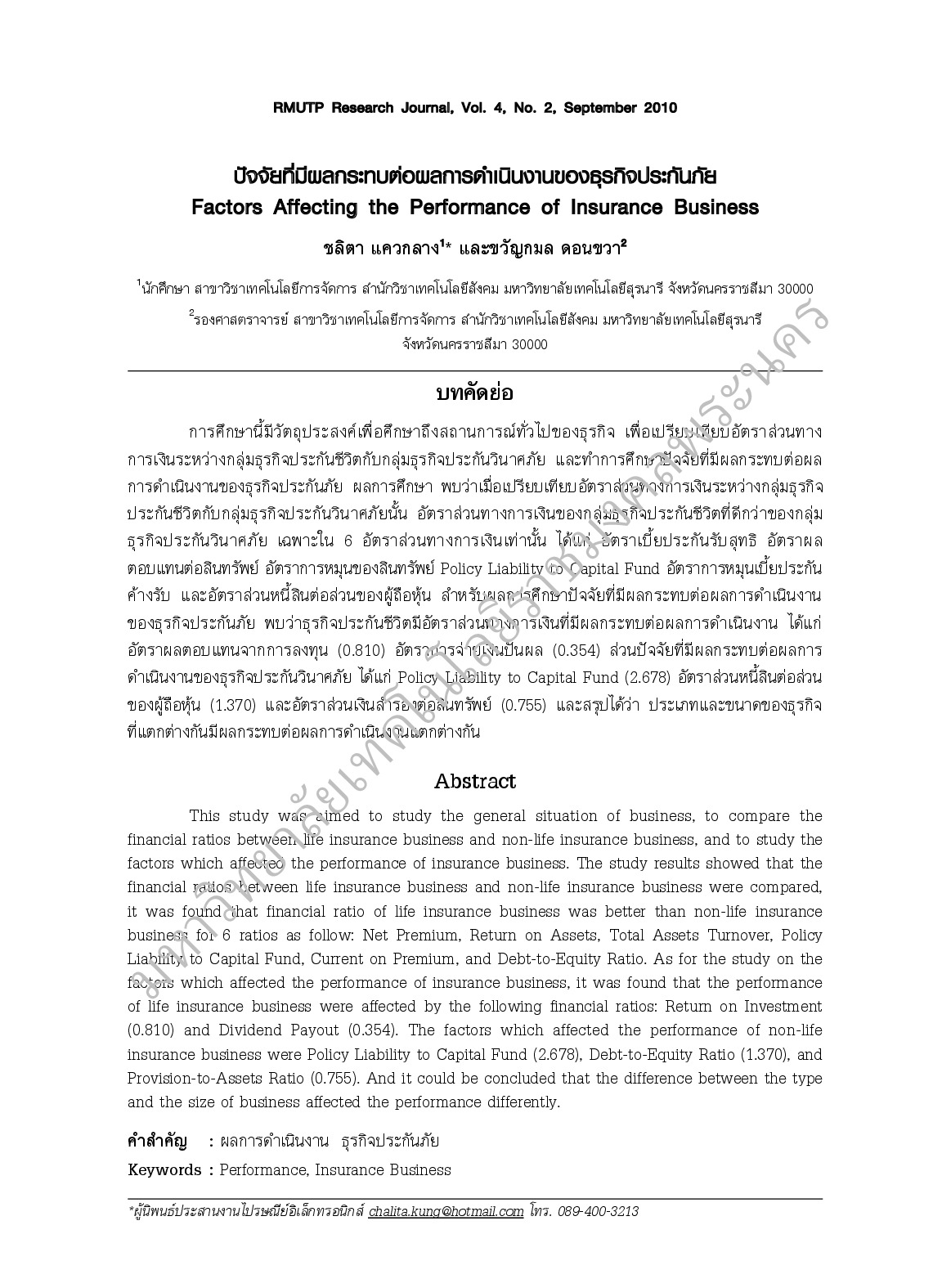
ปัจจัยที่มีผลกระทบต่อผลการดำเนินงานของธุรกิจประกันภัย
This study was aimed to study the general situation of business to compare the financial ratios between life insurance business and non-life insurance business and to study the factors which affected the performance of insurance business. The study results showed that the financial ratios between life insurance business and non-life insurance business were compared it was found that financial ratio of life insurance business was better than non-life insurance business for 6 ratios as follow: Net Premium Return on Assets Total Assets Turnover Policy Liability to Capital Fund Current on Premium and Debt-to-Equity Ratio. As for the study on the factors which affected the performance of insurance business it was found that the performance of life insurance business were affected by the following financial ratios: Return on Investment (0.810) and Dividend Payout (0.354). The factors which affected the performance of non-life insurance business were Policy Liability to Capital Fund (2.678) Debt-to-Equity Ratio (1.370) and Provision-to-Assets Ratio (0.755). And it could be concluded that the difference between the type and the size of business affected the performance differently.
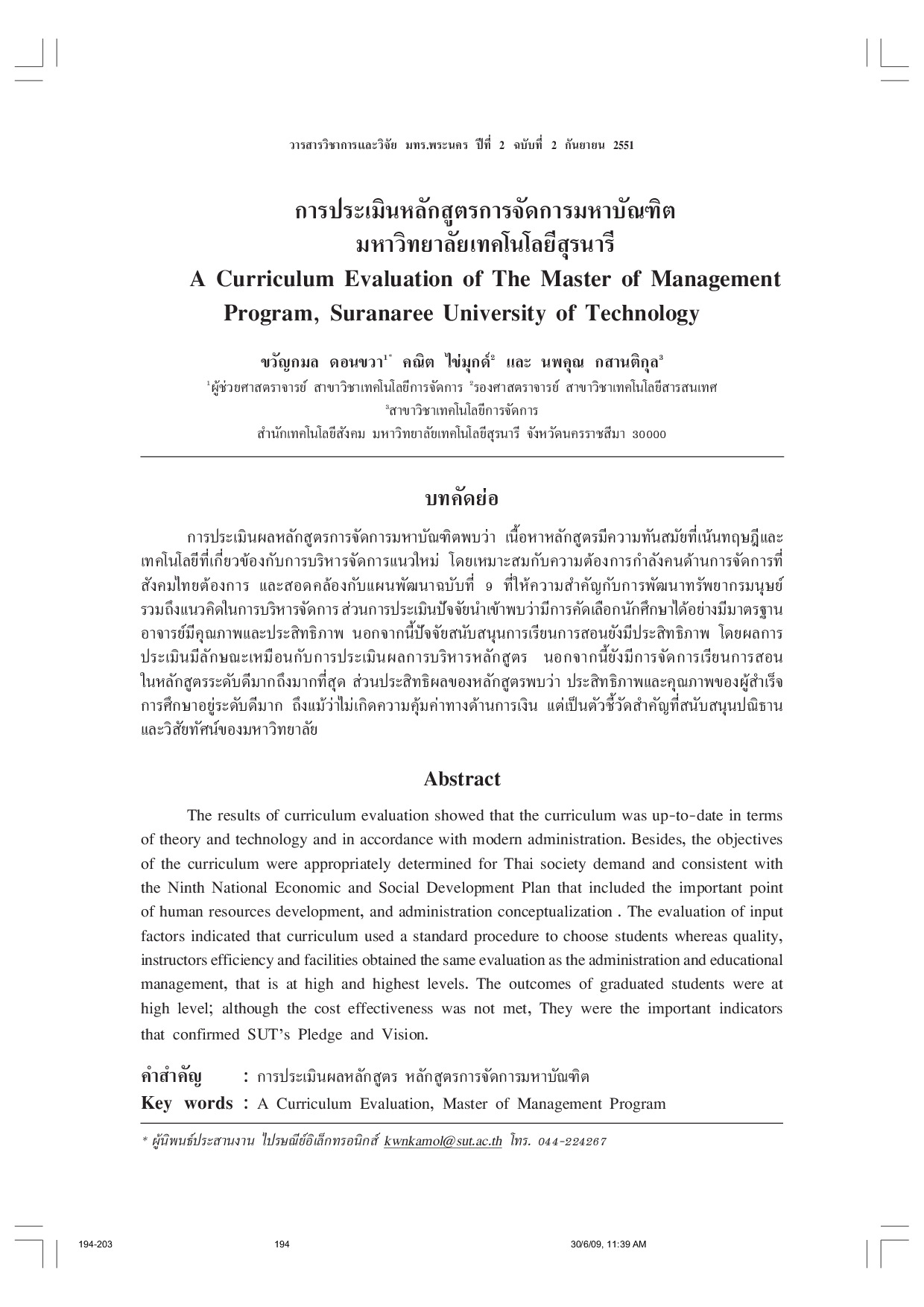
A Curriculum Evaluation of The Master of Management Program, Suranaree University of Technology
The results of curriculum evaluation showed that the curriculum was up-to-date in terms of theory and technology and in accordance with modern administration. Besides the objectives of the curriculum were appropriately determined for Thai society demand and consistent with the Ninth National Economic and Social Development Plan that included the important point of human resources development and administration conceptualization . The evaluation of input factors indicated that curriculum used a standard procedure to choose students whereas quality instructors efficiency and facilities obtained the same evaluation as the administration and educational management that is at high and highest levels. The outcomes of graduated students were at high level; although the cost effectiveness was not met They were the important indicators that confirmed SUT’s Pledge and Vision.