จำนวน Repository ( 63 )
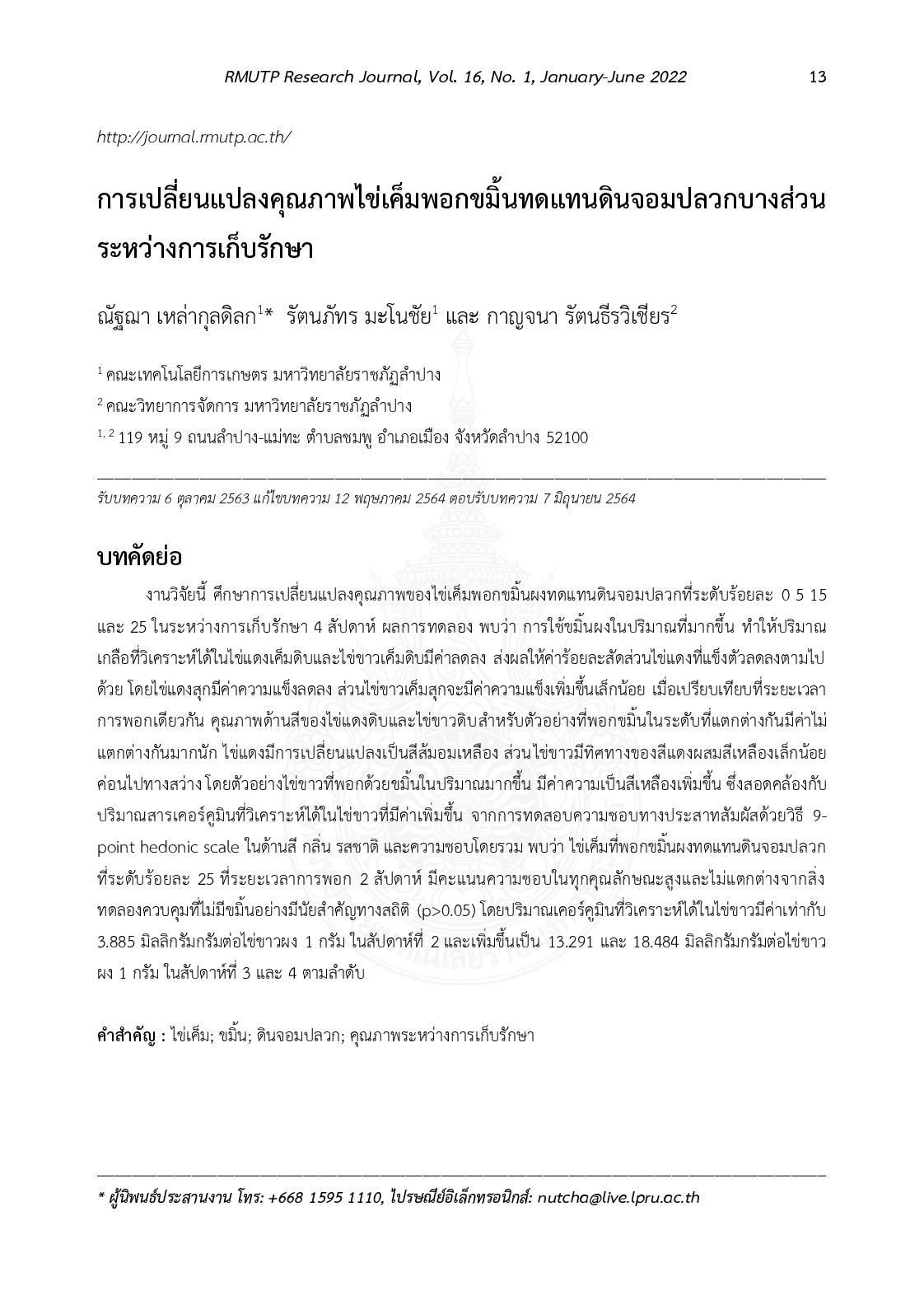
การเปลี่ยนแปลงคุณภาพไข่เค็มพอกขมิ้นทดแทนดินจอมปลวกบางส่วนระหว่างการเก็บรักษา
This research aimed to study the quality changes of coating salted eggs partially replacing soil from termite mound with turmeric powder at the level of 0% 5% 15% and 25% during storage for 4 weeks. The results showed that the increasing in turmeric level caused a decrease in salt content in raw egg yolk and raw egg white which led to decrease in hardening ratio of egg yolk. The hardness values of cooked - salted egg yolk decreased while those of cooked - salted egg white slightly increased. At the same salting period the color values of raw egg yolk and raw egg white coated with different levels of turmeric were slightly different. Egg yolks changed to a yellowish orange color while egg whites showed lightness with a direction of red and slightly yellowish color. The raw egg white coated with higher level of turmeric powder exhibited more yellowness which was in accordance with the increasing in curcumin content. From the results of 9-point hedonic scale in terms of color aroma overall taste and overall liking it was found that salted eggs coated with turmeric powder to partially replace soil at a level of 25% with 2 weeks of preserved duration had high scores of sensory acceptability which did not differ significantly from the control samples (0% turmeric) (p>0.05). The curcumin content analyzed in dry egg white was 3.885 mg/g at week 2 and increased to 13.291 and 18.484 mg/g at week 3 and 4 respectively.
แนวทางในการออกแบบพื้นที่สาธารณะและพื้นที่สำหรับการสัญจร ทางบกภายในชุมชนไร้แผ่นดิน ตำบลบางชัน อำเภอลุง จังหวัดจันทบุรี
Guidelines for designing public spaces and land traffic areas in the landless village Bang Chan Subdistrict Khlung District Chanthaburi Province This research is to propose guidelines for the design and construction of public spaces for various activities and areas for use in land traffic in the landless village. To create a village identity in both the physical environment and the way of life of the people in the village. This can be a selling point for sustainable tourism and also to improve the quality of life of the people in the village providing space for recreation and joint activities within the village. This will encourage strength within the village and lead to a livable village. By the way of conducting research It starts with collecting data which is divided into 2 steps: document gathering and related research. To build a body of knowledge on issues related to the research topic. And field data collection To obtain information based on the reality of the area that is current. The data was then analyzed based on the research objectives. Which consists of Physical characteristics of the environment and village characteristics and forms of existing public spaces within the village. And the nature of the use of public spaces of the people in the village After that conditions and factors influencing the design of public spaces and land traffic areas within the village were determined. And to establish guidelines for the design of public spaces and areas for land traffic within this landless village according to the above conditions and factors. To be consistent with the physical characteristics of the area and the public space behavior of the people in the village. From conducting research it was found that Guidelines for designing public and land traffic areas in the researched landless village It can be summarized as two main points to consider the first being the public space within the village There is only one place in the landless village that has been conducted this research which is a shrine at the entrance of the village. It consists of the area of the shrine building. Public restrooms for visitors And a multi-purpose outdoor patio area Which if there will be additional public space construction in the village It should be in a close position and can be connected primarily to the original shrine area. This will lead to better support of social activities within the village than by distributing the area to other parts of the village. This may cause public areas to be inactive as they should and may result in them becoming wasteful areas in the future. Coupled with the immediate vicinity of the shrine in front of the village entrance There is a wooden bridge across the brackish water canal. Which was used as a walkway to and from each other between houses on both sides of the canal And is also considered a destination that is beautiful and unique in the village. This is another factor that will help promote the appropriate public spaces located in this area in terms of the quality of the public spaces. And in terms of accession and usability. For the second issue of guidelines for designing public spaces and land traffic areas within the landless village the study should be taken It is a matter of land thoroughfare that is used as a main pedestrian route to connect the front of each house within the village. May be constructed from precast concrete slabs bamboo other types of timber that can be easily procured locally. Or made from other materials not mentioned here But it must be materials that will not affect the environment in the area both during the process of material transportation to the area construction process use process after construction is completed. Until the process of maintenance reuse or disposal after the end of their service life.
แนวทางในการสร้าง ต่อเติม หรือปรับปรุงอาคารสำหรับรองรับนักท่องเที่ยวอย่างยั่งยืนของ ชุมชนไร้แผ่นดิน ตำบลบางชัน อำเภอลุง จังหวัดจันทบุรี
Guidelines for constructing extending or renovating buildings for sustainable tourists of the landless village Bang Chan Subdistrict Khlung DistrictChanthaburi Province This research is to survey and study the architectural patternsand environment of the landless village. And propose guidelines for constructingextending or renovating buildings for tourists that are suitable for their lifestyles and livelihoods. Environment and natural resources within the village As well as creating knowledge and understanding for people in the village Including external entrepreneurs who will invest or construct in the village area in connection with the construction extension or renovation of buildings. For tourism Without causing impacts on ecosystems and natural resources within the area. And still able to maintain the identity and way of life of the local fisherman. By the way of conducting research It starts with collecting data which is divided into 2 steps: document gathering and related research. To build up knowledge of issues related to the research topic. And field data collection To obtain information based on the reality of the area that is current. The data was then analyzed based on the research objectives. Which consists of The physical characteristics of the environment and village the use of space people in the village and the architectural styles and of the various types of buildings within the village. As well as limitations on material selection transportation and construction methods within the area of the landless village. After that the conditions that would affect the architectural style and the ways in which the buildings were built renovated or renovated in this village were established. After that the guidelines for the construction extension or improvement of the buildings for sustainable tourist support of the landless village have been determined. From conducting research it was found that Guidelines for constructing extending or renovating buildings for sustainable tourists of the landless village that have been studied It must be taken into account the traditional housing space system of the village. Especially in the front porch area of each house To continue to look close to the traditional terrace area. In order to maintain the identity and the overall atmosphere of the village. For material selection There should be a selection of materials that can be easily transported by sea. It must also be a material that does not leave contaminants into rivers and peat. And in terms of building construction methods within that village Should choose to use construction methods that do not affect the environment. Both in terms of changing the physical condition of the area. Such as a change in the direction of the flow of water or sediment And the noise that will occur during the construction process that may affect the people in the village or the animals living nearby.
การผลิตวัสดุปรับปรุงดินจากเศษอาหารและผักตบชวาด้วยกรรมวิธีดีไฮเดรชั่น
The purpose of this study is to produce the soil improvement materials from food waste and water hyacinth by using a dehydration process. The experiments were divided into two parts : 1) the study of the optimum temperature and time for converting food waste and water hyacinths to soil improvement materials by determining the temperatures of 100 °C 150 °C and 200°C in the periods of 1 hour 2 hours and 3 hours respectively 2) the study of nutrient content in the materials before and after mixing into the soil for 5 days. The soil used in the experiment was sampled from Sai Ma Subdistrict Nonthaburi Province. The parameters used to evaluate the ability to improve the soil quality were soil moisture pH electro conductivity total nitrogen total phosphorus total potassium and organic matter. The results showed that the optimum temperature for drying the food waste was 150°C for 2 hours and the optimum temperature for drying the water hyacinth was 200°C for 3 hours. When the materials were mixed into soil it found that the soil drainage was improved. Mixing the materials into soil could increase the pH value from 5.2 to 5.4 and increase the electrical conductivity from 0.72 mS/cm to 14.78 mS/cm. Besides the plant nutrients including Nitrogen phosphorus and potassium also increased after adding soil improvement materials.
การตรึงอะโซโตแบคเตอร์แบคทีเรียตรึงไนโตรเจนในอากาศด้วยวัสดุธรรมชาติและผลต่อการเจริญเติบโตของผักกวางตุ้งในดิน
Nitrogen is an essential nutrient for plant growth. When the plants have been grown for a long-term effect to decreased nitrogen in soil and insufficiency of the plant growth. One biological method for increasing the nitrogen content in soil is utilize of free nitrogen-fixing bacteria Azotobacter. Therefore the objective of this research was to search natural material suitable for Azotobacter fixation. The 10 natural materials were observed physical structure and investigated the ability of natural materials for Azotobacter fixation. The results showed that water hyacinth and bagasse stalks were fixed the Azotobacter of 2.43x10⁸ and 1.94 x10⁸ CFU per gram of each natural material respectively. After that the selected fixed Azotobacter of water hyacinth and bagasse stalks were studied the growth of Brassica Chinensis. This experiment was designed to 4 treatments. The first treatment was mixed of water hyacinth stalks and the Azotobacter. Second treatment was mixed of bagasse stalks and the Azotobacter. The third treatment was the Azotobacter only. The last treatment was soil only. The results indicated that the average of plant growth include height leaf number root length fresh weight and dry weight of the mixed of water hyacinth stalks and the Azotobacter had significantly higher growth rates than other treatments. The total nitrogen was also increased 1.4 fold in the soil. All results suggest that the water hyacinth stalk is alternative for the fixation of the free nitrogen-fixing bacteria Azotobacter as induce nitrogen in the soil and plant growth promotion.