จำนวน Repository ( 9 )

ความต้องการเป็นผู้ประกอบการด้านคหกรรมศาสตร์ของนักศึกษาปริญญาตรีชั้นปีที่ 4 หลักสูตรคหกรรมศาสตรบัณฑิต คณะเทคโนโลยีคหกรรมศาสตร์ มหาวิทยาลัยเทคโนโลยีราชมงคลพระนคร
The purpose of this study was studied the need to be entrepreneur of Home Economics and compared the difference between the need to be entrepreneur of Home Economics program on Fourth-years undergraduate Students in Faculty of Home Economics Technology at Rajamangala University of Technology Phra Nakhon and personal factor. The sampling groups were fourth-years undergraduate students those were studying in first semester of Academic Year 2017 of 150 people with simple quota sampling. The use of tool was a questionnaire. The data analyses were used to percentage value average standard deviation t-test and F-test. The results of research were found on Fourth-years Undergraduate Students in Faculty of Home Economics Technology at Rajamangala University of Technology PhraNakhon they had the need to be entrepreneur of home economics program there were generally in high level as an average of 4. 06. There were considered as aspects found that the need of power was in high level as an average of 3. 86 the need of affiliation was in high level as an average of 4. 14 and the need of achievement was in high level as an average of 4. 19. The different comparison between the need to be entrepreneur of Home Economics on undergraduate students with classifiable as gender and parent’s occupation or guardian that had statistically significant difference at 0.05. The studied major program of generalization on every aspect was not difference. The experiences of work during the study were not difference of the need of power and the need of achievement and the need of affiliation was statistically significant difference at 0.05.
ปัจจัยส่วนบุคคลที่มีความสัมพันธ์กับการตัดสินใจเลือกประกอบอาชีพอิสระด้านคหกรรมศาสตร์ของนักศึกษา คณะเทคโนโลยีคหกรรมศาสตร์ มหาวิทยาลัยเทคโนโลยีราชมงคลพระนคร
The purposes of this research were: 1) to study personal factors knowledge of selfemployed in Home Economics and reasons for decision making of self-employed in Home Economics 2 ) to study the relationship between personal factors and decision making of self-employed in Home Economics and 3) to study the relationship between knowledge of self-employed in Home Economics and decision making of self-employed in Home Economics. The sample group was 196 of the 4th year undergraduate students Faculty of Home Economics Technology Rajamangala University of Technology Phra Nakhon who decided to work as self-employed person. The instrument used in the study was a questionnaire. The percentage mean standard deviation and Chi-Square values were used for statistical analysis. The results showed that: 1) most of the sample was female (72.45%) and more than a half of the sample studying in Department of Foods and Nutrition (52.55%) their cumulative GPA were between 3.01-3.50 (40.31%) followed by 2.51-3.00 (31.63%). For family information (64.80%) of their parents were entrepreneurs or self–employed the average monthly income of more than 35001 baht per family (34.18%) followed by 15001-25000 baht (30.61%) for the knowledge of self-employed in Home Economics in the overall was at a high level ( = 3.78 S.D.=0.69). Types of self-employed in Home Economics selected the most was production (50.00%) followed by distribution (26.53%) and services (23.47%). The reasons for choosing self-employed in Home Economics were freedom of work (37.25%) having to use knowledge aptitude and proficiency in work (23.47%) and having a good opportunity to being successful in work (12.25%) the expectation to have an average monthly income was between 25001-35000 baht (56.63%). 2) the relationship between personal factors and the decision making of selfemployed in Home Economics including gender field of study cumulative (GPA) parents’ occupation the average monthly of family income and work experience during study found that there was statistical significance at the level of .05 except the family self-employed. and 3) the relationship between knowledge of self-employed in Home Economics and the decision making of self-employed in Home Economics found that there was statistical significance at the level of .05
การพัฒนาหลักสูตรฝึกอบรมวิชาชีพระยะสั้นด้านคหกรรมศาสตร์ ของสมาชิกชมรมผู้สูงอายุบ้านโพธิ์แจ้ ตำบลบางน้ำจืด
The present research has the following objectives: 1) To examine the needs for short course training in home economics 2) To develop the short course curriculum in Home Economics in accordance to the needs of the members of Baan Pho Jaa Elderly Club and 3) To examine the satisfaction of the training in Home Economics for the members of Baan Pho Jaa Elderly Club Bang Namjuerd Muang District of Samutsakhorn Province. The samples selected for the research are the total number of 30 members of Baan Pho Jaa Elderly Club Bang Namjuerd Muang District of Samutsakhorn Province who have shown their interest in the program as well as had the capability to be trained. The research instrument is a questionnaire developed by the researcher and a training curriculum for the short course training in Home Economics. The data are analyzed in frequency and percentage. The findings are as follows: The members of Baan Pho Jaa Elderly Club showed the need to be trained in Home Economics with crispy rice noodle with spices tapioca dumpling with shiitake and salted duck egg with herbs respectively (43.33% 23.33% and 16.67%). The research developed the training curriculum accordingly using Taba’s instruction of curriculum development as consisting of 4 modules: i) an introduction to cooking ii) basic ingredients culinary instruments and cooking techniques iv) making crispy rice noodle with spices and v) package designing and calculating selling prices. The six-hour session of training took place at Baan Pho Jaa Medical Centre on Saturday – Sunday at 09.00 – 12.00 hrs and 13.00 – 16.00 hrs. The results of the training are as follows: i) the trainees showed an overall working skill at a good level ( X = 2.70) ii) the outcomes were evaluated and fell at a good level ( X = 2.83) and iii) the satisfaction of the trainees was considerably good ( X = 3.99).
การพัฒนารูปแบบของการสร้างหลักสูตรฝึกอบรมวิชาชีพระยะสั้น ด้านคหกรรมศาสตร์ กลุ่มอาชีพสหกรณ์ศิลปะประดิษฐ์ ตำบลเกาะเกร็ด จังหวัดนนทบุรี
This research aimed to study 1) the demand for short-term vocational training courses in home economics 2) create a training curriculum of home economics profession short of demand. Handicrafts Cooperative Occupational Groups Ko Kret Nonthaburi and her 3) the effects of short-term vocational training courses in home economics created The population in this study were selected purposively is a group of professional arts cooperative. Koh Kret Nonthaburi number 30 was used in the questionnaire and short-term training courses in home economics. Data analysis and statistics used were percentage average and standard deviation. The results were as follows: The population with an interest in the course of the invention include most academic inventor gift followed by molding the dough flowers Thailand. And the flowers The average score of 4.57 4.30 and 4.20 respectively Thus the curriculum invention gift. Style stuffed owl The concept of Taba comprises seven stages: 1) analysis of problems and needs for 2) define the aims of the course 3) selection of content 4) held a substantive 5) selection of a learning experience 6) experience. Learning and 7) evaluation of the course created consisting of five plans include 1) a basic knowledge about the inventor of the gift 2) materials and fabrication techniques stuffed owl onion 3) Knowledge of design creation. 4) the invention onions stuffed owl 5) costing and pricing onion stuffed owl. The six-hour period The results of the program found that participants with a performance favorably (83.33 percent) and a rating of the portfolio is in good shape (90.00 percent) from the satisfaction of the participants are. the most satisfied are averaging 4.58
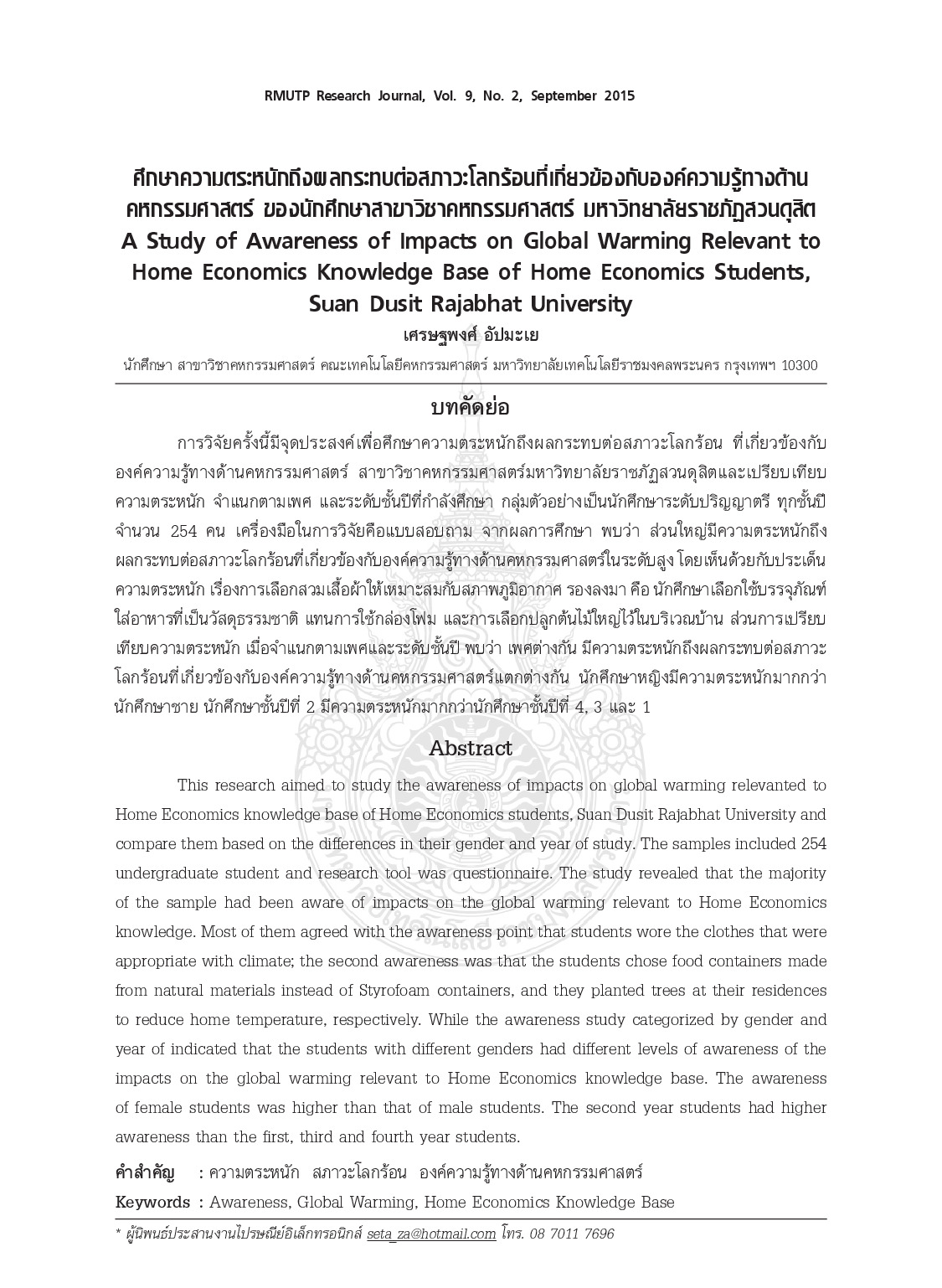
ศึกษาความตระหนักถึงผลกระทบต่อสภาวะโลกร้อนที่เกี่ยวข้องกับองค์ความรู้ทางด้านคหกรรมศาสตร์ ของนักศึกษาสาขาวิชาคหกรรมศาสตร์ มหาวิทยาลัยราชภัฏสวนดุสิต
This research aimed to study the awareness of impacts on global warming that is relevant to Home Economics knowledge base of Home Economics students Suan Dusit Rajabhat University and compare their awareness of impacts on global warming relevant to the Home Economics knowledge base considering their gender and year of study. The sample was 254 undergraduate students from Home Economics of Suan Dusit Rajabhat University. The research tool was questionnaire. The study revealed that the majority of the sample had been aware of impacts on the global warming relevant to Home Economics knowledge base in a high level. Most of them agreed with the awareness point that students wore the clothes that were appropriate with climate; for example they chose to wear light and thin clothes to reduce workload of air conditioners the students chose food containers made from natural materials instead of Styrofoam containers to reduce waste that took long time to decompose and they planted trees at their residences to reduce home temperature respectively. Comparing the awareness categorized by gender and year of study it was found that the students of Suan Dusit Rajabhat University of different genders had different levels of awareness of the impacts on the global warming relevant to Home Economics knowledge base. The awareness of female students was higher than that of male students and as for year of study the students of Suan Dusit Rajabhat University had different levels of the awareness of the impacts on the global warming relevant to Home Economics knowledge base. The second year students had higher awareness than the first third and fourth year students.