จำนวน Repository ( 4 )

Effect of bottom ash as fine aggregate on strength of concrete
This research was aimed to study the effect of bottom ash (BA) as fine aggregate in fly ash concrete and cement-only concrete on strength of water-cured and uncured concrete. The water to binder ratios were 0.35 and 0.55 to represent high strength and normal strength concrete respectively. The weight percentages of replacement of cement by fly ash were 0 and 30%. The replacement ratios of bottom ash as fine aggregate were 0 10 and 30% by volume of fine aggregate. The results indicated that the slump and setting time of concrete increased with the increase of bottom ash content. In contrast the compressive and tensile strength decreased with the increase of bottom ash content. From the curing sensitivity index it was showed that the fly ash concrete required longer curing period than cement-only concrete. In case of high strength concrete the use of bottom ash in fly ash concrete can reduce curing sensitivity of concrete
Development of concrete boat by using lightweight concrete
The objective of this study aims to develop a concrete boat by using lightweight concrete. The use of granular foam replaced the aggregate in various quantities to reduce the weight of boat. The replacement ratios of aggregate by the granular foam were 0 25 50 75 and 100% by volume of aggregate. The test results of compressive strength tensile strength modulus of rupture and unit weight of concrete were used to find out the appropriate mixture for producing the concrete boat. The results indicated that the appropriate mixture for producing concrete boat was the replacement of aggregate by granular foam at 100% which had the compressive strength at 28 days of 50.59 kg/cm2 and the unit weight was 949.71 kg/m3. The weight of lightweight concrete was lighter than the normal concrete about 57%. The prototype of lightweight concrete boat which had 1.04 m wide 2.20 m long and 0.38 m height had about 50 kg of weight. The maximum weight capacity of the boat was 240 kg. The cost of a lightweight concrete boat was about 650 baht
Effect of binders on shrinkage cracking behavior of concrete
This research was aimed to study the effect of binders on cracking behavior of high strength concrete under restrained shrinkage condition. The cracking behaviors of concrete that study were cracking age in uniaxially restrained shrinkage test shrinkage rate free shrinkage crack propagation and strength of concrete. The binders used in this study were fly ash and limestone powder. The weight percentage of replacement of cement by fly ash and limestone powder were 30 and 10% respectively. The water to binder ratios was 0.35. The results indicated that the influence parameters of shrinkage cracking were type of binder amount of free shrinkage shrinkage rate and tensile creep of concrete. The use of fly ash and limestone powder could reduce free shrinkage and shrinkage rate of concrete and result in the longer cracking age than cement-only concrete. The tensile creep of cement-only concrete was higher than that of limestone powder concrete and fly ash concrete respectively
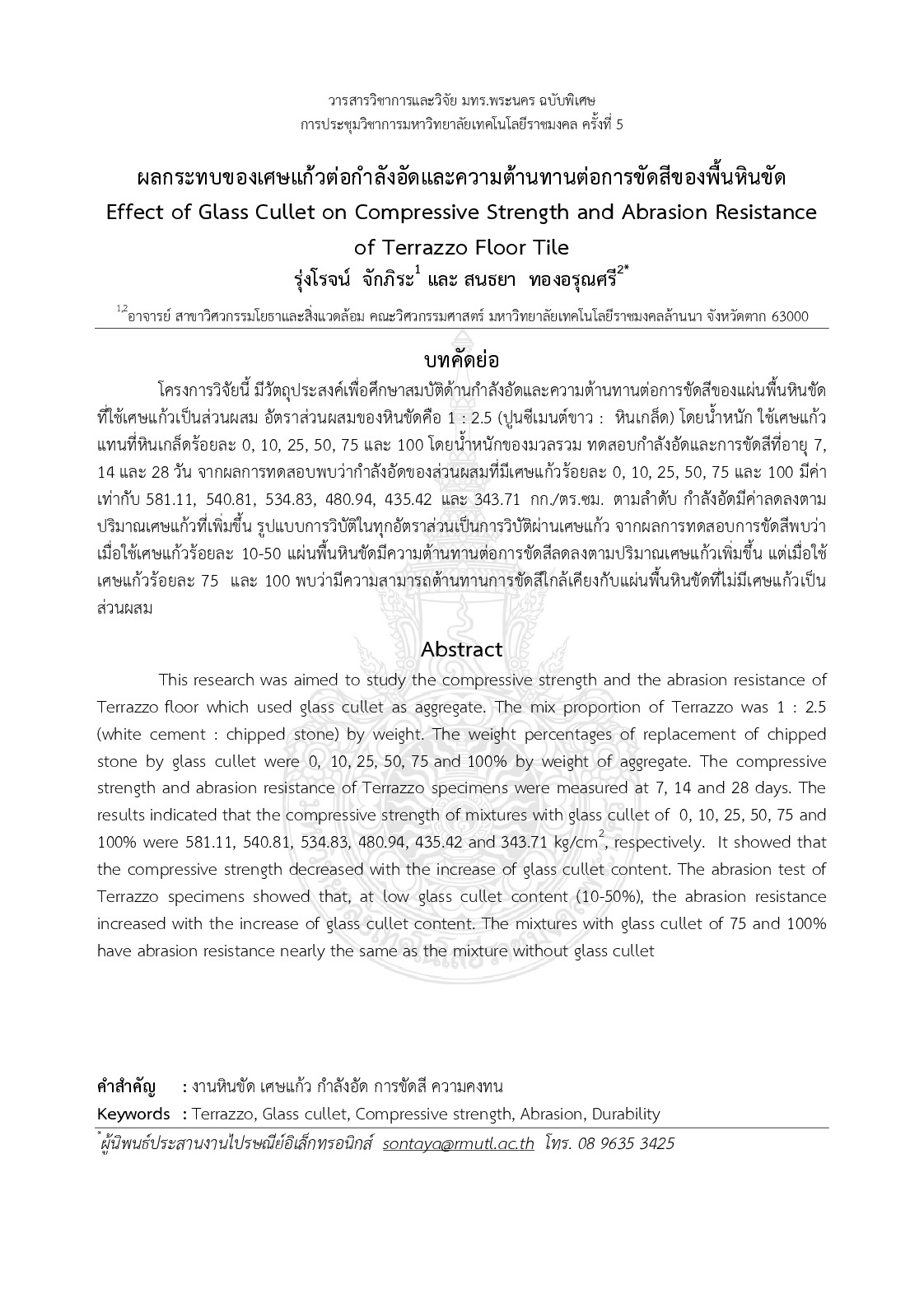
Effect of glass cullet on compressive strength and abrasion resistance of terrazzo floor tile
This research was aimed to study the compressive strength and the abrasion resistance of Terrazzo floor which used glass cullet as aggregate. The mix proportion of Terrazzo was 1 : 2.5 (white cement : chipped stone) by weight. The weight percentages of replacement of chipped stone by glass cullet were 0 10 25 50 75 and 100% by weight of aggregate. The compressive strength and abrasion resistance of Terrazzo specimens were measured at 7 14 and 28 days. The results indicated that the compressive strength of mixtures with glass cullet of 0 10 25 50 75 and 100% were 581.11 540.81 534.83 480.94 435.42 and 343.71 kg/cm2 respectively. It showed that the compressive strength decreased with the increase of glass cullet content. The abrasion test of Terrazzo specimens showed that at low glass cullet content (10-50%) the abrasion resistance increased with the increase of glass cullet content. The mixtures with glass cullet of 75 and 100% have abrasion resistance nearly the same as the mixture without glass cullet