จำนวน Repository ( 2 )
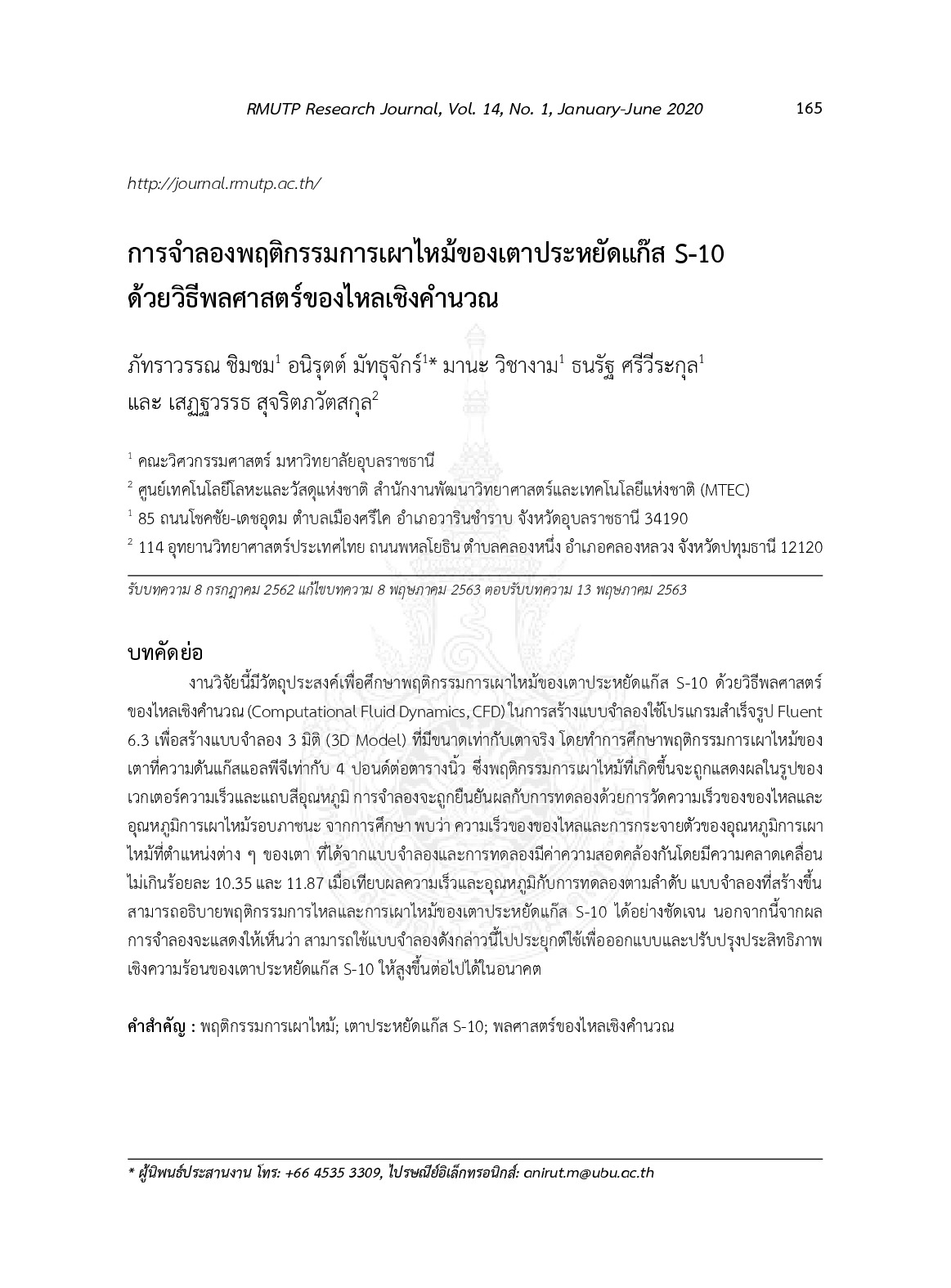
การจำลองพฤติกรรมการเผาไหม้ของเตาประหยัดแก๊ส s-10 ด้วยวิธีพลศาสตร์ของไหลเชิงคำนวณ
The objective of this research is to study the combustion behavior of a gas-saving burner S-10 using computational fluid dynamics (CFD). The simulation model was created using Fluent 6.3 in 3D-model of the same size of the burner. LPG pressure of 4 psi was released for this study. The combustion behavior was shown in temperature contour and velocity vector. The CFD results were verified by measuring the temperature around the burner head with a vessel. From the study it was found that the CFD’s results of flow velocity and combustion temperature distributions were validated with the experimental values. The CFD’s result errors were less than 10.35% and 11.87% comparing with the velocity and temperature measurement respectively. The fluid flow and combustion behaviors can be described by this CFD model. Moreover the CFD model of the gas-saving burner S-10 can be applied to improve the thermal efficiency of the burner in the future.
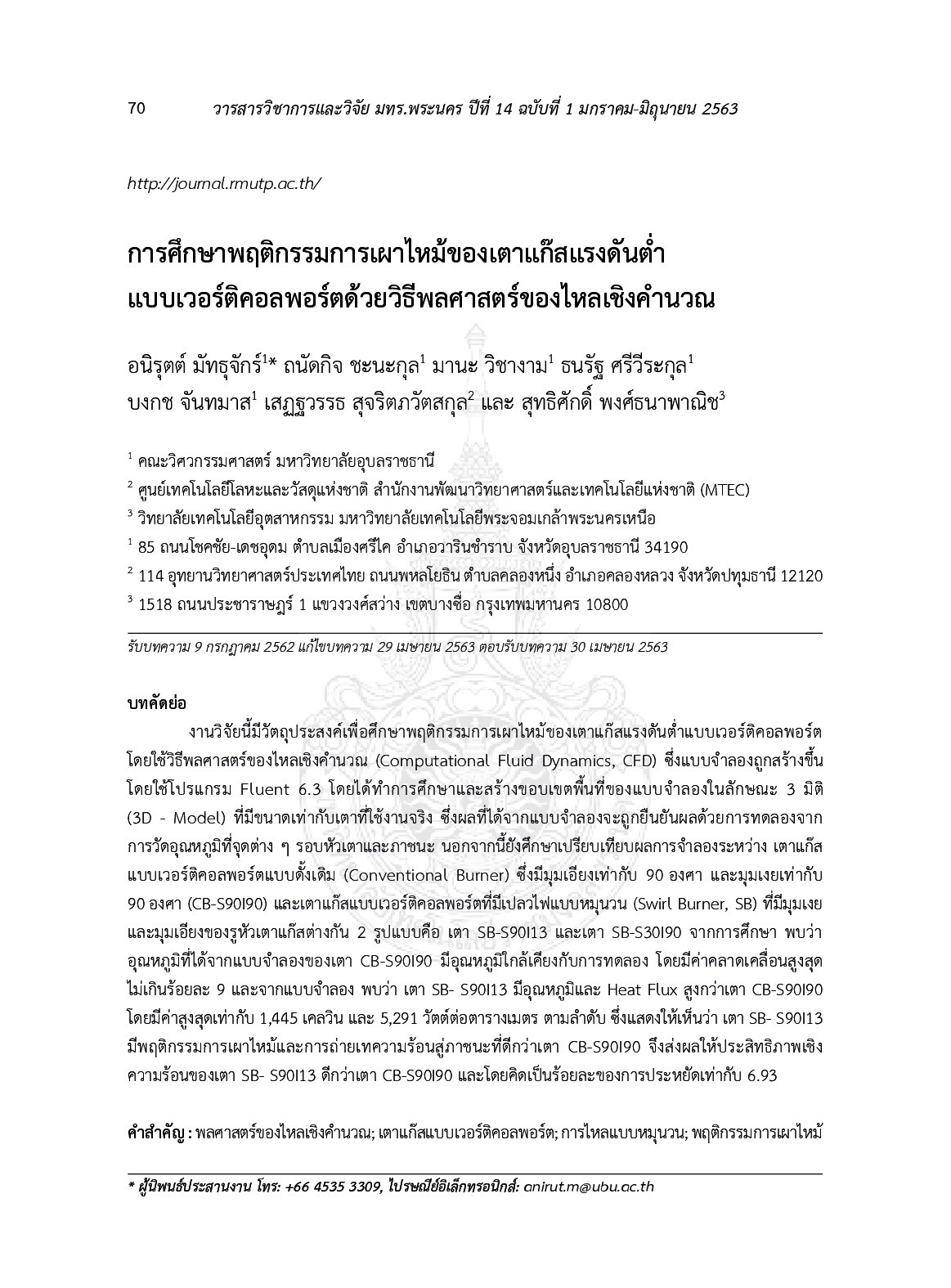
การศึกษาพฤติกรรมการเผาไหม้ของเตาแก๊สแรงดันต่ำแบบเวอร์ติคอลพอร์ตด้วยวิธีพลศาสตร์ของไหลเชิงคำนวณ
The objective of this research is to study the combustion characteristic of a low-pressure vertical port burner using computational fluid dynamics (CFD). The simulation model was created using Fluent 6.3 in 3D-model of the same size of the burner. The CFD results were verified by measuring the temperature around the burner head and a vessel. Moreover the results of conventional vertical port burner having the swirl angle of 90o and the inclination angle of 90o (CB-S90I90) and two swirl port burners (SB) being SB-S90I13 and SB-S30I90 were compared. The temperatures obtained from CFD and experiments were similar which the error was less than 9%. From the CFD’s results the temperature and heat flux of the SB-S90I13 burner were higher than those of the CB-S90I90 burner. The maximum temperature and heat flux of SB-S90I13 burner were 1445 K and 5291 W/m2 respectively. It was implied that the combustion characteristic and heat transfer to the vessel of SB-S90I13 burner was better than that of CB-S90I90 burner. It was resulted that the thermal efficiency of SB-S90I13 burner was better than that of CB-S90I90 burner which was the percentage energy saving of 6.93%.