จำนวน Repository ( 3 )
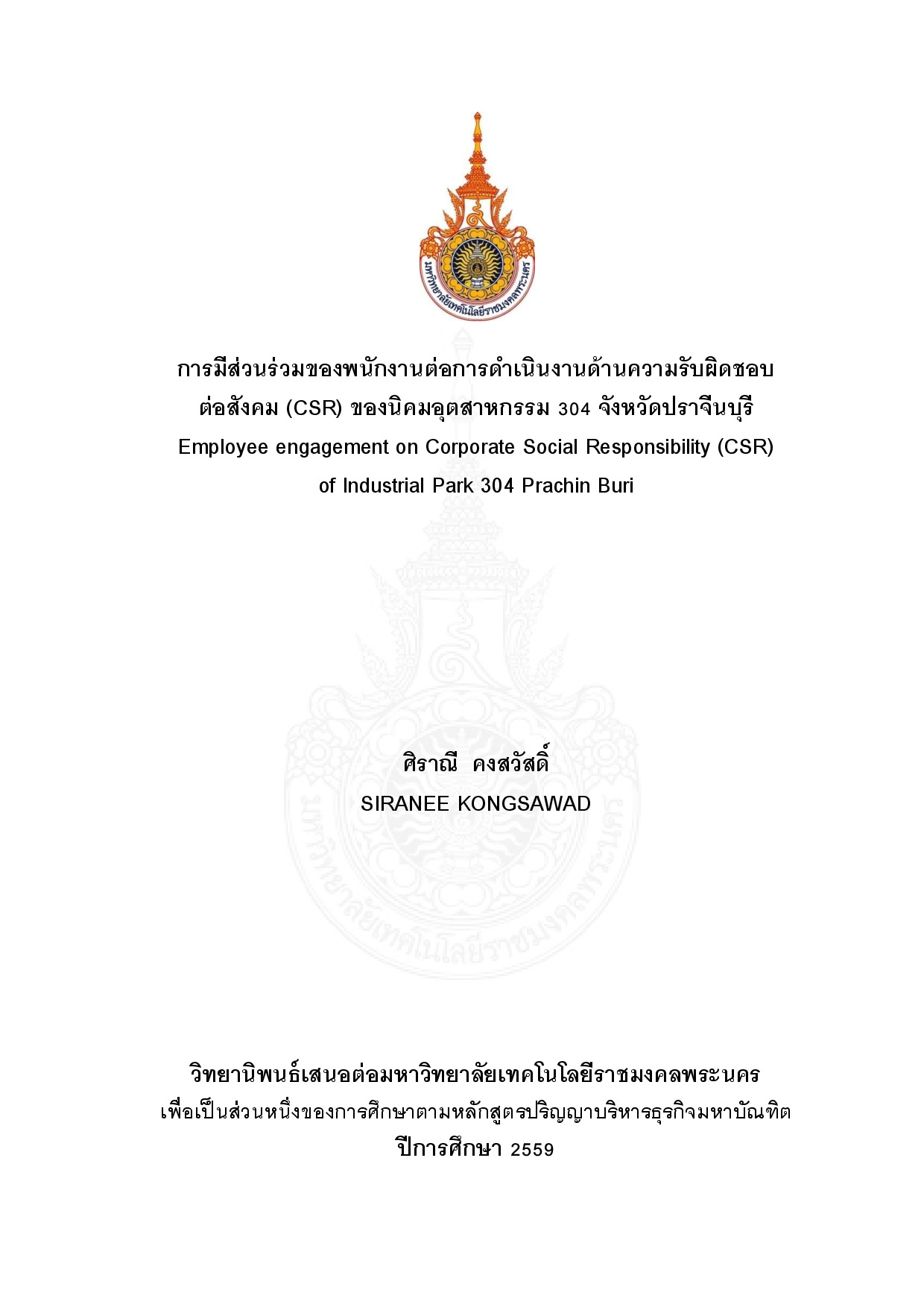
การมีส่วนร่วมของพนักงานต่อการดำเนินงานด้านความรับผิดชอบต่อสังคม (CSR) ของนิคมอุตสาหกรรม 304 จังหวัดปราจีนบุรี
The purposes of this research were to investigate the perception on activity maneuver and supporting factors regarding employees participation in Corporate Social Responsibility (CSR). The sample consisted of 250 employees of Prachin Buri Industrial Estate 304 Prachin Buri Province. The research results are as follows. The employees’ perception on activity maneuver information in CSR in the overall was at the highest level (= 4.62 S.D. = 0.44). The overall perception on the information had a statistically significant positive relationship with employees’ participation at the .01 level (r = .347). When considering each aspect the perception on activity information positively correlated with participation in CSR activities at the .01 level of significance (r = .295). The results of the appropriate model analysis used to forecast the employees’ perception on CSR activity indicated that the perception of policy information had a p-value of .012 meaning that the policy factor could predict the employees’ information perception at 0.05 statistical significance with a tolerance of .704 the VIF was 1.420. As for the planning aspect the tolerance value was .617 with the VIF value of 1.621 and the activity guideline aspect had its tolerance value of .532 with the VIF value of 1.881. This means that the perception regarding policy planning and guideline aspects was not beyond the Multicollinearity variables because their tolerance values were not lower than .2 and VIF did not exceed 10. Also the results of the regression coefficient analysis of factors affecting the information perception on CSR activities in the form of raw scores (B) were .298 .168 and .209 indicating that the variables predicting the perceived social responsibility included policy (X1) planning (X2) and activity guidelines (X3) and the three variables can together predict the level of awareness of CSR activities. These three factors could jointly predict the information perception on CRS at 11 percent. Factors promoting the employee participation on social responsibility were generally at a moderate level ( = 2.94 S.D. = 1.22) and there was a statistically significant positive correlation with employee participation at the .01 level (r = .855). When looking at each aspect it was found that factors promoting the employee participation in training and activities were positively related to the social responsibility aspect statistically significant at .01 (r = .773) and (r = .841). The results of the analysis of the appropriate models used to predict the factors contributing to employee participation showed that employees’ activity and training participation had the positive influence on CSR activities with p-value of .000 and .001 which was less than 0.05 indicating that their attendance could predict promoting factors of the employee participation statistically significant at the .05 level. This means activity and training participation factors could contribute to the promotion of employee participation statistically significant at the .05 level. While the training had a tolerance value of .225 the VIF value of 4.450 the activity participation had a tolerance value of .259 the VIF value of 3.858. As for being a group member the tolerance ship was .193 with the VIF value of 5.185 showing that participating in training and membership did not go beyond the Multicollinearity due to the tolerance value of not less than 2 and VIF value of not more than 10. The result of the regression coefficient analysis of factors affecting the level of factors contributing to employee participation on CSR operations were .157 .391 and .028 showing that the predicting variables of the employee participation promotion were training (X4) and participation (X5) and group membership (X6). The three variables could predict the level of factors contributing to employees participation on CRS at 72.70%
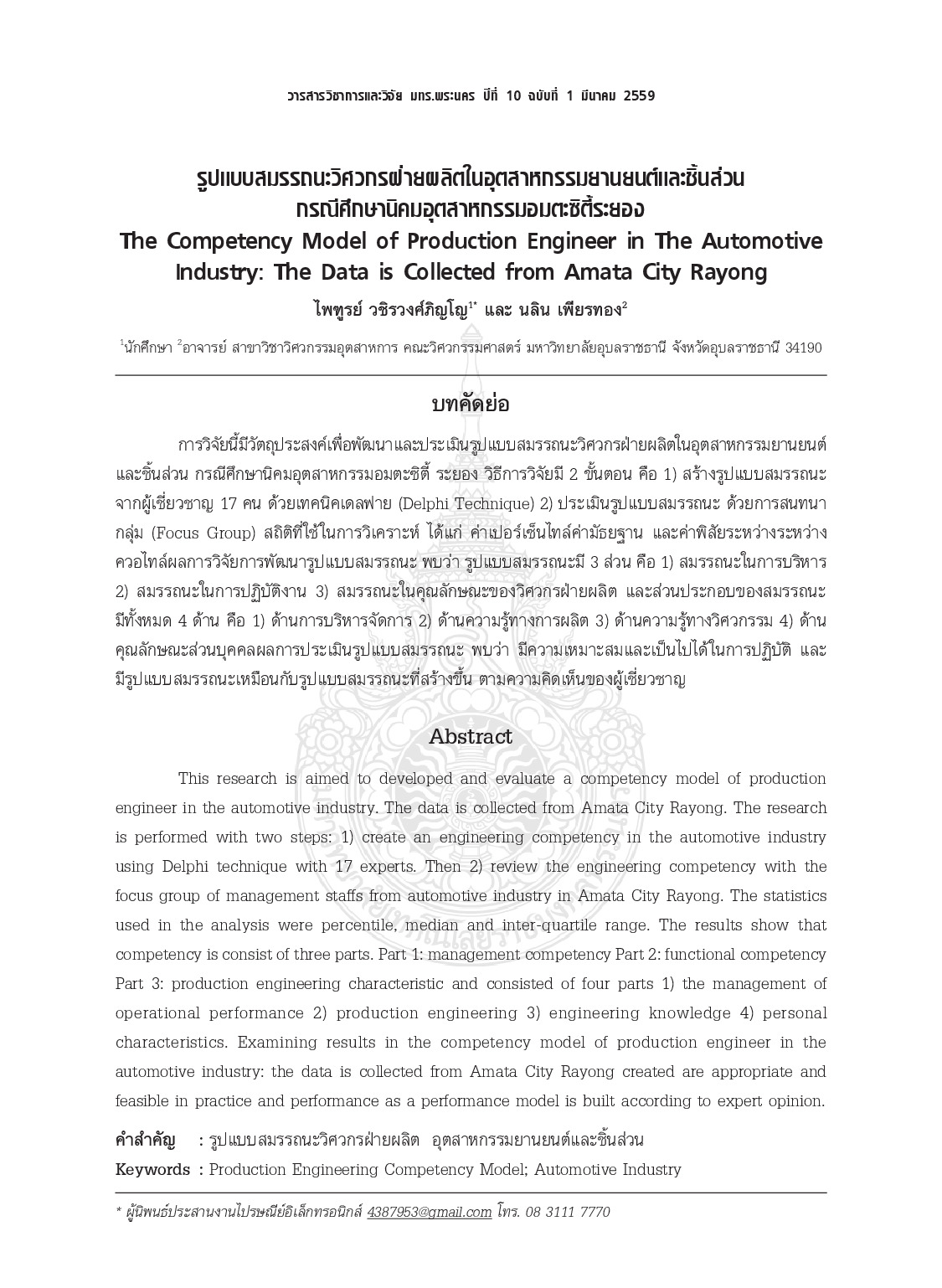
รูปแบบสมรรถนะวิศวกรฝ่ายผลิตในอุตสาหกรรมยานยนต์และชิ้นส่วน กรณีศึกษานิคมอุตสาหกรรมอมตะซิตี้ระยอง
This research is aimed to developed and evaluate a competency model of production engineer in the automotive industry. The data is collected from Amata City Rayong. The research is performed with two steps: 1) create an engineering competency in the automotive industry using Delphi technique with 17 experts. Then 2) review the engineering competency with the focus group of management staffs from automotive industry in Amata City Rayong. The statistics used in the analysis were percentile median and inter-quartile range. The results show that competency is consist of three parts. Part 1: management competency Part 2: functional competency Part 3: production engineering characteristic and consisted of four parts 1) the management of operational performance 2) production engineering 3) engineering knowledge 4) personal characteristics. Examining results in the competency model of production engineer in the automotive industry: the data is collected from Amata City Rayong created are appropriate and feasible in practice and performance as a performance model is built according to expert opinion.
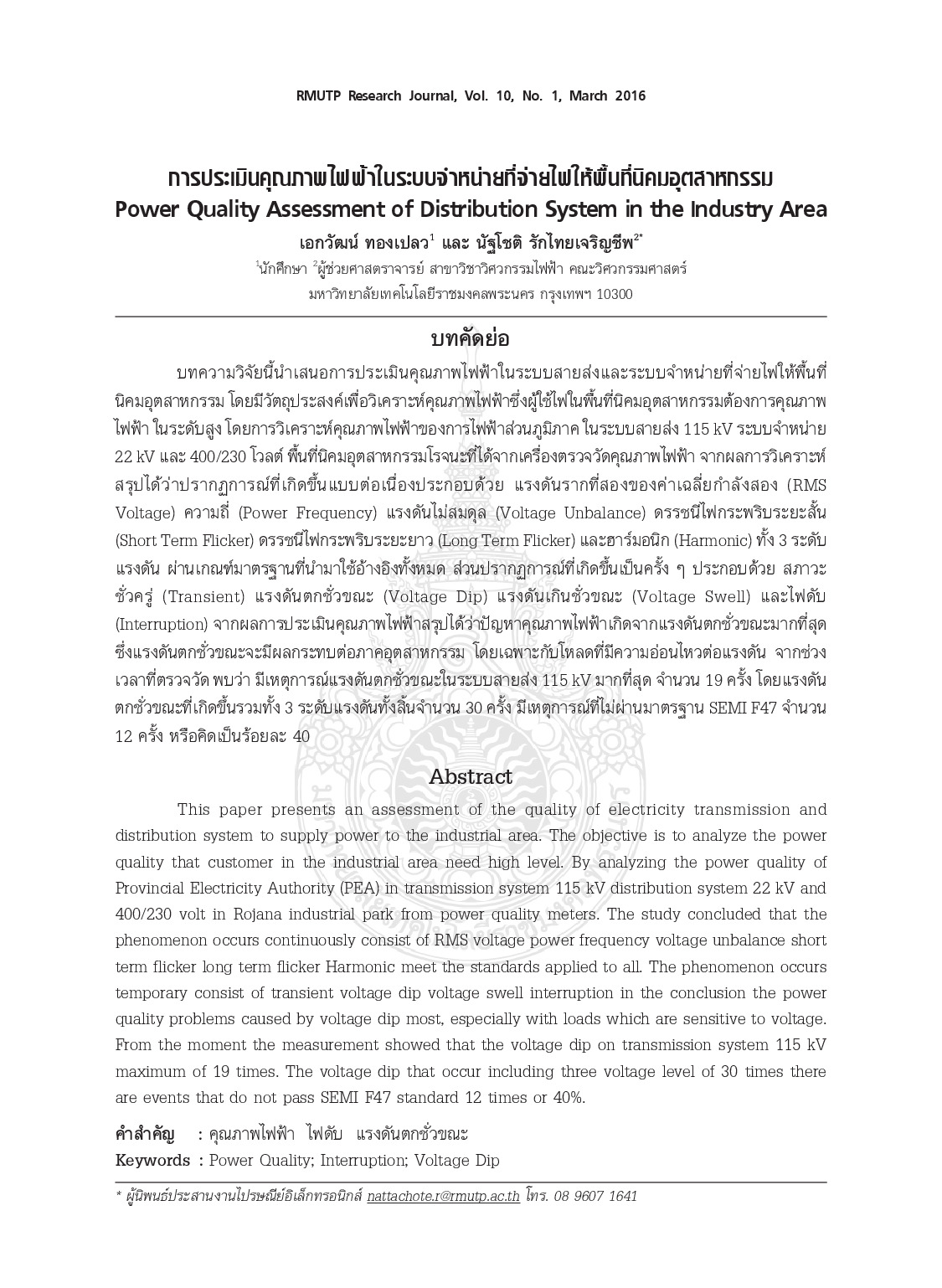
การประเมินคุณภาพไฟฟ้าในระบบจำหน่ายที่จ่ายไฟให้พื้นที่นิคมอุตสาหกรรม
This paper presents an assessment of the quality of electricity transmission and distribution system to supply power to the industrial area. The objective is to analyze the power quality that customer in the industrial area need high level. By analyzing the power quality of Provincial Electricity Authority (PEA) in transmission system 115 kV distribution system 22 kV and 400/230 volt in Rojana industrial park from power quality meters. The study concluded that the phenomenon occurs continuously consist of RMS voltage power frequency voltage unbalance short term flicker long term flicker Harmonic meet the standards applied to all. The phenomenon occurs temporary consist of transient voltage dip voltage swell interruption in the conclusion the power quality problems caused by voltage dip most especially with loads which are sensitive to voltage. From the moment the measurement showed that the voltage dip on transmission system 115 kV maximum of 19 times. The voltage dip that occur including three voltage level of 30 times there are events that do not pass SEMI F47 standard 12 times or 40%.