จำนวน Repository ( 4 )

การพยากรณ์ปริมาณน้ำฝนรายเดือนบริเวณประเทศไทยภายใต้ภาวะโลกร้อน โดยใช้โครงข่ายประสาทเทียม
he monthly rainfall forecasts are very important in Thailand because the most of people has a career in agriculture. The monthly rainfall forecasts can be analyzed for manage water resources. In addition the monthly rainfall forecasting is used to manage water for consume in Thailand. This research is forecasting monthly rainfall under the global warming using a multilayer neural network. It is a network with one hidden layer. The data from the Meteorological Department is use. Imported variables include temperature humidity and wind. The forecast from January to December 2018. The mean square error (MSE) to measure forecasting accurate and found that the value is suitable error (10.25). The neural network can provide accurate monthly rainfall forecasts from January to December. It was found that the southern region had the highest rainfall and the eastern region northeastern region northern region central and western regions respectively. Therefore neural networks can be forecast rainfall accurately and efficiently. It can be used to analyze and manage water resources effective.
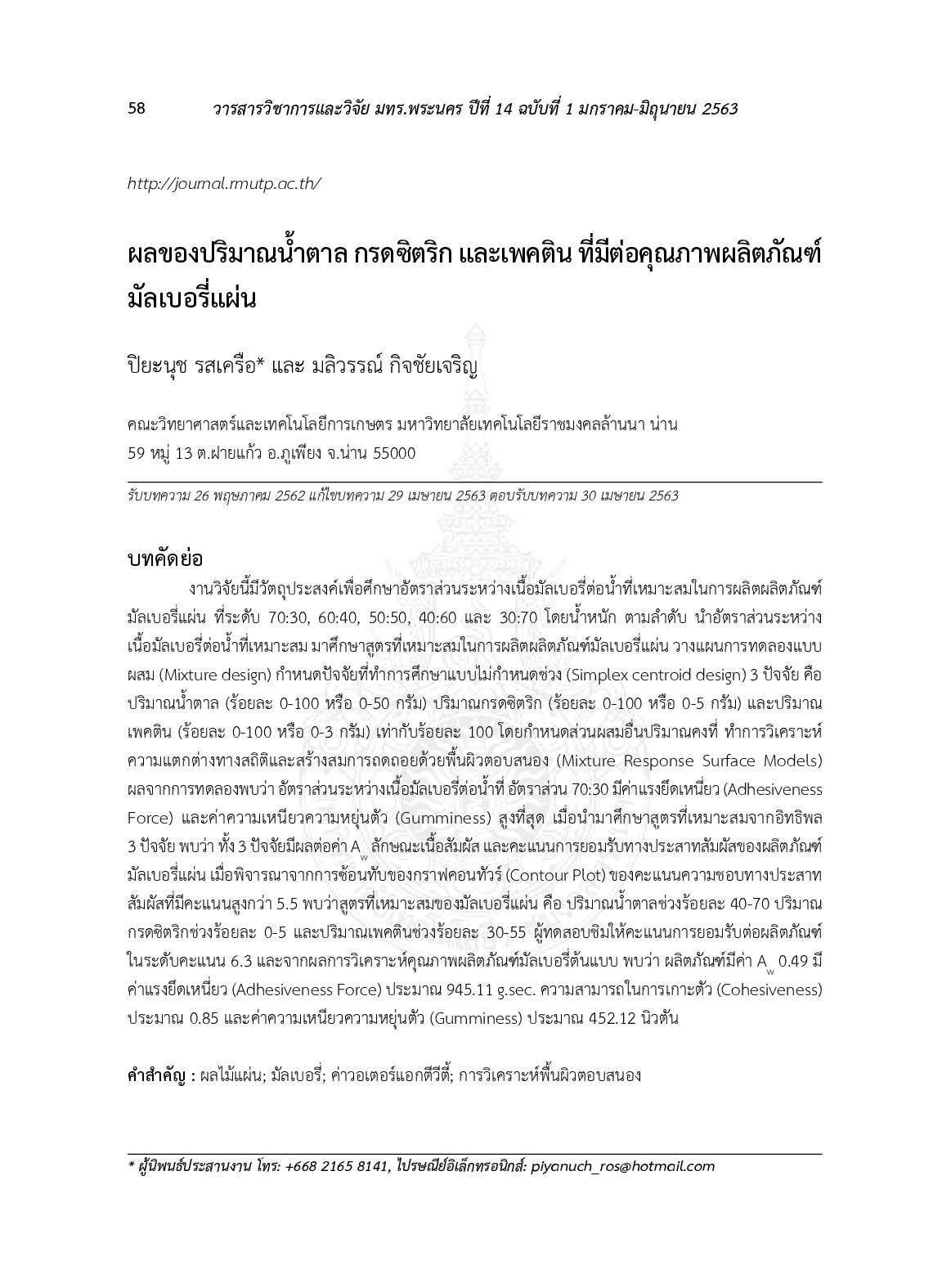
ผลของปริมาณน้ำตาล กรดซิตริก และเพคติน ที่มีต่อคุณภาพผลิตภัณฑ์มัลเบอรี่แผ่น
The objective of this study was to investigate the optimal formulation of mulberry fruit leather product when varying the weight ratio of mulberry fruit: water as 70:30 60:4050:50 40:60 and 30:70. Three factors were then determined by simplex centroid design; sugar (0-100% or 0-50 grams) citric acid (0-100% or 0-5 grams) and pectin (0-100% or 0-3 grams) which the sum of them equivalent to 100% while other ingredients remained constant. Analysis of the data was performed using ANOVA and Mixture Response Surface Models. The results indicated that the highest adhesiveness force and gumminess of mulberry fruit leather product were founded when the weight ratio of mulberry fruit to water was 70:30. The amount of sugar acid and pectin had effects on water activity (Aw) texture profile and sensory score of overall liking of product. From contour plot the predictive models were obtained by plottin g the contour line of all sensory attributes with acceptable score greater than 5.5 and thus the optimization area was selected. After overlapping contour plots an optimal formulation obtained was composed of 40-70% sugar 0-5% citric acid and 30-55% pectin. The sensory score of overall liking of product using a 9-point hedonic scale was 6.3. The water activity (Aw)adhesiveness force cohesiveness and gumminess of the prototype mulberry fruit leather product was 4.9 945.11 g. sec. 0.85 N and 452.12 N. respectively.

การวิเคราะห์ปัจจัยที่มีผลต่อปริมาณน้ำมันตะไคร้หอมจากเครื่องกลั่นด้วยการออกแบบการทดลอง
The purposes of this research were to investigate the factors consisted of a temperature different parts of the lemongrass and a size of chopped lemongrass that affected to distillation of lemongrass essential oils. There are two experiments in this work. The first experiment investigated the factors by defining 1) temperature at 105 oC and 110 oC 2) different parts of the lemongrass (Leaves and trunk) and 3) sizes of chopped lemongrass at 1-2 cm and 15-20 cm respectively. 2k Factorial designs method was used for this experiment. In the second experiment the appropriate parameters from experiment 1 were used for 3 replicates to find an average of lemongrass essential oils. The results of first experimental analysis showed that the appropriate parameters were temperature parts of the lemongrass and sizes of chopped lemongrass at 110 oC leaves and 1-2 cm respectively. For the result of experiment 2 it was found that the average of lemongrass essential oils was 30.36 ml.
การพัฒนาแบบจำลองสำหรับคาดการณ์ปริมาณน้ำท่าบริเวณลุ่มน้ำมูล
In this paper proposed remote sensing using Normalized Difference Vegetation Index from NOAA STAR cluster value from k-means temperature rainfall number of rainy days and runoff to create runoff prediction model using Artificial Neural Network (ANN) and evaluated runoff models with the R2 and RMSE. The results show that the using of cluster value with other parameters to create predictive models can enhance forecasting results. When using Normalized Difference Vegetation Index with temperature value at lag time 1-2 month and cluster value at lag time 1 month to create model with ANN we have got the best performance which are RMSE=0.09 and R2=0.743. The experimental results shows that remote sensing data and cluster value from k-means can be used to predictive the runoff effectively.