จำนวน Repository ( 2 )
การศึกษาสูตรและพัฒนากรรมวิธีการผลิตปลานิลหยอง
This research aimed to study the basic recipes of making “Pla Nil Yong” were studied. The Completely Randomized Design (CRD) was used to evaluate the sensory property in overall liking the characteristic appearances color flavour taste and texture. There were used 30-testers and a 9-Point Hedonic Scale were used. The study found that the second basic recipe had the highest scores in overall satisfaction. The 3 types of heating of fish meat production used were: Steaming Pressure Cooking and Broiling. It was found that the Pressure Cooking had the highest scores of all averages. The Steaming and the Pressure Cooking made the fish fiber fluffier than the Broiling. By the color variation of finishing product was as follow: Brightness (L*) 53.91 Red (a*) 10.50 Yellow (b*) 30.25 aw 0.57. By the amount of total microorganism 2.5x10² CFU/g Yeast and Fungus <25 CFU/g Moisture 4.75% Fat 6.54% Protein 48.06% Ash 7.47% Fiber 0.54% Carbohydrate 32.64%. The study of 3-differrent-temperature of storage were 28 40 and 50 degree Celsius. In 90-day storage checking; found that all of the three variation had overall liking the characteristic appearances and color were different but flavour taste and texture were of no difference. The total amount of microorganisms: yeast and fungus were a lower standard. The production cost of Pla Nil Yong is 397.10 bahts per kilogram.
Quality changes of nile tilapia fillets dipped in phosphate solution and coated with chitosan kept in refrigerated storage
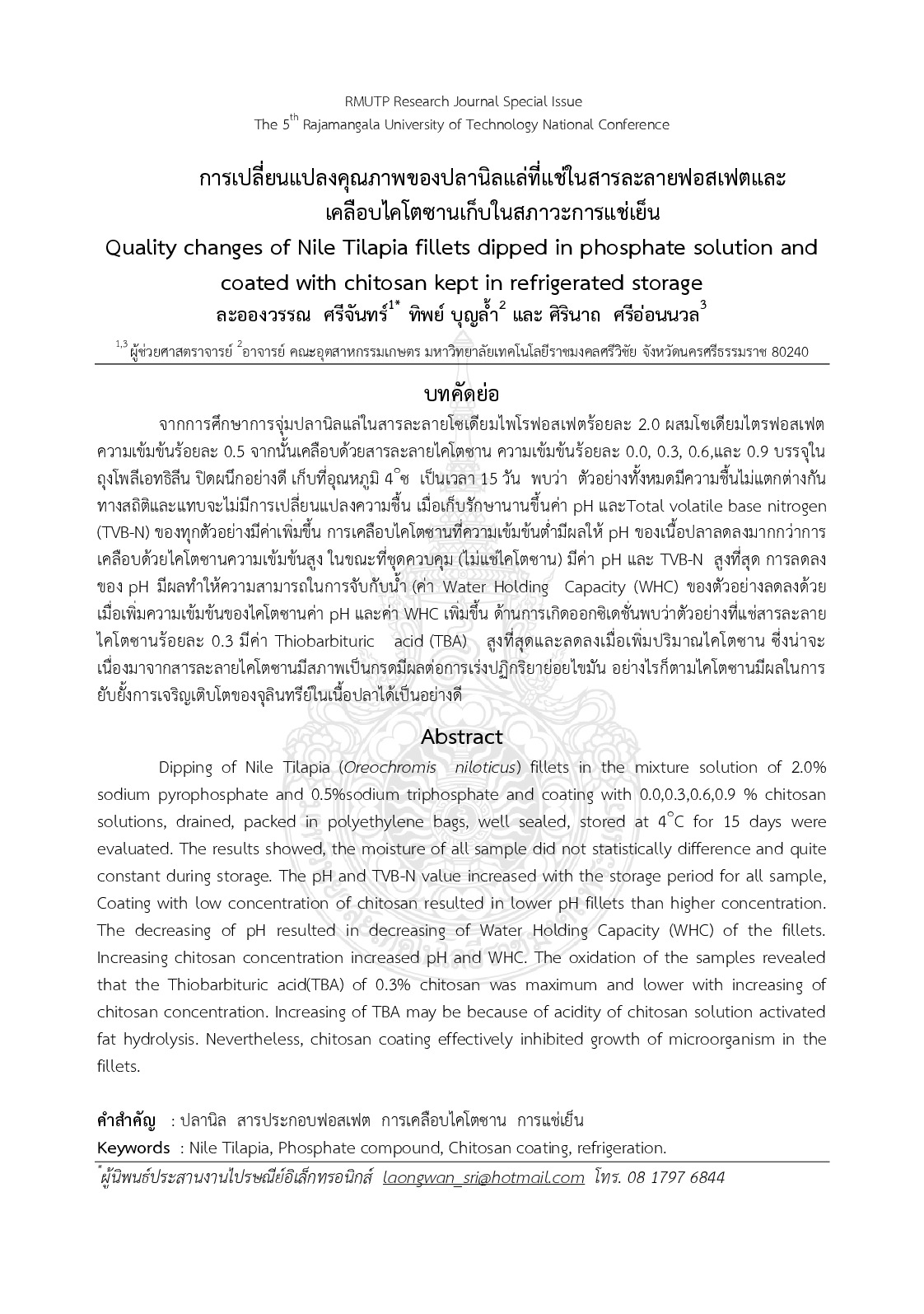
Dipping of Nile Tilapia (Oreochromis niloticus) fillets in the mixture solution of 2.0% sodium pyrophosphate and 0.5%sodium triphosphate and coating with 0.00.30.60.9 % chitosan solutions drained packed in polyethylene bags well sealed stored at 4๐C for 15 days were evaluated. The results showed the moisture of all sample did not statistically difference and quite constant during storage. The pH and TVB-N value increased with the storage period for all sample Coating with low concentration of chitosan resulted in lower pH fillets than higher concentration. The decreasing of pH resulted in decreasing of Water Holding Capacity (WHC) of the fillets. Increasing chitosan concentration increased pH and WHC. The oxidation of the samples revealed that the Thiobarbituric acid(TBA) of 0.3% chitosan was maximum and lower with increasing of chitosan concentration. Increasing of TBA may be because of acidity of chitosan solution activated fat hydrolysis. Nevertheless chitosan coating effectively inhibited growth of microorganism in the fillets.