จำนวน Repository ( 2 )

Evaluation of genetic variation of neolissochilus stracheyi wild populations in the nan river watershed using microsatellite dna markers
This study evaluated the genetic diversity of two natural populations of Neolissochilus stracheyi in Nan River watershed Amphoe Bokluea (BK) and Amphoe Mae Jarim (MJ). We analyzed microsatellite markers originally developed for Tor tambroides (Nguten et al. 2009). Three out of five microsatellite loci analyzed were polymorphic . Genetic variation within BK and MJ populations were not different. The number of allele per locus and allelic richness averaged over three loci was 2.33 and 2.67 for BK and MJ respectively. Observed heterozygosity value was 0.50 and 0.56 and the average expected heterozygosity was 0.41 and 0.53 for BK and MJ respectively. In addition the two populations were genetically distinct (P<0.05) and geographic isolation of two locations may explain this genetic pattern.
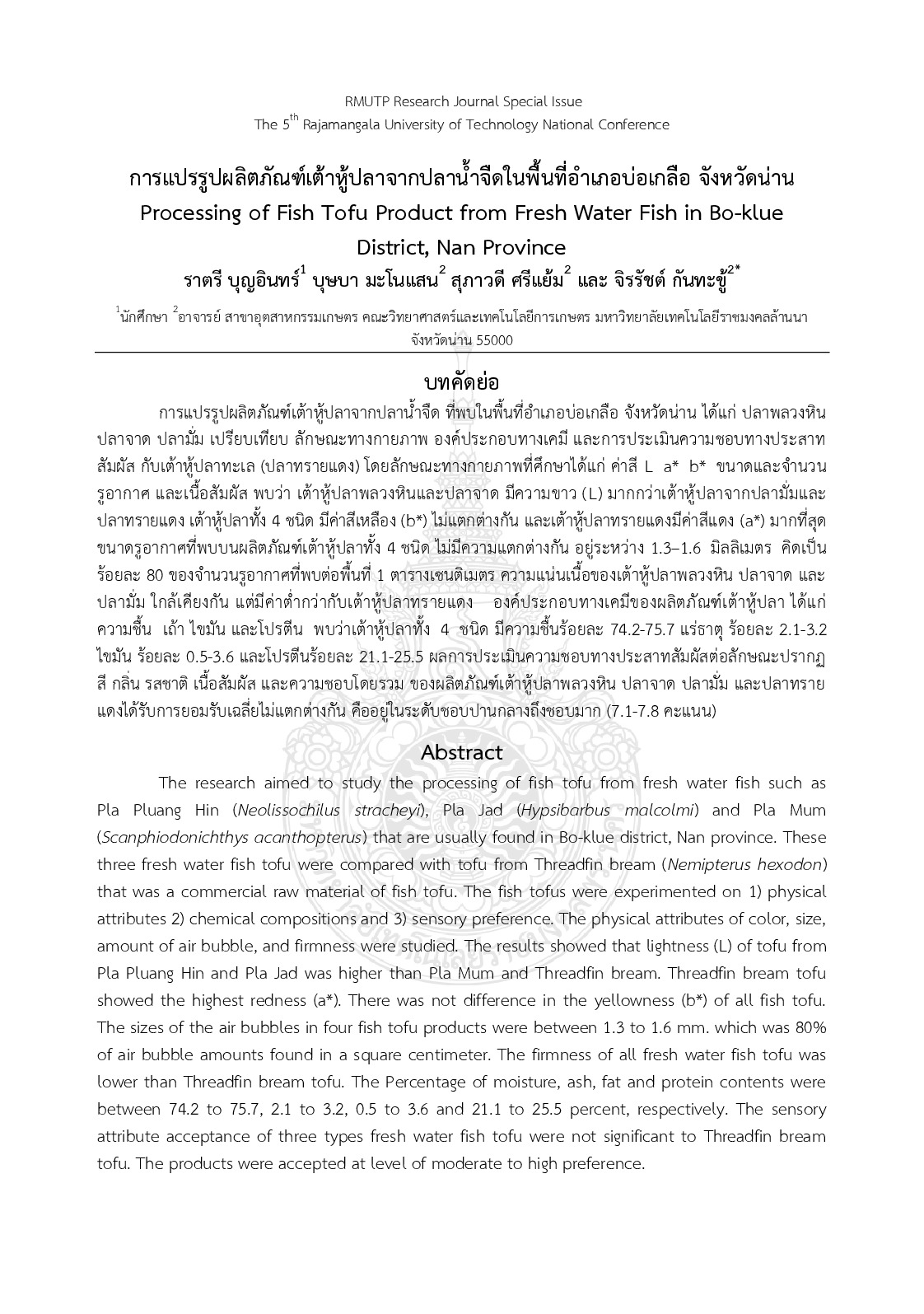
Processing of fish tofu product from fresh water fish in bo-klue district, nan Province
The research aimed to study the processing of fish tofu from fresh water fish such as Pla Pluang Hin (Neolissochilus stracheyi) Pla Jad (Hypsibarbus malcolmi) and Pla Mum (Scanphiodonichthys acanthopterus) that are usually found in Bo-klue district Nan province. These three fresh water fish tofu were compared with tofu from Threadfin bream (Nemipterus hexodon) that was a commercial raw material of fish tofu. The fish tofus were experimented on 1) physical attributes 2) chemical compositions and 3) sensory preference. The physical attributes of color size amount of air bubble and firmness were studied. The results showed that lightness (L) of tofu from Pla Pluang Hin and Pla Jad was higher than Pla Mum and Threadfin bream. Threadfin bream tofu showed the highest redness (a*). There was not difference in the yellowness (b*) of all fish tofu. The sizes of the air bubbles in four fish tofu products were between 1.3 to 1.6 mm. which was 80% of air bubble amounts found in a square centimeter. The firmness of all fresh water fish tofu was lower than Threadfin bream tofu. The Percentage of moisture ash fat and protein contents were between 74.2 to 75.7 2.1 to 3.2 0.5 to 3.6 and 21.1 to 25.5 percent respectively. The sensory attribute acceptance of three types fresh water fish tofu were not significant to Threadfin bream tofu. The products were accepted at level of moderate to high preference.